
Develop a brand positioning framework that works

A brand positioning framework is a strategic document that defines your brand’s unique place in the market, who you serve, and why customers should choose you. Without one, messaging drifts, teams pull in different directions, and marketing spend produces inconsistent results. A well-designed framework functions as an organisational operating system, aligning leadership decisions across product, marketing, and hiring with the brand’s core promise. This guide covers every stage of the process: the essential components, the preparation work, the step-by-step build, and how to embed it so it actually holds.
What are the essential components of a brand positioning framework?
A complete brand positioning framework articulates five interconnected elements: target segment, frame of reference, point of difference, reasons to believe, and brand character. Each component does a specific job. Together, they give your team a shared language for every decision from campaign copy to product naming.
| Component | Purpose |
|---|---|
| Target segment | Defines precisely who you serve and who you do not |
| Frame of reference | Sets the category your brand competes in |
| Point of difference | States your unique edge over alternatives |
| Reasons to believe | Provides verifiable proof that your claims are true |
| Brand character and tone | Guides how you communicate across all channels |

The most common mistake teams make is writing vague statements at each component. “We serve ambitious businesses” is not a target segment. A real segment names the industry, company size, buying role, and the specific problem that person needs solved. Specificity is what makes the framework usable rather than decorative.
Pro Tip: Write your target segment description so precisely that a colleague could identify a qualifying prospect from it without asking you a single follow-up question.
How to plan and prepare before you build
Preparation determines whether your framework reflects reality or wishful thinking. Skipping this stage produces a document that sounds good internally but fails when tested against actual customers.
The core preparation steps are:
- Market research. Map the category you compete in, including direct rivals, substitutes, and alternatives. Understand how customers currently make decisions in your space.
- Stakeholder interviews. Speak with leadership, sales, product, and customer success teams. Each group holds a different piece of the positioning puzzle.
- Customer insight gathering. Conduct interviews or surveys with existing customers. Ask why they chose you, what they almost chose instead, and what they would miss most if you disappeared.
- Competitor audit. Review how rivals position themselves. Identify the claims they own and the gaps they leave open.
- Template selection. Choose a positioning statement template before you start drafting. Having a structure prevents blank-page paralysis.
Developing a functional framework typically takes between 2 and 6 weeks, depending on the involvement of internal teams or external consultants. That timeline reflects the research, drafting, and alignment work required. Rushing it produces a framework that teams ignore.
Pro Tip: Block stakeholder time in week one. The biggest delay in most positioning projects is waiting for interview slots, not the writing itself.
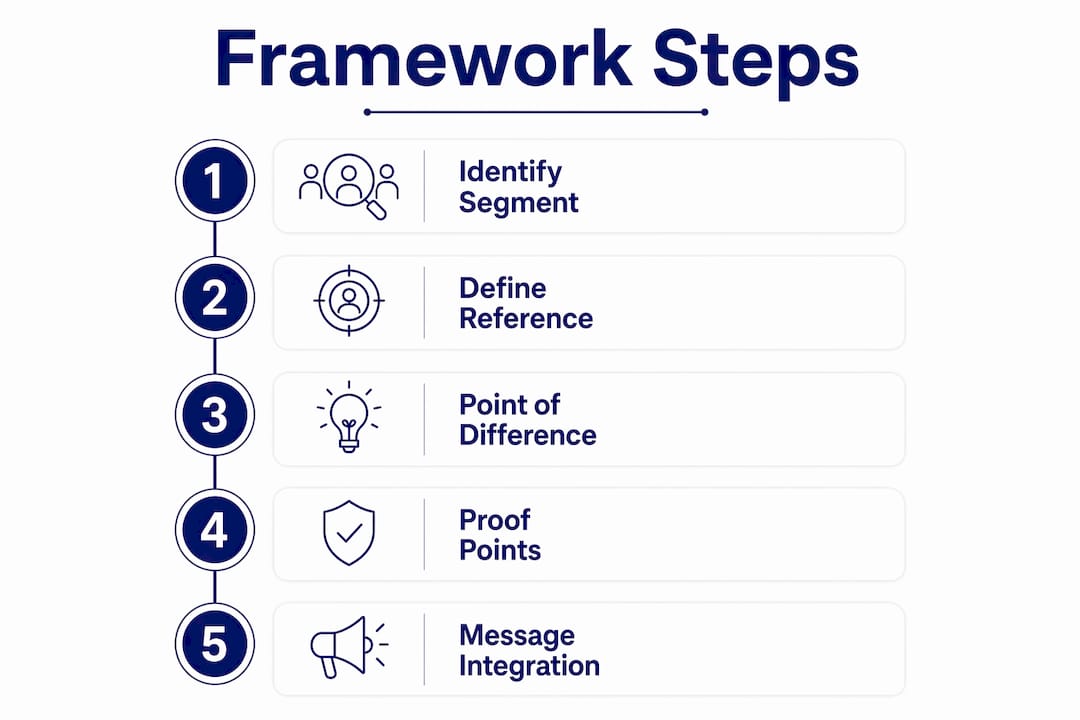
Step-by-step process to create and validate your framework
A structured process prevents the two most common failure modes: positioning that is too broad to be useful, and positioning built on claims that cannot be proved.
-
Map your competitor categories broadly. Mapping three competitor categories — direct rivals, substitutes, and alternatives — forces broader thinking and sharper differentiation. A project management tool competes directly with similar tools, but also with spreadsheets (substitute) and email threads (alternative). Each category reveals a different positioning opportunity.
-
Define your target segment with precision. Name the industry, company size, job title, and the specific trigger that makes someone ready to buy. The more precise the segment, the more resonant the positioning. A well-designed framework forces strategic choices on who to serve and who to exclude, ensuring organisational focus.
-
Identify your unique value proposition. Find the intersection of what your audience urgently needs and what your organisation genuinely does better than anyone else. If that intersection is empty, you have a product problem, not a positioning problem.
-
Build your reasons to believe. A positioning framework without at least two verifiable proof points risks being mere assertion and is unlikely to hold in the market. Proof points include client results with real numbers, third-party accreditations, proprietary processes, or independently verified data.
-
Draft your positioning statement. Positioning statements should commit to specific choices, naming target customers, the problem, the category, the benefit, and the differentiation in clear terms under 50 words. Use a proven template and resist the urge to make it sound like a tagline. It is an internal working document, not a headline.
-
Test against real customer feedback. Share the draft positioning with five to ten customers or prospects. Ask whether it reflects how they think about the category and whether the claims feel credible. Weak claims surface immediately at this stage.
-
Assign owners and set a remediation timeline. Organisations should assign owners to address messaging disconnects across teams within 30 days of framework completion. Without named owners, the framework sits in a shared drive and changes nothing.
The table below shows how different competitor category types shape positioning approaches:
| Competitor category | Positioning approach |
|---|---|
| Direct rivals | Differentiate on a specific feature, audience, or outcome |
| Substitutes | Reframe the category to make the substitute feel inadequate |
| Alternatives | Educate on the cost of inaction or the DIY approach |
Pro Tip: If your positioning statement could describe three other brands in your category, it is not specific enough. Replace every generic claim with a named, verifiable one.
You can also explore AI-driven brand strategy approaches to accelerate the research and drafting stages, particularly useful when internal resources are stretched.
How do you operationalise your framework across the organisation?
A positioning framework that lives only in a PDF is not a framework. It is a filing exercise. Embedding brand positioning into daily work requires defined ownership, clear processes, and integration into existing workflows.
The first step is establishing a named owner. This is not a committee. One person holds accountability for framework consistency, reviews content against the positioning, and flags drift when it appears. In smaller organisations, this is typically the marketing lead. In larger ones, it sits with the brand or communications director.
The second step is creating a messaging filter checklist. This is a short set of questions that any content creator can apply before publishing. Does this piece speak to our defined segment? Does it reinforce our point of difference? Does it use our brand character? A checklist removes the need for a full strategic review every time a blog post or sales deck goes out.
The third step is integrating the framework into adjacent functions. Sales teams need it to qualify leads and frame conversations. Product teams need it to prioritise features. Leadership needs it to evaluate partnerships and hiring decisions. Effective brand positioning frameworks prevent messaging drift and enable faster, sharper marketing and sales decisions precisely because every function is working from the same foundation.
Pro Tip: Treat your positioning framework as a living document. Schedule a formal review every six months and update it when your market, audience, or offer changes materially.
For guidance on aligning brand strategy with broader business goals, the process mirrors what you have built here but extends into financial and operational planning.
Key takeaways
A brand positioning framework only delivers value when it is specific, proof-backed, and embedded into how every team communicates and decides.
| Point | Details |
|---|---|
| Specificity is non-negotiable | Vague segments and generic claims produce frameworks that no one uses. |
| Proof points validate claims | Include at least two verifiable reasons to believe or the positioning will not hold competitively. |
| Preparation takes weeks, not days | Allow 2–6 weeks for research, stakeholder input, and drafting to produce an accurate framework. |
| Ownership drives adoption | Assign a named owner and a 30-day remediation window to prevent messaging drift post-launch. |
| Operationalisation is the real work | Messaging filters and cross-functional integration turn a document into an organisational habit. |
Why most positioning frameworks fail before they reach the market
I have worked on brand positioning projects across a wide range of sectors, and the pattern of failure is almost always the same. The framework is well-written, the workshop was productive, and the document looks polished. Then it goes into a shared drive and nothing changes.
The problem is not the framework. It is the assumption that writing it is the hard part. The hard part is the conversation with the sales director who insists the positioning is “too narrow” because it excludes prospects he is currently chasing. The hard part is the product team that keeps adding features for a segment the framework explicitly excludes. Specificity creates internal friction. That friction is the point.
The frameworks I have seen hold up over time share one characteristic: they made someone uncomfortable during sign-off. They named a segment precisely enough to exclude someone. They committed to a proof point that required the business to actually deliver something. They drew a line.
Cross-team alignment is not a soft benefit of good positioning. It is the mechanism by which positioning produces commercial results. When sales, marketing, and product all operate from the same framework, the customer experience becomes coherent. Coherence builds trust. Trust shortens sales cycles and increases retention. That is the business case for doing this properly.
If you are working through a brand repositioning process, the same principles apply. Specificity, proof, and ownership are what separate frameworks that hold from ones that gather dust.
— Calum
How Michaelbell supports your brand positioning work
Positioning work is only as good as the team behind it. Michaelbell works with marketing professionals and business leaders to build brand positioning frameworks that are specific, validated, and ready to deploy across every channel.
We operate as an extension of your team, not an outside vendor parachuted in for a workshop. That means we stay involved through the research, the stakeholder alignment, the drafting, and the operationalisation. Our brand communications services cover the full process from initial audit to messaging filter creation and cross-functional rollout. If you are ready to build a framework that actually holds, we would love to hear from you.
FAQ
What is a brand positioning framework?
A brand positioning framework is a strategic document that defines your target segment, frame of reference, point of difference, reasons to believe, and brand character. It aligns all internal teams around a single, consistent market position.
How long does it take to develop a brand positioning framework?
The process typically takes between 2 and 6 weeks, depending on the size of the organisation and the depth of stakeholder involvement required.
How many proof points does a positioning framework need?
A positioning framework needs at least two verifiable proof points. Without them, the positioning remains an unsupported assertion that is unlikely to hold competitively.
How do you stop a brand positioning framework from becoming outdated?
Assign a named owner, schedule a formal review every six months, and update the framework whenever your market, audience, or core offer changes materially.
What is the difference between a positioning statement and a brand positioning framework?
A positioning statement is a single, concise declaration of under 50 words that captures your market position. A brand positioning framework is the full document that includes the statement plus the research, proof points, messaging filters, and guidelines that support it.