
How to refresh brand messaging for your existing audience

A brand messaging refresh is the process of updating your language, proof points, and visual style to better connect with your current audience without losing your core brand identity. This is not a rebrand. A rebrand replaces the foundation. A refresh builds on it. Marketing professionals and business leaders who want to refresh brand messaging for their existing audience face a specific challenge: change enough to stay relevant, but not so much that loyal customers feel lost. Done well, a messaging refresh strengthens trust, sharpens positioning, and measurably improves audience engagement.
How to assess your current messaging and identify the right scope
The clearest signal that a refresh is needed is not a gut feeling. Repeated sales objections, drops in priority journey conversions, or consistent competitive losses all point to a narrative that is no longer doing its job. When the same friction appears across three or more independent sources, that is your trigger.
Before you write a single new word, diagnose the problem properly. Pull your conversion data, review lost deal notes, and audit your most recent customer feedback. Look for patterns, not outliers. A single complaint is noise. A pattern is a brief.
Once you have identified the problem, scope the work honestly. The GTM Playbook framework defines three levels:
- Light refresh (2–3 weeks): Update language, swap tired proof points, tighten headlines. The positioning stays the same.
- Partial refresh (4–6 weeks): Revise key messages for one or two audience segments or use cases. Core story pillars remain intact.
- Full positioning rebuild (8–12 weeks): Rethink your category, value proposition, and narrative architecture from the ground up.
Most teams overscope. If your core positioning is still sound, a light or partial refresh is almost always the right call. Choosing a full rebuild when a partial update would do wastes time and creates unnecessary internal disruption.
Pro Tip: Narrow your initial refresh to one audience segment or one use case. A focused update is faster to test, easier to measure, and far less likely to confuse your team or your customers.
You can also use the 9 key signals framework to cross-check your diagnosis against proven indicators before committing to a scope.
What strategies actually work when updating messaging for loyal customers?
Updating messaging for an existing audience is not the same as writing for a cold prospect. Your existing customers already have a relationship with your brand. The goal is to deepen that relationship, not reintroduce yourself.
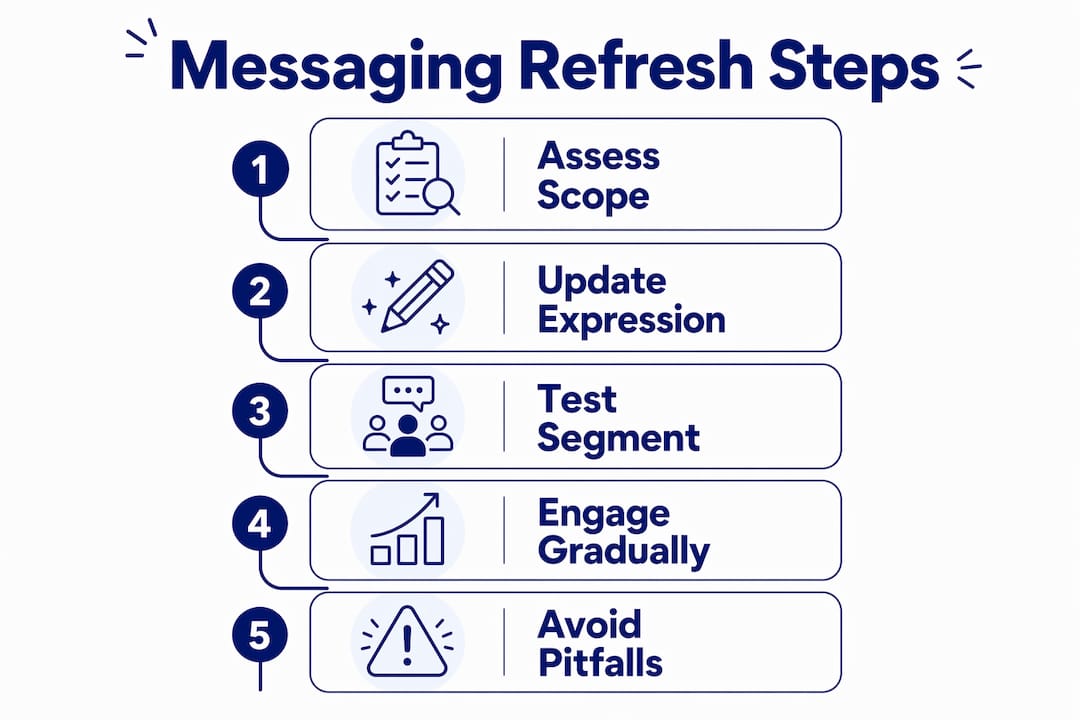
The most effective approach is to maintain your core story pillars while updating the expression around them. Your values, your origin, your reason for existing: these do not change. What changes is how you articulate them, the examples you use, and the proof points you lead with. Swap out dated case studies for recent wins. Replace generic claims with specific, verifiable outcomes.

Positioning adjustments should be subtle and additive. If your brand has grown into a new market or developed a new capability, reflect that in your messaging without abandoning the language your existing audience already trusts. Think of it as updating a wardrobe, not replacing one.
Key principles for updating messaging without alienating loyal customers:
- Keep your brand voice consistent. Changing tone and messaging simultaneously makes it impossible to know which variable is driving any change in results.
- Update proof points with recent, specific examples. Vague claims erode credibility over time.
- Reflect your audience’s current language back at them. The words your customers use in reviews and support tickets are often better than anything your team invents.
- Adjust positioning to reflect genuine growth, not aspirational positioning you have not yet earned.
Testing new messaging with a small segment before a full rollout is not optional. It is the single most effective way to protect existing audience loyalty while still moving forward. Run a segment test for two to four weeks, measure engagement and conversion, then roll out with confidence.
How do you improve audience engagement during a messaging refresh?
Audience engagement does not improve automatically when you update your messaging. You have to build the conditions for it. Engagement works best as an integrated system that links analytics, content planning, and direct participation. Treating it as a set of one-off tactics produces one-off results.
The most practical steps to build engagement around refreshed messaging:
- Use interactive content formats. Polls, Q&As, and open questions invite your audience to respond rather than scroll. Interactive tools increase brand confidence by 45.1%, which matters enormously when you are asking an existing audience to accept change.
- Respond to initial comments quickly. Responding to early comments can boost overall engagement by up to 42%. The first hour after publishing is the highest-leverage window.
- Use social listening to shape content. Social listening moves your content from being about your brand to meeting your audience’s actual needs. Monitor the language your audience uses, the questions they ask, and the frustrations they express. Then answer those directly in your refreshed messaging.
- Plan a content series, not a single launch. A series builds returning audiences and creates a sense of community. One announcement post is forgotten. A four-part series becomes a habit.
Pro Tip: Do not launch refreshed messaging with a single big reveal. Introduce changes gradually through a content series. Your existing audience will absorb the shift naturally rather than noticing a sudden change.
Connecting your brand storytelling approach to your engagement plan is what separates brands that build communities from those that simply accumulate followers. The story is the engine. Engagement is the fuel.
What mistakes should you avoid during a brand messaging overhaul?
The most damaging mistake is refreshing too often. Frequent messaging rewrites confuse teams and damage brand credibility. Every time your messaging changes without a clear reason, your audience loses a little confidence. Your sales team loses their footing. Your content becomes inconsistent.
Common pitfalls to avoid:
- Changing voice and messaging at the same time. These are two separate variables. Updating both simultaneously makes it impossible to isolate what is working. Change one, measure it, then address the other.
- Failing to communicate internally. Your customer-facing teams need to know what is changing, what is staying the same, and why. A refresh that surprises your own people will produce inconsistent communication at every customer touchpoint.
- Ignoring the “do not change” list. Every refresh should include a documented list of elements that are explicitly protected: your brand name treatment, your core value proposition, your founding story. This list prevents scope creep and keeps the refresh focused.
- Refreshing without a clear trigger. A refresh driven by boredom or internal politics rather than market signals produces change for its own sake. That is not a refresh. That is noise.
Buyer trust is the hardest thing to rebuild once lost. The brands that maintain recognition through a refresh are the ones that change their expression while protecting their identity. Think of it as updating the packaging, not reformulating the product. Your existing audience bought the product. Do not confuse them about what they bought.
For a deeper look at the difference between a refresh and a full rebrand, the strategic guide for leaders is worth reading before you commit to a scope.
Key takeaways
A brand messaging refresh works when it is triggered by real market signals, scoped to the right level of change, and tested with existing audience segments before full rollout.
| Point | Details |
|---|---|
| Scope the refresh correctly | Light, partial, and full refreshes have distinct timelines: 2–3, 4–6, and 8–12 weeks respectively. |
| Use data to trigger the refresh | Repeated sales objections and conversion drops are the clearest signals that messaging needs updating. |
| Protect core story pillars | Update proof points and expression without changing the values and narrative your audience already trusts. |
| Test before full rollout | Segment testing for 2–4 weeks protects existing loyalty and gives you real data before committing. |
| Build engagement as a system | Combine interactive content, social listening, and planned content series to sustain audience connection. |
What I have learned from watching brands get this wrong
The brands I have seen struggle most with a messaging refresh are not the ones that changed too much. They are the ones that changed without telling anyone why.
A refresh without a clear internal narrative creates a vacuum. Your sales team starts improvising. Your content team goes off-brief. Your customers notice the inconsistency before they notice the new messaging. By the time leadership realises what has happened, the damage is already done.
The best refreshes I have witnessed share one quality: the leadership team was honest about what was not working before they started. They did not frame the refresh as a celebration of how far the brand had come. They framed it as a response to something specific. That honesty gave the creative team a real brief and gave the wider organisation a reason to get behind the change.
There is also a tendency to underestimate the creative team’s role. Executives set the vision. That is right and proper. But the creative team’s job is to interpret that vision in a way that keeps the existing audience on board. When executives try to write the new messaging themselves, they almost always produce something that reflects where they want the brand to go rather than where the audience currently is. The gap between those two things is exactly what a good creative team is there to close.
Patience matters too. A refresh is not a campaign. It does not have a launch date and a results window of four weeks. The messaging needs time to embed across channels, teams, and customer touchpoints. Give it that time before you judge it.
— Calum
Michaelbell and your brand messaging refresh
Refreshing your brand messaging is one of the most precise pieces of work a marketing team can undertake. Get the scope wrong and you waste months. Get the story wrong and you lose the audience you already have.
At Michaelbell, we work as an extension of your team, not an outside vendor. We bring the creative expertise and communications discipline to scope your refresh correctly, update your messaging with precision, and build the engagement strategy that keeps your existing audience connected throughout the process. Our brand communications services cover everything from light messaging updates to full positioning work, all delivered at a fraction of the cost of an in-house agency. If you are ready to get your messaging working harder, we would love to talk.
FAQ
What is a brand messaging refresh?
A brand messaging refresh is the process of updating your language, proof points, and positioning to better connect with your audience without replacing your core brand identity. It is distinct from a rebrand, which changes the brand’s foundation.
How do you know when to refresh your brand messaging?
The clearest triggers are repeated sales objections, drops in conversion rates, and consistent competitive losses. When the same friction appears across three or more independent sources, a refresh is warranted.
How long does a brand messaging refresh take?
Timelines depend on scope. A light refresh takes 2–3 weeks, a partial refresh takes 4–6 weeks, and a full positioning rebuild takes 8–12 weeks.
How do you refresh messaging without losing existing customers?
Maintain your core story pillars and brand voice while updating proof points and expression. Test new messaging with a small audience segment before rolling it out more widely.
What is the biggest mistake in a brand messaging overhaul?
Changing brand voice and messaging content at the same time is the most common mistake. It makes it impossible to identify which change is driving results, and it creates confusion for both your team and your audience.