
Modernise legacy brand communications: a leader’s guide

Modernising legacy brand communications is the process of updating established brand messaging, visuals, and channels while preserving the core identity that built your reputation in the first place. For business leaders at established brands, this is not a cosmetic exercise. Clear, consistent messaging builds trust that compounds into recognition, loyalty, and resilience over time. The challenge is knowing when to evolve, how far to go, and which tools to use. This guide gives you a structured framework to do exactly that, from initial audit through to AI-assisted execution.
What does modernising legacy brand communications actually require?
Before you touch a single headline or colour palette, you need a clear picture of where you stand. A brand audit is the non-negotiable starting point. It maps every customer-facing touchpoint, from your website copy and sales collateral to internal communications and social channels, against what your audience actually expects today.
The audit should answer three questions. What messaging is still working? What has drifted out of alignment with your audience? And where are competitors gaining ground because your language feels dated?

Relevance over reach is the governing principle of modern brand communication. This means identifying the specific channels where your audience chooses to engage, then concentrating your effort there rather than broadcasting louder across every platform. A heritage financial services brand, for example, may find its audience has shifted from print and email to LinkedIn and short-form video. Knowing that changes everything about the refresh scope.
Three types of messaging refresh
Not every update requires the same investment. The scope you choose should match the signals you are seeing.
| Refresh Type | Scope | Typical Timeline |
|---|---|---|
| Light update | Tone, word choice, minor visual tweaks | 2–3 weeks |
| Partial refresh | Segment-specific messaging, channel updates | 4–6 weeks |
| Full narrative rebuild | Positioning, story, visual identity overhaul | 8–12 weeks |
Selecting the wrong scope is one of the most common and costly mistakes. A light update applied to a brand with a fundamentally broken narrative wastes time. A full rebuild triggered by a single bad quarter wastes budget and goodwill.
How to implement a phased brand communications refresh
A phased approach is the most reliable way to revamp corporate messaging without losing what makes your brand recognisable. Here is a practical sequence that works for established brands of any size.
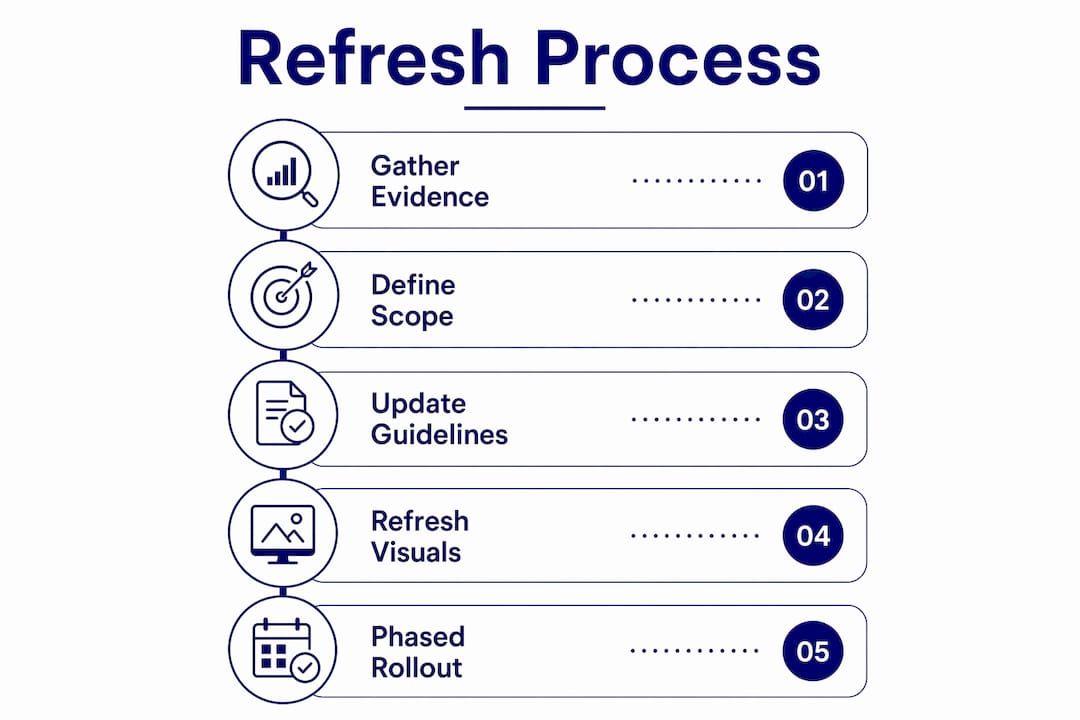
Step 1: Gather evidence before you write a word.
Commission consumer surveys with a minimum of 200 participants, run focus groups with your core customer segments, and conduct competitor benchmarking. Structured consumer research during a messaging update increases digital engagement and sales while protecting loyalty in heritage brands. The data tells you what to keep and what to change.
Step 2: Define your refresh type.
Use the table above to match your scope to the signals from your audit. If sales objections are consistent, conversion rates are falling, and you are losing deals to competitors on messaging grounds, a partial or full refresh is warranted. If the core narrative is sound but the language feels stale, a light update is sufficient.
Step 3: Update your brand guidelines system.
Static PDF brand guidelines become outdated the moment they are published. Replace them with a queryable, dynamic system that all teams can access in real time. This prevents version drift, where different departments use different versions of your messaging, which is one of the most damaging and least visible problems in large organisations.
Step 4: Refresh visual storytelling and channel formats.
Modern brand messaging is not just about words. Updating your brand storytelling approach means adapting your narrative to the formats your audience actually consumes: short-form video, interactive content, and platform-native formats rather than repurposed print assets.
Step 5: Roll out in phases, not all at once.
A phased rollout of messaging updates minimises risk by preserving effective elements while updating only where needed. Start with your highest-traffic digital channels, measure response, then extend to secondary channels and internal communications.
Pro Tip: Set a firm scope document before kick-off and require sign-off from a senior stakeholder to change it. Scope creep is the single biggest cause of delayed brand refresh projects.
What mistakes derail legacy brand modernisation?
The risks in evolving legacy communications are real, and most of them are avoidable with the right governance in place.
- Unnecessary rewrites erode credibility. Frequent, unjustified messaging changes confuse both your team and your customers. Trigger a refresh only when you have consistent signals from at least three sources: sales objections, conversion data, and competitor win/loss analysis.
- Internal misalignment kills momentum. When marketing, sales, and leadership are working from different versions of the brand story, the customer experience fractures. A single, accessible source of brand truth prevents this.
- Losing the brand core in pursuit of modernity. The most damaging refreshes strip out the heritage cues that customers trust. Consumer feedback and competitor benchmarking during the update process protect against this by grounding decisions in evidence rather than internal preference.
- Underestimating stakeholder management. A brand refresh touches every department. Leaders who treat it as a marketing project rather than an organisational change programme consistently underestimate the time and communication required.
“Not every dip in brand performance requires a full overhaul. Data-driven triggers reduce risk and preserve team clarity.”
Pro Tip: Map every internal stakeholder who touches brand communications before you start. Brief them early, involve them in feedback rounds, and give them a clear timeline. Surprises at the review stage cost weeks.
Understanding when a brand genuinely needs a refresh versus when it needs steadier management is a skill that separates effective brand leaders from reactive ones.
How can AI and digital tools accelerate brand communication modernisation?
Digital transformation of your marketing infrastructure is not optional if you want to maintain brand equity at scale. Modernising your martech stack directly improves customer engagement by removing the friction between brand strategy and execution.
The most significant development for brand communications teams is the emergence of MCP-enabled brand hubs. These are dynamic, queryable systems that hold your brand guidelines as structured, living data rather than static documents. When your guidelines change, every connected tool, from AI writing assistants to design platforms, receives the update automatically. This eliminates the manual update errors that cause inconsistency across large organisations.
| Tool Type | Traditional Approach | MCP-Enabled Approach |
|---|---|---|
| Brand guidelines | Static PDF, emailed to teams | Real-time queryable hub |
| Messaging updates | Manual redistribution | Automatic propagation to all tools |
| Version control | Inconsistent across departments | Single source of truth |
| AI tool alignment | Manual prompt engineering | Structured brand data fed directly |
Queryable brand hubs aligned with AI automatically propagate updated guidelines, eliminating manual errors and accelerating consistency. For a brand operating across multiple markets or business units, this is transformative. What previously required a co-ordinated internal communications campaign to roll out now happens at the point of update.
The practical implication is that your creative and communications teams spend less time policing consistency and more time producing content that connects. Relevant, targeted messaging is what drives online visibility and audience engagement, and AI-assisted brand systems make that relevance easier to maintain at scale.
Pro Tip: When evaluating brand hub tools, test whether they can answer a specific brand question in plain language, such as “What tone do we use for complaint responses?” If the system cannot surface that answer directly, it is not queryable enough for modern brand management.
Key takeaways
Modernising legacy brand communications succeeds when it is driven by evidence, governed by clear scope, and supported by digital systems that keep guidelines current across every team and tool.
| Point | Details |
|---|---|
| Audit before you act | Map every touchpoint and gather customer and competitor data before changing any messaging. |
| Match scope to signals | Choose a light, partial, or full refresh based on consistent evidence from sales, conversion, and competitor data. |
| Use phased rollouts | Update high-traffic channels first, measure results, then extend to secondary channels and internal comms. |
| Adopt dynamic brand hubs | Replace static PDF guidelines with queryable, MCP-enabled systems to prevent version drift. |
| Protect your brand core | Use consumer research and benchmarking to anchor every change in evidence, not internal preference. |
The part most brand leaders get wrong
I have worked with enough established brands to know that the hardest part of evolving legacy communications is not the creative work. It is the decision about how much to change.
There is a persistent temptation to treat a brand refresh as a reset. Leaders who have inherited a brand that feels tired often want to draw a clean line and start fresh. In my experience, that instinct is almost always wrong. The heritage cues that feel dated to an internal team are frequently the exact signals that customers use to identify and trust you. Strip them out and you do not modernise the brand. You orphan your existing customers while failing to attract new ones.
The brands that get this right treat modernisation as an evolutionary process, not a replacement. They change the language without abandoning the values. They update the visual system without discarding the equity built into the logo or colour palette. They adopt new channels without pretending the old ones never existed.
What I find most useful is the idea of communications refresh cycles as a regular discipline rather than a crisis response. Brands that refresh on a planned cadence, triggered by data rather than panic, make smaller, more confident changes. They build internal capability over time. And they never find themselves in the position of needing a full narrative rebuild because they let the gap between their messaging and their market grow too wide.
The role of leadership in this is specific. It is not to approve creative work. It is to set the tolerance for change, hold the line on brand core, and give the team the time and resources to do the research properly. Strategic patience is not passivity. It is the discipline to wait for the right signals before acting, and then to act decisively when they arrive.
— Calum
Ready to evolve your brand communications?
At Michaelbell, we work with established brands that need to move forward without losing what makes them trusted. We are direct marketing and internal communications specialists, and we operate as an extension of your team rather than an outside vendor.
Whether you need a light messaging refresh or a full narrative rebuild, our brand communications services cover strategic planning, creative execution, and internal alignment. We bring the rigour of a structured process and the creative expertise to make your brand feel current without feeling unfamiliar. If you are ready to connect your external messaging with your internal culture, we would love to talk. Explore how we work and get in touch with the team.
FAQ
What is legacy brand communication modernisation?
Legacy brand communication modernisation is the process of updating an established brand’s messaging, visuals, and channels to stay relevant to current audiences while preserving the core identity and heritage that built customer trust.
How long does a brand messaging refresh take?
Refresh timelines range from 2–3 weeks for a light update to 8–12 weeks for a full narrative rebuild, depending on the scope of change required.
When should a brand trigger a messaging update?
Trigger a refresh only when consistent signals align across at least three sources: recurring sales objections, measurable conversion drops, and competitor win/loss analysis. A single dip in performance is not sufficient justification.
What is the difference between a brand refresh and a rebrand?
A brand refresh updates specific elements of messaging or visual identity while preserving the existing brand foundation. A rebrand replaces the core positioning, name, or identity. Most legacy brands need a refresh rather than a rebrand.
How do mcp-enabled brand hubs improve brand consistency?
MCP-enabled brand hubs store guidelines as structured, queryable data. When guidelines are updated, every connected tool receives the change automatically, eliminating the version drift that causes inconsistency across large teams and markets.