
Omnichannel branding explained: a 2026 guide

Omnichannel branding is defined as an integrated strategy that unifies every physical and digital customer touchpoint to deliver a consistent brand experience, sharing data and context across all interactions. Unlike multichannel marketing, which treats each channel independently, omnichannel branding creates a single customer view that follows your audience from a social media ad to an in-store visit to a post-purchase email. The result is a brand that feels coherent, not fragmented. For marketing professionals and business leaders, this is the difference between a brand customers remember and one they forget after a single interaction.
What is omnichannel branding and how does it differ from multichannel marketing?
Omnichannel branding integrates all touchpoints so that context and data travel with the customer. Multichannel marketing simply means being present on several channels. The critical distinction is that multichannel channels operate independently, while omnichannel channels share information and reinforce each other.
Consider a practical example. A customer sees your Instagram ad, visits your website, abandons a basket, and then receives a relevant email reminder. That sequence only works when your CRM, email platform, and website share the same customer data. Without that integration, the email arrives with no reference to the abandoned basket, and the experience feels generic.
The mechanics behind this rely on three foundations:
- Unified customer data: A single customer profile that captures behaviour across all channels, often managed through a Customer Data Platform or CRM.
- Shared context: Each channel knows what happened on the previous one. A customer who called your support line should not have to repeat their issue on live chat.
- Consistent identity: Logos, typography, colour palette, and tone of voice remain uniform whether the customer is on your app, your website, or in your physical store.
Consistent branding across email, social, websites, and stores builds trust, reduces friction, and creates a unified brand conversation. That trust compounds over time, which is why omnichannel brands consistently outperform those running disconnected channel strategies.
Pro Tip: Before investing in any new technology, map your current customer journey across every touchpoint. You will quickly see where context breaks down and where the biggest gains are.

How to build a consistent omnichannel brand identity
Brand consistency is the engine of omnichannel success. Strict adherence to brand guidelines for visual identity and communication across channels keeps products and services instantly recognisable, increasing both conversion rates and customer loyalty. Consistency is not a creative constraint. It is a commercial advantage.
Visual identity
Your visual identity covers every element a customer sees: your logo, typography, colour palette, image style, and iconography. Each of these must be documented in a brand guidelines document and distributed to every team and agency that produces content on your behalf. A social media post that uses a different shade of your brand colour is not a minor error. It erodes the subconscious recognition you have spent budget building.
Communication standards
Voice and tone are just as important as visuals. Your brand voice is the personality behind every word you publish, whether that is a product description, a customer service response, or a paid ad. Tone shifts depending on context (a complaint response sounds different from a campaign headline), but the underlying voice stays constant. Document your core messaging pillars, your tone of voice guidelines, and your key phrases. Then train every team that writes on behalf of the brand.
Enforcement across channels
Consistency breaks down at scale when there is no governance. The most effective approach combines three things:
- A central brand asset library accessible to all teams and agencies.
- A review process for new creative before it goes live.
- Regular audits of live content across all channels to catch drift before it becomes habit.
Physical stores require the same discipline as digital channels. Point-of-sale materials, staff uniforms, and packaging all contribute to the brand experience. A customer who has a polished digital experience and then walks into a poorly branded store will notice the gap immediately.
Pro Tip: When you scale into new markets or channels, do not adapt your brand guidelines on the fly. Create a formal localisation framework that defines what can change (language, cultural references) and what cannot (logo, core colour palette, brand voice).
How to implement omnichannel branding effectively
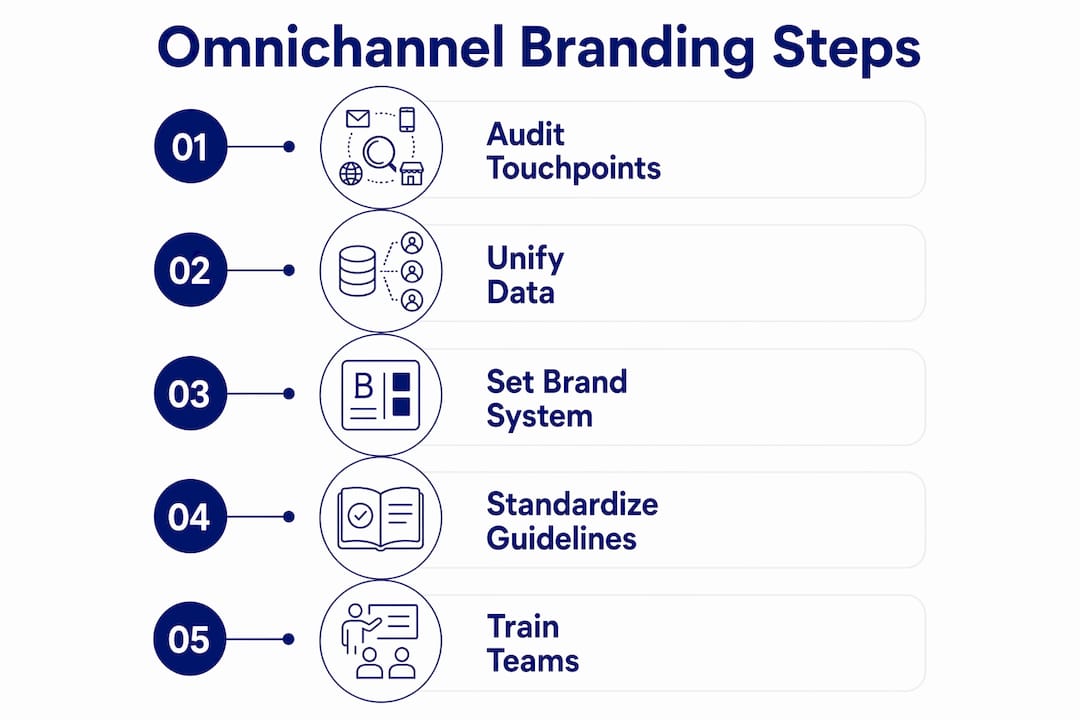
Effective implementation follows a phased approach rather than attempting to fix every channel at once. The recommended method is to establish a unified data foundation first, then select two or three high-impact customer journeys to optimise, and measure performance every 30–90 days using metrics like customer lifetime value, retention rate, and purchase frequency.
A practical implementation sequence looks like this:
- Audit your current state. Map every touchpoint your customers use. Identify where data is siloed and where brand consistency breaks down.
- Establish your data foundation. Connect your CRM, website analytics, email platform, and any point-of-sale systems so that customer data flows between them.
- Define your brand system. Before any technology investment, document your core messaging, visual identity, and tone of voice. A foundational brand system must exist before you invest in Customer Data Platforms or CRM technologies.
- Select priority journeys. Choose two or three customer journeys with the highest commercial impact. A common starting point is the acquisition-to-first-purchase journey and the post-purchase retention journey.
- Activate and measure. Use multi-touch attribution models such as those available in Google Analytics 4 and Adobe Analytics to understand which channels contribute to conversions. Last-click attribution will mislead your budget decisions.
- Review and refine. Set a 30–90 day review cycle. Adjust channel mix, messaging, and creative based on what the data tells you.
Organisational alignment is as important as the technology. True omnichannel success requires alignment between marketing, sales, and customer service teams. When these teams operate in silos, the customer experience fractures at the handover points. Marketing strategist Guy Sheetrit notes that technology alone does not deliver omnichannel success. Cross-department collaboration is what makes the customer journey feel coherent. You can read more about this in Michaelbell’s guide on aligning brand strategy with business goals.
For a broader view of how omnichannel strategies drive growth, the omnichannel marketing overview from BabyLove Growth is worth your time.
What are the most common pitfalls in omnichannel branding?
The most damaging mistakes in omnichannel branding share a common root: moving too fast without the right foundations. Recognising these pitfalls before you hit them saves significant time and budget.
- Presence on every channel is not the goal. Omnichannel success depends on the right channels, not every channel. Being active on a platform where your audience is not engaged wastes resource and dilutes your brand.
- Over-communication on high-intent channels. SMS and push notifications should be used sparingly for time-sensitive updates. Sending too frequently causes opt-outs and damages the relationship you have worked to build.
- Technology before brand system. Companies that invest in platforms before defining their core messaging and visual identity end up with fragmented communications. The technology amplifies the inconsistency rather than fixing it.
- No governance model. Without a clear owner for brand standards and a review process, inconsistency creeps in as teams and agencies produce content independently.
- Personalisation without privacy boundaries. Customers expect relevant experiences but are sensitive to feeling surveilled. Personalisation should feel helpful, not intrusive. Establish clear data use policies and communicate them transparently.
The pattern across all of these pitfalls is the same. Brands that skip the foundational work and jump straight to execution create more problems than they solve. The customer journey design work that connects digital and physical touchpoints only delivers value when the brand system underneath it is solid.
Key takeaways
Omnichannel branding succeeds when a unified brand system, shared customer data, and cross-team alignment work together across every channel your audience uses.
| Point | Details |
|---|---|
| Define before you build | Establish core messaging, visual identity, and tone of voice before investing in any technology. |
| Unify your data | Connect CRM, analytics, and sales systems so customer context travels across every touchpoint. |
| Choose the right channels | Focus on channels where your audience is active, not every available platform. |
| Measure with multi-touch attribution | Use Google Analytics 4 or Adobe Analytics to understand true channel contribution, not just last click. |
| Align your teams | Marketing, sales, and customer service must share a common view of the customer journey to deliver coherent experiences. |
Branding is a feeling, not just a framework
Here is what I have noticed after years of working on brand communications: most businesses understand omnichannel branding as a logistics problem. Get the data connected. Get the visuals consistent. Get the channels talking to each other. That is all necessary, but it is not sufficient.
The brands that genuinely earn loyalty do something more. They treat every touchpoint as an opportunity to reinforce an emotional truth about who they are. Emotional connection through storytelling is as critical as visual consistency. A customer who feels understood by a brand will forgive a delayed delivery. A customer who feels like a data point will churn the moment a competitor offers a lower price.
Brand building is a layered experience. The role of storytelling in branding is not a soft, optional extra. It is the mechanism by which consistent messaging becomes something a customer actually cares about. The brands I have seen struggle with omnichannel are almost always the ones that treated it as a technology project rather than a communications one.
My honest advice: get your brand story right first. Then build the infrastructure to tell it consistently. The sequence matters more than most people realise.
— Calum
How Michaelbell can help you build a connected brand
Building a coherent omnichannel brand presence takes more than good intentions. It takes a clear brand system, the right channel strategy, and teams that are genuinely aligned around the same story.
Michaelbell works with marketing teams and business leaders to create exactly that. From defining your brand communications strategy to designing the customer journeys that connect your digital and physical touchpoints, we work as an extension of your team rather than an outside vendor. We bring the creative expertise and strategic thinking without the overhead of an in-house agency. If you want brand comms that actually hold together across every channel, we would love to talk.
FAQ
What is omnichannel branding?
Omnichannel branding is the practice of delivering a consistent, unified brand experience across all physical and digital customer touchpoints by sharing data and context between channels. It differs from multichannel marketing in that channels are integrated rather than independent.
How does omnichannel branding differ from multichannel marketing?
Multichannel marketing means being present on several channels; omnichannel branding means those channels share customer data and reinforce each other. The result is a single, coherent customer experience rather than a series of disconnected interactions.
What are the key steps to implement omnichannel branding?
Start by auditing your current touchpoints, then establish a unified data foundation, define your brand system, and select two or three priority customer journeys to optimise. Measure performance every 30–90 days using metrics like customer lifetime value and retention rate.
Why is brand consistency so important in omnichannel marketing?
Consistent visual identity and messaging across all channels build recognition and trust, which directly increases conversion rates and customer loyalty. Inconsistency signals a fragmented organisation and erodes confidence in the brand.
What is the biggest mistake brands make with omnichannel branding?
The most common mistake is investing in technology before establishing a foundational brand system. Without defined core messaging, visual identity, and tone of voice, platforms amplify inconsistency rather than resolve it.