
The role of feedback loops in campaigns: a practical guide

Feedback loops convert customer and behavioural signals into iterative campaign improvements that compound over time. That is the short version. The longer version is that without a structured loop, your campaigns improve slowly, if at all, because insights sit in reports rather than changing what you actually put out into the world.
Here is what you can do this week to get started:
- Collect: Pull your top three support tickets or live chat queries from the past fortnight. These are your first creative inputs.
- Measure: Tag one conversion event you are not currently tracking, whether that is a form submission, a click-to-call, or a post-purchase reply.
- Govern: Assign one person as the loop owner. Without ownership, the loop breaks at the analysis stage every time.
The four core elements are simple: output (your campaign), response (what customers do or say), analysis (what the data tells you), and iteration (what you change next). The business outcomes are better conversion, stronger retention, and faster learning across every channel you run.
Table of Contents
- What a feedback loop is and the types you will use in campaigns
- Why feedback loops matter for campaign performance and growth
- Five practical steps to design and run feedback loops for campaigns
- Where to get reliable signals — channels and hidden sources marketers often miss
- Cadence, KPIs, and how quickly to act on what you learn
- Data governance, storage, and GDPR considerations for UK marketing teams
- How an agency embeds feedback loops into campaign workflows
- Key takeaways
- What we see work best in practice
- MB Brand Communications can help you close the loop faster
- Further reading and tools
What a feedback loop is and the types you will use in campaigns
A feedback loop, in marketing terms, is the structured process of capturing how your audience responds to a campaign and using that response to improve the next version. It is not a one-off survey or a post-campaign debrief. It is a repeating cycle: output, response, analysis, iteration, and back to output again.

The distinction that matters most for marketing leaders is the difference between a learning loop and an isolated A/B test. An A/B test is a single-variable experiment, siloed to one channel or one creative element. A learning loop is holistic: insights from an outreach campaign should inform your blog content, your lead scoring model, and your future targeting. Learning loops make every campaign smarter because they produce compounding intelligence rather than one-off wins. Treating each campaign as a fresh start prevents those gains from accumulating.
There are also two system-level types worth knowing. A positive feedback loop amplifies a signal, for example, doubling down on a message that is resonating. A negative feedback loop corrects a deviation, pulling a campaign back toward its target when performance dips. Both are useful; most campaign teams only run the negative version reactively.
The four loop types you will use in practice:
| Loop type | Signal source | Primary use | Where to start |
|---|---|---|---|
| Behavioural | Clicks, session paths, scroll depth | Creative and UX optimisation | Paid and owned channels |
| Transactional | Conversion tests, purchase data | Offer and funnel improvement | E-commerce, lead gen |
| Qualitative | Support tickets, NPS, live chat | Messaging and positioning | CRM, support desk |
| Sales-sourced | Win/loss interviews, call objections | Positioning and battle cards | B2B, longer sales cycles |
For most teams, the behavioural loop is already partially in place via Google Analytics 4 or a similar tool. The qualitative and sales-sourced loops are where the biggest untapped gains sit, and they are the ones we will come back to throughout this guide.
Why feedback loops matter for campaign performance and growth
The business case for structured feedback is not complicated. Companies using feedback loops report measurable improvements in customer satisfaction, and the mechanism is straightforward: when you know what customers actually think and do, you stop wasting budget on messages that miss.
The specific benefits break down like this:
- Faster optimisation: You catch underperforming creative in days, not weeks.
- Higher conversion: Messaging aligned to real customer language converts better than agency-guessed copy.
- Better retention: Feedback programmes give customers a transparent channel to report their experience, and companies that use them are more likely to retain customers.
- Smarter creative: Real objections and pain points from support tickets outperform hypothetical creative briefs.
- Reduced waste: You stop running ads that generate clicks but not conversions.
- Faster detection of messaging mismatch: A loop catches a positioning problem in the current campaign, not the next one.
The deeper business case is about compounding. A single A/B test improves one element. A learning loop improves the whole system, and those improvements stack quarter over quarter. B2B teams that run structured feedback loops separate themselves from competitors through this compounding effect, while teams without loops improve only marginally between campaigns.
Statistic: Analysis cited by GetThematic reports that companies using structured feedback loops see measurable improvements in customer satisfaction, with some analyses pointing to figures around 85% of organisations reporting positive outcomes.
Consider a concrete example. A B2B software company was running paid search ads with agency-written copy focused on “efficiency” and “productivity.” A single pass through their support tickets revealed that customers’ real concern was data security during onboarding. One creative change, swapping the headline to address that specific fear, produced a measurable lift in click-through rate and a reduction in drop-off at the sign-up stage. That is one loop, one iteration, one change. The revenue impact of customer feedback programmes scales significantly when those iterations run continuously.
Five practical steps to design and run feedback loops for campaigns
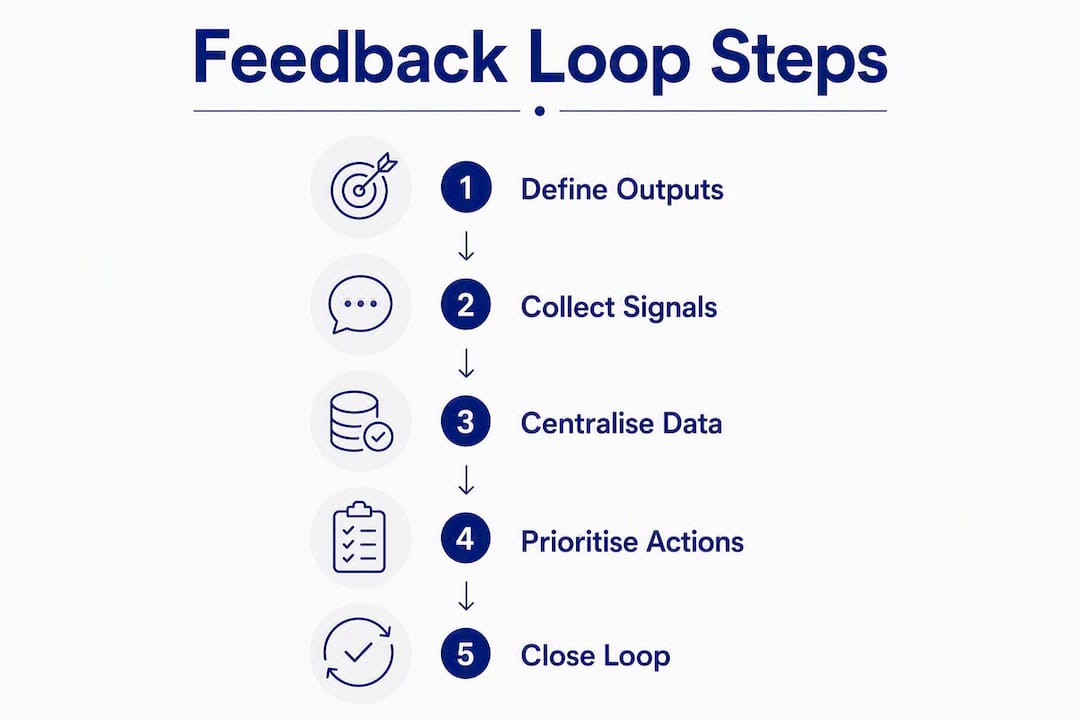
1. Define your outputs and signals
Before you collect anything, be clear about what your campaign is trying to do and what a meaningful response looks like. A paid social campaign has different signals from an email nurture sequence. Map your outputs (ads, emails, landing pages, sales decks) to the responses you want to measure (clicks, replies, conversions, objections).
2. Collect signals reliably
Reliability means consistency. Set up tracking before the campaign launches, not after. For each channel, capture:
- Paid: CTR, conversion rate, frequency, comment sentiment
- Owned (email/web): Open rate, click map, scroll depth, reply content
- Earned (social/PR): Shares, comments, sentiment, inbound mentions
- Product/onboarding: Feature adoption, drop-off points, in-app feedback
- Sales: Call recordings, objection logs, win/loss notes
3. Centralise and analyse
Raw signals in separate dashboards are not a loop. They are a pile. Pull data into a single view, whether that is a CRM, a BI tool like Looker Studio, or even a well-structured spreadsheet. AI tools can accelerate pattern detection across call transcripts and qualitative data, but they do not replace the strategic judgement of a human analyst deciding what to act on.

4. Prioritise and test changes
Not every insight deserves immediate action. Score each insight by three criteria: impact (how much could this move the needle?), effort (how hard is it to change?), and customer value (how many customers does this affect?). High-impact, low-effort, high-volume insights go first. Build a hypothesis card for each: “We believe that changing X will produce Y, because the signal Z tells us so.”
5. Close the loop and communicate outcomes
This is the step most teams skip. Closing the loop publicly, telling customers or internal stakeholders what you changed and why, increases trust and encourages further feedback. Internally, share a brief weekly insight memo so sales, support, and marketing all know what the data is saying. Without this step, the loop breaks and insights accumulate in reports that nobody reads.
Pro Tip: Treat sales conversations and support tickets as campaign creative inputs, not just operational data. The exact language a customer uses to describe their problem is often the most effective ad headline you will ever write. Capture it, tag it, and test it.
Where to get reliable signals — channels and hidden sources marketers often miss
Most marketing teams are already collecting behavioural data. The gap is almost always in qualitative and sales-sourced signals, which tend to carry the highest creative intelligence.
Here is a ranked view of signal sources by quality and actionability:
- Sales call recordings and objection logs: The single richest source of positioning intelligence in B2B. Win/loss interviews and sales-call objections surface gaps that should update your messaging within weeks, not quarters.
- Support tickets and live chat logs: Customers describe their problems in their own words here, unfiltered by survey design. These are gold for creative testing.
- Post-purchase email replies: Almost universally ignored. A reply to a transactional email is a voluntary, high-intent signal. Read them.
- NPS and CSAT surveys: Useful for trend tracking, but the free-text comments matter more than the score.
- Ad creative performance data: CTR and conversion by creative variant tells you which message is resonating, not just which ad is winning.
- Social comments and DMs: Sentiment and language patterns here often predict what will work in paid creative.
- Behavioural analytics (GA4, Hotjar, Clarity): Session paths and scroll maps reveal where interest drops, which is a content and UX signal as much as a campaign one.
The practical move is to extract usable language snippets from qualitative sources and inject them into creative testing. Using customer-sourced language in ad copy consistently outperforms agency-generated copy because it maps directly to how customers think about their own problems.
A simple example: a support ticket reads, “I kept getting confused about whether the price included VAT.” That single sentence becomes a test headline: “All prices shown include VAT. No surprises at checkout.” You have not invented a message; you have reflected one back.
Pro Tip: The most underused high-signal sources for campaign copy are post-purchase emails and sales call objections. Set up a shared Slack channel or a tagged folder in your CRM where sales and support can drop verbatim customer quotes weekly. Your creative team will use them.
For a deeper look at how customer data shapes brand communications, the Michaelbell blog covers the translation from insight to messaging in practical detail.
Cadence, KPIs, and how quickly to act on what you learn
Speed matters, but so does statistical discipline. Acting on three days of data from a low-traffic campaign is how you make changes that hurt performance. Here is how to calibrate.
KPI checklist for feedback loop measurement:
- Conversion lift (primary campaign goal, measured against baseline)
- Micro-conversion rates (scroll depth, video completion, form start)
- NPS, CSAT, or CES where customer experience is the campaign objective
- Churn and retention delta (for retention-focused campaigns)
- Time-to-insight (how long from signal capture to creative change)
- Test significance (aim for 95% confidence before declaring a winner)
Cadence guidelines:
- Within days: Act on signals that indicate a technical failure (broken link, incorrect pricing, tracking error) or a sharp drop in CTR with no external explanation.
- Within weeks: Act on qualitative patterns that appear in three or more independent sources (e.g., the same objection in support tickets, sales calls, and ad comments).
- Quarterly: Review structural changes to targeting, channel mix, or positioning based on accumulated loop data.
A sample dashboard for a mid-size campaign might include these fields:
| Field | Type | Frequency | Trigger for action |
|---|---|---|---|
| CTR by creative variant | Behavioural | Daily | Drop in CTR versus baseline |
| Conversion rate by landing page | Transactional | Weekly | Drop in CTR versus baseline |
| Support ticket themes | Qualitative | Weekly | Three or more tickets on same topic |
| NPS free-text themes | Qualitative | Monthly | New theme appearing in 5%+ of responses |
| Sales objection frequency | Sales-sourced | Fortnightly | Any common objection recurring in multiple calls |
| Time-to-insight | Governance | Monthly | Target: under two weeks |
On statistical power: if your campaign is generating fewer than 500 conversions per variant per week, you likely do not have the sample size to declare significance on a conversion test. In that case, use qualitative signals to guide creative direction and reserve statistical testing for higher-volume channels. Pausing a change is the right call when the data is inconclusive; iterating on noise is worse than waiting.
For guidance on refreshing messaging cadence in line with what your feedback loops are telling you, Michaelbell’s blog covers the timing question in detail.
Data governance, storage, and GDPR considerations for UK marketing teams
Collecting feedback signals in the UK means operating under UK GDPR, which mirrors the EU framework with minor post-Brexit adjustments. The practical obligations for marketing teams are not onerous, but they do require deliberate process design.
GDPR checklist for feedback collection:
- Lawful basis: Identify your lawful basis before you collect. Legitimate interest is commonly used for B2B marketing analytics; consent is required for most direct marketing communications. Document your basis in a processing record.
- Transparency: Tell customers what you are collecting and why at the point of collection. A one-line note on a survey or post-purchase email is sufficient for most cases.
- Data minimisation: Collect only what you will actually use. If you are extracting language patterns from support tickets, you do not need to retain the customer’s name alongside the verbatim text.
- Anonymisation and pseudonymisation: Before routing qualitative data (transcripts, chat logs, survey responses) into third-party analytics or AI tools, strip or pseudonymise personal identifiers. This reduces your risk profile significantly.
- Retention policy: Set a defined retention period for feedback data. A practical default for campaign-level feedback is 12 months of raw data, with anonymised aggregates retained indefinitely for trend analysis.
- Vendor due diligence: Before connecting a feedback tool to a third-party AI or analytics platform, ask: Where is data stored? Is it used to train models? What is the data processing agreement? Who has access?
Questions to ask analytics and AI vendors before routing personal data:
- Is data stored within the UK or EEA?
- Do you use customer data to train shared models?
- Can we sign a Data Processing Agreement (DPA)?
- What is your data deletion process on contract termination?
One legal note: this guidance is general information, not legal advice. Confirm your specific processing activities with a qualified data protection professional or the ICO’s published guidance.
The role of internal communications in governance is worth considering here too: GDPR compliance in feedback programmes depends as much on internal process discipline as on technical controls.
How an agency embeds feedback loops into campaign workflows
The most common failure mode is not a lack of data. It is a lack of process discipline at the point where analysis should become iteration. Organisations that run structured feedback-to-action workflows avoid the pattern where insights sit in reports and never change campaign outputs.
Here is how a well-structured agency workflow looks in practice:
Workflow stages:
- Intake: Campaign brief defines outputs, signals to capture, and loop owner.
- Signal capture: Tracking set up pre-launch across all channels; qualitative sources (support, sales) briefed on what to log.
- Analysis sprint: Weekly or fortnightly review of signals against KPIs; qualitative themes extracted and tagged.
- Hypothesis design: Top-priority insights converted into hypothesis cards with a clear “if we change X, we expect Y” structure.
- Test execution: Changes deployed; variant tracked against baseline.
- Iteration and stakeholder update: Results shared in a weekly insight memo; loop restarts.
RACI for a typical campaign feedback loop:
| Activity | Marketing | Sales | Support | Analytics | Agency |
|---|---|---|---|---|---|
| Define signals and KPIs | A | C | C | R | R |
| Capture qualitative signals | I | R | R | I | A |
| Centralise and analyse data | C | I | I | R | A |
| Design hypotheses | A | C | I | C | R |
| Execute tests | R | I | I | C | A |
| Communicate outcomes | A | I | I | I | R |
R = Responsible, A = Accountable, C = Consulted, I = Informed
Templates to build:
- Weekly insight memo: Signal summary, top three themes, one recommended action, owner, and deadline.
- Hypothesis card: Campaign element, current performance, proposed change, expected outcome, measurement method, and sample size required.
- Win/loss interview guide: Five questions covering why the customer chose (or did not choose) you, what nearly stopped them, and what language they used to describe the problem you solve.
For agencies working on retainer, embedding the loop into the monthly rhythm means the client never has to ask “what did we learn this month?” The answer is always ready. How agencies structure brand revitalisation engagements follows a similar logic: the loop is the mechanism that keeps the work relevant between major strategic reviews.
Key takeaways
Feedback loops work because they convert real customer signals into iterative campaign changes, and those changes compound over time into measurable improvements in conversion, retention, and creative quality.
| Point | Details |
|---|---|
| Define the loop before launch | Map outputs to signals and assign an owner before the campaign goes live, not after. |
| Qualitative sources are underused | Support tickets, sales objections, and post-purchase replies carry more creative intelligence than most teams realise. |
| Cadence must match signal urgency | Act within days on technical failures, within weeks on qualitative patterns, and quarterly on structural changes. |
| GDPR requires deliberate process design | Anonymise data before routing to third-party tools, document your lawful basis, and set a 12-month retention default. |
| Michaelbell embeds loops into retainer workflows | Michaelbell structures campaign engagements around a weekly insight memo, hypothesis cards, and a RACI-driven iteration cycle. |
What we see work best in practice
The gap between teams that improve campaigns quickly and those that do not is almost never about data access. Both groups have analytics dashboards. The difference is whether someone is accountable for translating the data into a change, and whether that change gets made before the next campaign brief lands.
What we see work consistently at Michaelbell is fast iteration paired with sales-marketing alignment. When the sales team logs objections in a shared format and the marketing team reviews them fortnightly, creative briefs change. Headlines shift. Landing page copy gets sharper. The feedback loop becomes a conversation between two teams that used to operate in separate rooms.
One pattern we see repeatedly: a client runs a paid campaign for three months with reasonable results, then we introduce a structured qualitative review of their support tickets and post-purchase emails. Within six weeks, the creative brief looks completely different, not because the strategy changed, but because the messaging finally reflects what customers actually say. The compounding effect of that alignment tends to show up in conversion rates within a quarter.
The other pattern worth naming is analysis paralysis. Some teams collect everything, build beautiful dashboards, and then debate which insight to act on for so long that the campaign has already moved on. The fix is triage discipline: one owner, one weekly decision, one change at a time. Loops that try to act on ten insights simultaneously act on none of them properly.
If you are considering bringing an agency in to accelerate this, the right moment is usually when you have the data but not the process to act on it consistently. That is where an external team adds the most value: not in collecting more signals, but in building the workflow that turns signals into decisions on a reliable cadence. Brand revitalisation strategies often begin exactly here, with a feedback audit that reveals what the brand has been missing.
MB Brand Communications can help you close the loop faster
Campaigns that improve continuously are not the result of more data. They are the result of a clear process for acting on the data you already have. Michaelbell gives marketing teams and business leaders the dedicated agency resource to build that process without the overhead of an in-house team.
A typical engagement starts with a two-week insight audit: we review your existing signal sources, identify the gaps, and map a loop structure to your campaign calendar. From there, a 90-day pilot runs the full cycle with measurable KPIs agreed upfront, so you can see exactly what the loop is producing. For teams that want ongoing support, our retainer model embeds the weekly insight memo, hypothesis cards, and iteration cycle directly into your campaign rhythm.
The result is a marketing team that gets smarter with every campaign, not just every year. To see how we work and what a feedback-loop engagement looks like in practice, visit our agency services page or get in touch directly. We will get straight back to you.
Further reading and tools
A short list of authoritative sources and tools for teams going deeper on feedback loop design and measurement:
- Marketing feedback loops: strategies for optimisation (GetThematic) — practical framework for structuring qualitative feedback analysis.
- Customer feedback loops in B2B marketing (Abmatic AI) — covers the four-stage loop, common failure modes, and AI-assisted analysis.
- Learning loops make every campaign smarter (Jay Mount Consulting) — clear explanation of how learning loops differ from isolated A/B tests.
- Feedback loops (Mailchimp resources) — practical guidance on closing the loop and communicating changes to customers.
- Customer feedback to improve your ads (AbanCommercials) — how to map qualitative feedback categories to ad creative components.
- Boost content engagement using feedback loops — partner resource on using feedback to inform content strategy and engagement optimisation.
- ICO guidance on UK GDPR and legitimate interest — primary source for lawful basis decisions in UK marketing data collection.
- Michaelbell: customer journey mapping and signal analysis — how Michaelbell maps channel signals to funnel stages for campaign clients.
Two vendor-selection notes for analytics and AI tools:
- Before connecting any feedback tool to a third-party AI platform, confirm that a signed Data Processing Agreement is in place and that data is stored within the UK or EEA.
- Ask whether your data is used to train shared models. Several popular AI analysis tools use customer data for model improvement by default; opt-out clauses exist but must be explicitly requested.