
Role of internal communications in marketing

Internal communications is the practice of aligning employees with an organisation’s goals, values, and messaging so that every customer interaction reflects the same brand promise. The role of internal communications in marketing is direct: when employees understand and believe in what a brand stands for, they deliver it consistently to customers. This article covers how effective internal communication strategies strengthen brand messaging, improve employee engagement, and give marketing leaders a practical edge. You will find evidence, frameworks, and tools drawn from current research, with a focus on what actually works in practice.
How does internal communications drive marketing success?
Employee engagement is the top strategic goal for 42% of internal communicators in 2026. That figure signals a fundamental shift: internal communications is no longer a back-office function. It is a core driver of the outcomes marketing teams care about most.
The financial case is equally clear. Replacing an employee costs between 50% and 200% of their annual salary. Poor internal communication is one of the leading causes of disengagement and departure, which means every gap in your internal messaging carries a direct cost to the business.
“When employees feel informed, heard, and connected to a shared purpose, they become the most credible advocates your brand has. No campaign budget can replicate that.”
Two-way communication models are the mechanism that makes this work. When employees can raise concerns, share customer feedback, and respond to leadership messaging, trust builds organically. That trust translates into consistent, authentic brand delivery at every touchpoint.
How do internal communications and marketing align?

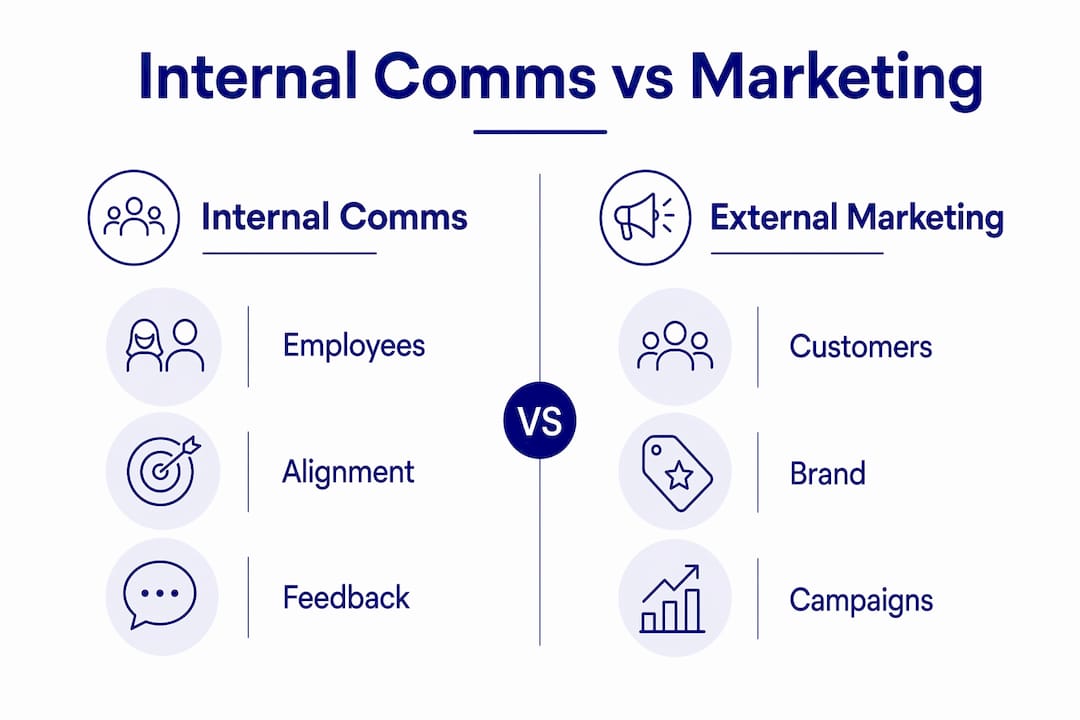
Marketing and internal communications serve distinct but complementary purposes. As one widely cited distinction puts it, marketing helps people decide what to do with understanding, while communications helps people understand. Both are necessary. Neither works well without the other.
The practical challenge for marketing leaders is ensuring that the story told externally matches the reality experienced internally. A campaign promising exceptional customer service falls flat when frontline staff have not been briefed on the new service standards. A brand refresh fails to land when employees still use outdated messaging.
Shared tools and feedback loops
The most effective organisations use overlapping channels to keep internal and external messaging in sync. These include:
- Campaign pre-briefs sent to all customer-facing teams before a campaign goes live
- Brand messaging guides distributed via the intranet, updated with each major campaign cycle
- Feedback channels such as pulse surveys or team meetings where employees report customer reactions in real time
- Leadership communications that reinforce campaign themes through consistent, visible behaviour
Leadership visibility and credible day-to-day interactions matter more to internal trust than formal corporate messaging. When senior leaders visibly model the brand values being marketed externally, employees follow. When they do not, no amount of internal messaging closes the gap.
Internal comms versus external marketing: a practical comparison
| Dimension | Internal communications | External marketing |
|---|---|---|
| Primary audience | Employees and leadership | Customers and prospects |
| Core goal | Alignment, trust, and advocacy | Awareness, consideration, and conversion |
| Key channels | Intranet, email, instant messaging, team meetings | Social media, advertising, content, PR |
| Tone | Direct, transparent, and inclusive | Persuasive, aspirational, and brand-led |
| Feedback loop | Surveys, manager cascades, two-way dialogue | Customer data, reviews, and campaign analytics |
Longitudinal research with senior managers confirms that internal communications must be integrated into strategic decision-making, not treated as a support function. When marketing and internal comms operate from a shared plan, the result is a brand communications strategy that holds together from the boardroom to the shop floor.
What internal communication strategies work for marketing leaders?
A foundational internal communications strategy can be built in 2–4 weeks using four core tools. That timeline is achievable for most marketing and business leaders without a dedicated internal comms team.
The four channels are:
- Internal email platform. Use a dedicated tool that tracks open rates and click-throughs, not a standard email client. This gives you measurable data on whether messages are reaching people.
- Employee texting. SMS reaches employees who are not desk-based. It is particularly effective for time-sensitive updates, such as campaign launches or service changes.
- Instant messaging (Slack or Microsoft Teams). These platforms support real-time dialogue and allow marketing teams to share assets, answer questions, and gather quick feedback from colleagues.
- Intranet or knowledge hub. A central repository for brand guidelines, campaign materials, and messaging frameworks. This is where employees go to find the definitive version of any communication.
Setting a predictable communication cadence matters as much as the tools themselves. Weekly team updates, monthly leadership messages, and quarterly brand reviews give employees a reliable rhythm. They know when to expect information and where to find it.
Measurement of open rates, clicks, and survey responses helps you refine your approach over time. Start with simple metrics and build from there.
Pro Tip: Create a one-page manager communication summary for every major campaign. Managers cascade messages more confidently when they have a clear brief, and their teams receive consistent information regardless of department.
Aligning your internal messaging with your broader goals is easier when you have a clear framework for brand strategy alignment in place. Internal comms and brand strategy are not separate workstreams. They are the same conversation, held in different rooms.
How does internal communications inform marketing decisions?
Strong employee experience, created through effective internal communications, is one of the biggest predictors of strong customer experience. This is not a soft claim. It is a measurable relationship: organisations that invest in internal communication quality consistently outperform those that do not on customer satisfaction metrics.
The mechanism is straightforward. Frontline employees interact with customers every day. They hear complaints, spot patterns, and notice what the marketing team cannot see from a dashboard. When internal communication channels are open and two-way, that intelligence flows back to the people who make marketing decisions.
“Two-way dialogue turns frontline teams into real-time customer insight engines. The organisations that listen internally are the ones that respond to customers fastest.”
The practical benefits for marketing leaders include:
- Faster campaign iteration. Frontline feedback on a new offer reaches the marketing team within days, not quarters.
- More accurate customer personas. Employees who speak to customers daily add texture and nuance that survey data misses.
- Authentic employer brand. When employees feel genuinely engaged, they share that experience publicly. This strengthens recruitment and reinforces the external brand simultaneously.
- Reduced message drift. When employees are briefed consistently, the gap between what marketing promises and what customers experience narrows.
Effective internal communication drives faster decision-making, stronger goal alignment, and lower turnover. These outcomes compound: a team that makes faster decisions and retains its people builds institutional knowledge that no competitor can easily replicate.
Understanding how customer feedback drives revenue growth reinforces why internal channels that surface this feedback are worth building properly. The data flowing through your organisation is only useful if the communication infrastructure exists to move it to the right people.
When you are ready to refresh brand messaging for your audience, the quality of your internal communications will determine how well that refresh lands internally before it ever reaches a customer.
Key takeaways
Internal communications is a direct driver of marketing performance, not a peripheral support function. Organisations that treat it as infrastructure see measurable gains in employee engagement, brand consistency, and customer experience.
| Point | Details |
|---|---|
| Engagement drives marketing outcomes | 42% of internal communicators cite employee engagement as their top goal, linking directly to retention and brand advocacy. |
| Two-way dialogue is non-negotiable | Frontline feedback loops give marketing teams real-time customer intelligence that no analytics platform can replicate. |
| Four tools are enough to start | An email platform, employee texting, instant messaging, and an intranet hub form a complete foundational infrastructure. |
| Leadership consistency builds trust | Visible, credible leadership behaviour reinforces brand values more effectively than formal messaging alone. |
| Internal and external messaging must align | Campaigns that are not pre-briefed internally create gaps between brand promise and customer experience. |
Why I think internal comms is the most underused asset in marketing
Most marketing leaders I speak with treat internal communications as someone else’s problem. It sits with HR, or with a comms manager who reports into a different part of the business. The marketing team focuses on the external story and assumes the internal one will sort itself out.
It does not sort itself out. The external brand promise is only as strong as the people delivering it. When employees do not know what a campaign is about, or why a brand value matters, customers feel that gap immediately. They just cannot name it.
The organisations I have seen get this right share one habit: they include internal communications in campaign planning from the start, not as an afterthought. The brief goes to employees at the same time it goes to the agency. The launch plan includes an internal launch. The post-campaign review includes employee feedback alongside customer data.
Leadership involvement in internal communications builds the trust and credibility that makes marketing alignment possible. That is not a soft benefit. It is the foundation everything else sits on.
— Calum
Michaelbell: brand communications that work inside and out
At Michaelbell, we work with marketing teams and business leaders who want their internal and external communications to tell the same story. Our specialists in brand communications services build the infrastructure, messaging frameworks, and campaign alignment processes that keep your team and your customers on the same page. We operate as an extension of your team, not an outside vendor, which means we understand the internal dynamics that shape how your brand is experienced. If you want brand communications that hold together from the inside out, we would love to talk.
FAQ
What is the role of internal communications in marketing?
Internal communications aligns employees with brand messaging and campaign goals, so that every customer interaction reflects the same brand promise. It is the operational link between what marketing promises externally and what employees deliver in practice.
Why does internal communication matter for brand consistency?
When employees receive clear, consistent messaging about brand values and campaigns, they deliver a consistent customer experience. Gaps in internal communication create gaps in the brand experience that customers notice.
How quickly can a business build an internal communications strategy?
A foundational internal communications strategy can be built in 2–4 weeks using four core tools: an internal email platform, employee texting, instant messaging, and an intranet hub.
How does internal communication affect customer experience?
Strong employee experience, created through effective internal communications, is one of the biggest predictors of strong customer experience. Frontline teams who feel informed and engaged deliver better service and surface valuable customer insights.
What role does leadership play in internal communications?
Leadership visibility and consistent day-to-day behaviour matter more to internal trust than formal corporate messaging. When leaders model brand values visibly, employees align their own behaviour with the external brand promise.