
The role of tone of voice in branding

Tone of voice is the emotional and stylistic character of everything your brand says. It is not what you communicate but how you communicate it, and that distinction shapes whether customers see you as trustworthy, approachable, or worth recommending. Get it right and your brand feels coherent and human across every touchpoint. Get it wrong and even a strong visual identity cannot compensate for messaging that feels cold, inconsistent, or off-brand.
The business case is clear. Ninety percent of customers expect consistent interactions across channels, and tone is the thread that holds those interactions together. A well-defined tone builds recognition, reduces confusion, and gives every member of your team, from content writers to customer support agents, a shared communication standard to work from.
Here is what a well-executed tone of voice delivers in practice:
- Brand recognition: Customers identify your brand by how it sounds, not just how it looks.
- Trust: Consistent, appropriate tone signals reliability and reduces cognitive friction.
- Emotional connection: The right register makes customers feel understood, not processed.
- Differentiation: Your tone expresses a personality that competitors cannot simply copy.
- Internal alignment: Clear tone guidelines unify marketing, sales, and support communications.
Pro Tip: Consistency does not mean rigidity. Your tone should remain recognisable whether you are writing a LinkedIn post or a complaint response, but the emotional register should shift to fit the situation. A brand that sounds identically chirpy in a crisis as it does in a product launch has confused consistency with inflexibility.

What is the difference between brand voice and tone of voice?
Brand voice and tone of voice are related but distinct, and conflating them is one of the most common mistakes in brand communications. Understanding both is foundational to any effective brand communications strategy.
Brand voice is your fixed personality. It is the combination of values, word choices, and communication characteristics that remain constant regardless of channel, audience, or context. Think of it as who your brand is. A brand that is direct, warm, and unpretentious carries those traits into every piece of copy it produces.
Tone of voice is how that personality expresses itself in a given moment. It adapts to the emotional register the situation demands, shifting from enthusiastic in a product launch to measured and empathetic in a service recovery scenario, while always sounding like the same brand.
Without this distinction, brands risk what communications professionals call brand schizophrenia: messaging that feels inconsistent because the underlying personality has no fixed core to return to. The voice stays constant; the tone modulates around it.
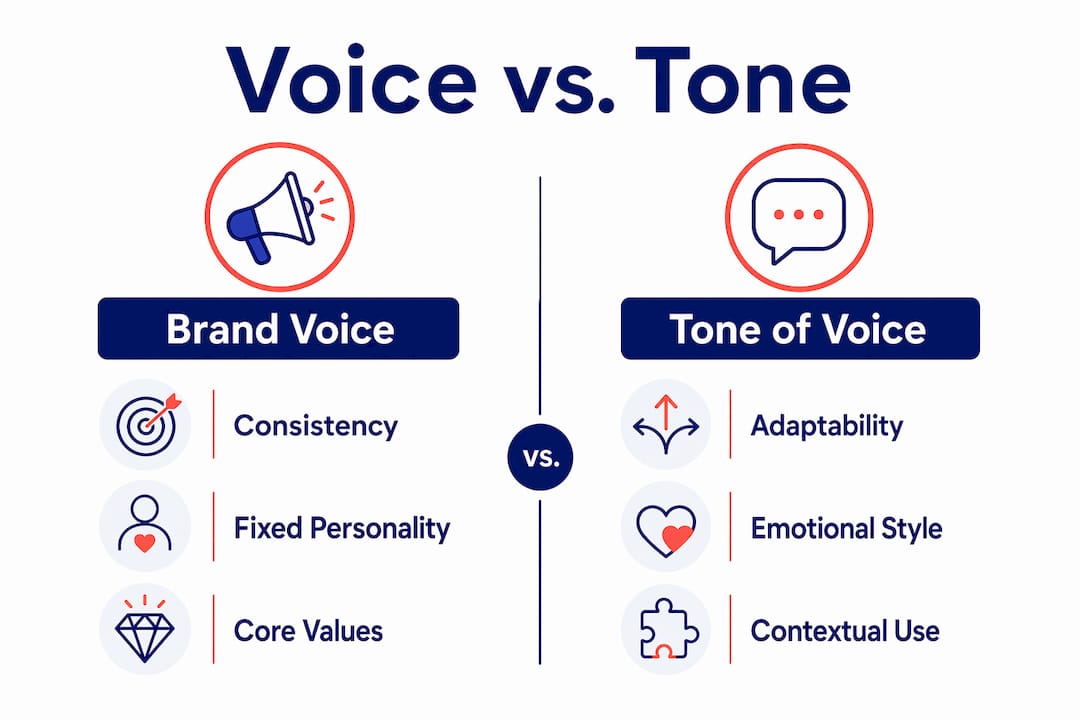
| Attribute | Brand voice | Tone of voice |
|---|---|---|
| Consistency | Fixed across all channels | Adapts to context and audience |
| Function | Defines brand personality | Expresses emotional register |
| Changes over time | Rarely, only with brand evolution | Frequently, per message and medium |
| Documented as | Core voice characteristics | Tone modulation rules per channel |
| Risk if absent | Brand feels generic | Brand feels inconsistent or tone-deaf |
A useful analogy: your voice is your accent and vocabulary. Your tone is whether you speak quietly or with energy, formally or casually, depending on who you are talking to and why.
Why tone of voice matters for brand perception

Tone of voice has a measurable impact on how customers perceive your brand, and the research is specific about where that impact lands. Nielsen Norman Group’s study found that casual, conversational, and moderately enthusiastic tones consistently produced the highest scores for friendliness, trustworthiness, and desirability across multiple industries.
The trust finding is particularly striking. Trustworthiness accounts for 52% of the variability in desirability scores, measured as willingness to recommend a brand. Friendliness adds only a further 8%. That means the tone you use to signal reliability has a far greater influence on whether customers advocate for your brand than whether they simply like it.
Tone also plays a direct role in differentiation. Brand personality is the primary reason customers choose one brand over another in crowded categories, and voice is the primary vehicle for expressing that personality. A brand that sounds exactly like its competitors has already lost part of the argument before the product is even considered.
The loyalty dimension matters too. Consistent brand tone across channels builds the kind of familiarity that converts first-time buyers into repeat customers. Small inconsistencies, a formal email following a playful social post, erode that familiarity faster than most brand managers expect.
What components shape your brand’s tone of voice?
Tone of voice is not a single dial you turn up or down. It is a combination of several elements that work together to produce a consistent, recognisable communication style. Comprehensive tone guidelines from leading brands show that the most effective frameworks address all of these components explicitly.
- Vocabulary: The specific words and phrases your brand uses, including whether you adopt industry jargon, plain language, or a distinctive lexicon.
- Formality: The degree of professional distance in your writing, from highly formal to conversational.
- Enthusiasm: How much energy and positivity your brand expresses, and whether that varies by channel.
- Humour: Whether your brand uses wit, and if so, what kind: dry, warm, playful, or self-deprecating.
- Respectfulness: How your brand acknowledges and honours the intelligence and experience of its audience.
- Tone adaptability: The rules governing how the above elements shift across different contexts, audiences, and platforms.
| Component | What it controls | Effect on customer perception |
|---|---|---|
| Vocabulary | Word choice and phrase style | Signals expertise, accessibility, or personality |
| Formality | Register and distance | Shapes perceived professionalism and approachability |
| Enthusiasm | Energy level in copy | Influences perceived friendliness and brand warmth |
| Humour | Use of wit and levity | Builds affinity; requires careful calibration by sector |
| Respectfulness | How the audience is addressed | Builds trust and signals brand values |
| Tone adaptability | Context-specific modulation rules | Maintains coherence across varied communication scenarios |
These components do not operate in isolation. A brand with high enthusiasm but low respectfulness can read as patronising. High formality paired with warm vocabulary can work well for financial services, where the Nielsen Norman Group research showed that a conversational but serious tone outperformed a cold formal one on both friendliness and trustworthiness scores. The interaction between components is where the craft lies.
Pro Tip: When writing your tone guidelines, document not just what your brand sounds like but what it does not sound like. A “do/don’t” example pair for each component gives writers a faster, more reliable reference than adjectives alone.
How to define and apply your brand’s tone of voice
Defining tone of voice is a process, not a one-off decision. The brands that get it right treat it as a living framework, revisited as the business evolves and as new channels emerge. Here is a practical approach.
-
Define your core values. Tone must be authentic to what your brand actually stands for. Start with three to five values that genuinely describe your organisation, not aspirational ones, and use them as the filter for every tone decision that follows.
-
Analyse your audience. Tone that resonates with c-suite executives in financial services will jar with Gen Z consumers on social media. Map your primary audience segments, their communication preferences, and the emotional register they respond to. Salesforce research shows that 66% of customers expect brands to understand their needs and expectations, which makes audience analysis a prerequisite, not an optional step.
-
Audit your existing communications. Read your current content as a customer would. Note where the tone feels right and where it drifts. Inconsistencies in existing copy are your clearest signal of where guidelines are missing or being ignored.
-
Set three to five voice characteristics. Choose specific adjectives that describe how your brand should sound. “Warm, direct, and unpretentious” is more useful than “professional and friendly” because it is harder to misinterpret. Each characteristic should come with a brief description and a written example.
-
Establish tone modulation rules by channel. Your voice stays constant; your tone shifts. Define how enthusiasm, formality, and vocabulary adjust for social media, email, long-form content, customer support, and crisis communications. For omnichannel consistency, these rules need to be explicit, not assumed.
-
Document everything in a style guide. A tone framework only works if the people writing your communications can access and apply it. Build it into your brand style guide with real examples, not just principles.
-
Govern and refresh over time. Assign ownership of the tone guidelines. Schedule a review annually, or whenever the brand undergoes a significant change. Tone that felt current in 2022 may read as dated or misaligned by 2026.
Pro Tip: Involve cross-functional teams in the tone definition process. When marketing, sales, and customer support all contribute examples of what sounds right to them, you surface inconsistencies early and build buy-in across the business. A tone framework created in isolation by the marketing team rarely survives contact with the rest of the organisation.
What the research tells us about tone of voice effectiveness
The evidence base for tone of voice as a brand performance lever has grown considerably, and the findings are more specific than the general advice you will encounter in most brand guides.
The most cited pathway runs through social presence. Experimental research published in the International Journal of Communication found that humanised brand communications on social media generate a significantly greater sense of social presence than corporate tone, and that social presence is the key mediator between tone and both engagement and purchase intention. In other words, a conversational tone does not directly drive purchases; it creates the feeling of a human connection, which then drives engagement, which then drives purchase behaviour. The implication for brand managers is that tone investment pays off over time through relationship building, not through immediate conversion.
There is an important caveat. Research published in the Journal of Interactive Marketing found that a human tone can actually reduce purchase intentions in high-involvement or high-risk contexts, where customers prioritise formal reliability over warmth. A conversational tone works well for hedonic purchases; for utilitarian or high-stakes decisions, a more measured register often performs better. This is not a reason to avoid humanised tone; it is a reason to calibrate it carefully by context.
Vocal characteristics extend the picture beyond written copy. A study of 521 participants found that low-pitched brand spokesperson voices produced more positive brand associations and better brand recall, regardless of the gender of either the speaker or the listener. The effect was mediated by the associations the voice triggered, suggesting that the emotional connotations of a voice carry independent weight in building brand equity.
The practical takeaway for brand managers is that tone of voice strategy should span written, verbal, and digital communications. Updating your brand voice guidelines to account for video, podcast, and AI-generated content is no longer optional; it is where the next wave of brand differentiation will be won or lost.
Key takeaways
Tone of voice is one of the most measurable and modifiable levers in brand communications, directly shaping trust, loyalty, and the likelihood that customers will recommend you.
| Point | Details |
|---|---|
| Trust outweighs friendliness | Trustworthiness accounts for 52% of variability in brand desirability scores, per Nielsen Norman Group research. |
| Voice is fixed; tone adapts | Brand voice is your constant personality; tone modulates the emotional register for each context and channel. |
| Social presence drives purchase | Humanised tone builds social presence, which mediates engagement and purchase intention rather than driving them directly. |
| Document tone across channels | Explicit modulation rules for each channel prevent the inconsistencies that erode customer trust over time. |
| Calibrate tone to context | Conversational tone lifts hedonic brand perception; high-involvement or high-risk contexts often require a more measured register. |
How Michaelbell can help you get this right
At Michaelbell, we work with marketing teams who know their brand has a voice but are not yet confident it is working as hard as it should. We help you define, document, and apply a tone of voice that feels genuinely yours and performs consistently across every channel, from internal communications to customer-facing campaigns.
We are not an outside vendor parachuted in to hand over a document. We work as an extension of your team, which means the tone framework we build with you gets embedded in how your people actually write and communicate, not just filed away in a style guide. Explore our brand communication services to see how we approach tone strategy in practice.