
Startup messaging framework examples: build yours today

A usable startup messaging framework delivers one core value line, three supporting pillars, and a handful of proof points your whole team can pull from. Here is a template you can fill in right now:
“We help [audience] [achieve outcome] by [key differentiator].”
Filled example for a SaaS startup: “We help operations teams cut manual reporting time by automating data collection across their existing tools.”
- Core value line: one sentence, 25 words maximum
- Three messaging pillars: the themes that prove your core claim
- Proof points: one metric, one customer outcome, one feature-to-benefit statement per pillar
- Tone guidelines: three rules that keep every writer sounding like the same brand
Pro Tip: Paste your filled template into your homepage hero and your next sales email subject line before you do anything else. Consistency across two channels is worth more than perfection on one.
Key takeaways
A startup messaging framework works when it starts with customer language, organises that language into three to five pillars, and is stored in a single document every team can access and apply.
| Point | Details |
|---|---|
| Start with customer language | Harvest 10–15 real quotes before writing a single word of copy. |
| Build pillars from themes | Group customer phrases into three to five themes, then name them as pillars. |
| Attach proof points | Every pillar needs one concrete metric or outcome to stay credible. |
| Test before publishing | Run five questions past five real users; rewrite if three give the same wrong answer. |
| Michaelbell as your partner | Michaelbell delivers the workshop, living framework document, rollout templates, and team training as a scoped agency engagement. |
Table of Contents
- What is a messaging framework and why do startups need one?
- What are the core components every framework must include?
- How do you build a messaging framework in a day?
- Six copy-ready messaging framework examples for UK startups
- How do you pressure-test messaging before you commit?
- How do you make the framework stick across your team?
- What are the most common messaging pitfalls and how do you avoid them?
- How do you tailor messaging frameworks to different buyer personas?
- What does successful post-launch adaptation look like?
- Why most startup messaging fails before it starts
- Ready to build your messaging framework with Michaelbell?
- Useful sources and further reading
What is a messaging framework and why do startups need one?
A messaging framework is a structured document that captures what you do, who you do it for, and why it matters — in language your whole team can use. It is not a brand bible or a tone-of-voice guide. It is a one-page playbook that turns product features into a clear promise.
Marketing uses it to write homepage copy. Sales uses it to open calls. Product uses it to prioritise features. Customer success uses it to handle objections. When all four teams pull from the same source, the message your buyer hears is consistent at every touchpoint.
“Product messaging should capture what you do, why it matters, and who should care. A framework turns feature lists into a clear promise used across teams.” — Product School
Research on message effectiveness confirms that messages connecting with an audience’s existing values and lived experience outperform generic claims. That is why the framework starts with customer language, not your feature list.
What are the core components every framework must include?
Core value line
One sentence, 25 words or fewer. Formula: “We help [ICP] [achieve outcome] without [key friction].” This is not your tagline. It is the internal anchor every piece of copy maps back to.
Audience one-liners
One sentence per ICP segment that links their specific pain to your core value line. A B2B fintech might write: “For finance directors at Series A companies, we replace the spreadsheet audit trail with a real-time compliance dashboard.”
Proof points
Metrics beat adjectives. A conversion rate, a time saving, or a named outcome from a real customer all count. Map one proof point to each pillar so claims stay grounded.
“A compact messaging hierarchy — headline, pillars, proof points, features — makes it far easier for cross-functional teams to apply the framework across marketing, product and sales assets.” — Product School
Tone guidelines
Three short rules are enough: preferred vocabulary (plain English over jargon), sentence length target, and one phrase to avoid. Keep them on the same page as the framework.
Pro Tip: Write your tone rules as “do / don’t” pairs. “Do: use active verbs. Don’t: write in passive voice.” Teams follow contrasts more reliably than abstract principles.
How do you build a messaging framework in a day?
This seven-step workshop runs in 90 minutes with a small group or across a week if you prefer async input. Invite the CEO, a product lead, one customer success manager, and your marketer.
- Sort idea buckets (20 min). Group customer quotes into three to five themes. These become your pillar candidates. Heavybit’s messaging framework guide calls this the “idea bucket” method and recommends it before any wordsmithing.
For the customer interview stage, use these six discovery prompts: What were you trying to do before you found us? What nearly stopped you from signing up? How would you describe us to a colleague? What would you miss most if we disappeared? What do you wish we said more clearly? What do you tell people we do?
Pro Tip: Record your workshop with permission and run a transcript through a word-frequency tool. The words that appear most often in customer answers belong in your pillars, not the words your team prefers.
For deeper positioning exercises that complement this workshop, the brand positioning framework guide from Michaelbell walks through practical activities you can run alongside step four.
Six copy-ready messaging framework examples for UK startups
These examples follow the SaaS messaging framework structure: core message, three pillars, one proof point, two headline variants. Adapt the language to your product.
SaaS (project management)
Core: “We help distributed teams close projects on time without chasing updates.”
Pillars: Visibility / Accountability / Speed. Proof: customers report improved deadline adherence.
Headlines: “Your team, always in sync” / “Stop chasing. Start closing.”

Marketplace (B2B procurement)
Core: “We connect UK manufacturers with vetted suppliers in under 48 hours.”
Pillars: Speed / Verified quality / UK-first sourcing. Proof: suppliers are matched rapidly.
Headlines: “Source smarter, not slower” / “UK suppliers. Verified. Fast.”
Fintech (expense management)
Core: “We help finance teams at growing UK businesses replace manual expense reports with real-time spend visibility.”
Pillars: Compliance / Control / Clarity. Proof: includes an FCA-aligned audit trail.
Headlines: “Expenses sorted, compliance covered” / “Real-time spend. Zero surprises.”
Health tech (note: claims must comply with MHRA and ASA guidelines; avoid unsubstantiated clinical outcomes)
Core: “We help NHS-integrated GP practices reduce admin time on referrals.”
Pillars: Integration / Accuracy / Time saving. Proof: reduces referral administration time.
Headlines: “Less admin. More patient time.” / “Referrals that actually reach the right place.”
Consumer app (personal finance)
Core: “We help UK adults understand where their money goes, without a spreadsheet.”
Pillars: Simplicity / Insight / Privacy. Proof: shows open banking data in clear language.
Headlines: “Your money, finally explained” / “Know your numbers. No jargon.”
B2B services (HR consultancy)
Core: “We help UK SMEs handle employment law changes without an in-house HR team.”
Pillars: Expertise / Responsiveness / Compliance. Proof: clients benefit from professional HR guidance.
Headlines: “HR expertise, without the headcount” / “Employment law sorted. Fast.”
At Michaelbell, a B2B services client came in with a core message built around their process. After two rounds of user interviews, the language shifted entirely to outcomes. The revised homepage headline lifted demo requests within the first month of the new copy going live.
For more inspiration, the startup branding examples post shows how headline variants and pillar proof points translate into real brand assets.
How do you pressure-test messaging before you commit?
Run five questions past five real users before publishing anything:
- After reading this, what do you think the product does?
- Who do you think it is for?
- What problem does it solve?
- Would you trust this company? Why or why not?
- What is missing or confusing?
If three or more respondents give the same wrong answer to question one, your core message needs rewriting. For homepage A/B tests, change one element at a time: headline copy, subheadline, or CTA button text. Measure click-through rate, demo request rate, and bounce rate by cohort. Run each variant for long enough to collect meaningful data before drawing conclusions — directional learning from a small sample is more useful than waiting for statistical certainty that a seed-stage startup rarely has the traffic to achieve.
Key metrics to track: homepage bounce rate by traffic source, demo or trial request rate, email open rate by subject line variant, and qualitative NPS comments that reference your messaging language.
Research on audience segmentation shows that message effectiveness varies by audience values, which is why testing across different buyer segments matters as much as testing copy variants.
How do you make the framework stick across your team?
Store the framework in a single shared document — a Notion page or a Google Doc with version history works well. Publish it as the source of truth and link to it from your brand guidelines, your sales playbook, and your onboarding materials.
Templates to create from the framework: homepage hero copy block, sales one-pager intro paragraph, cold email opening line, support macro for common objections, and social media bio variants.
“A messaging strategy must manage channels and customer preferences. Omnichannel consistency depends on teams pulling from the same source document, not individual interpretation.” — RingCentral
For governance, assign one owner who approves edits. Run a quarterly review: does the language still match how customers describe the product? Handle change requests through a short brief (one paragraph describing what changed and why) rather than open editing. Version the document with a date stamp each time it updates.
Pro Tip: Run a 30-minute team walkthrough the week the framework launches. Ask each person to rewrite one piece of their current copy using the new pillars. The exercise surfaces gaps faster than any review cycle.
The startup brand launch checklist from Michaelbell pairs well with this rollout stage.
What are the most common messaging pitfalls and how do you avoid them?
“Don’t start with word-smithing. Gather real customer phrases and idea buckets first, sort them into thematic pillars, and only then polish the language.” — Heavybit
Red flags to watch for: pillars that overlap so much they feel like the same point restated; a core value line written in internal product language rather than customer language; proof points that are vague (“trusted by businesses”) rather than specific.
Pre-launch checklist before publishing new messaging:
- Core value line tested with at least five real users
- Each pillar has one concrete proof point attached
- Homepage, sales deck, and email intro all use the same core language
- Tone guidelines documented and shared with every writer
- Governance owner assigned and review date set
- A/B test variant live for the homepage headline
If early signals suggest the messaging is failing (high bounce rate, low demo conversion, sales team reverting to their own language), go back to the customer interview stage before rewriting copy. The problem is almost always a mismatch between the language you chose and the language your buyer uses.
For a full brand launch checklist, the Michaelbell startup launch guide covers assets, governance, and channel readiness in one place.
How do you tailor messaging frameworks to different buyer personas?
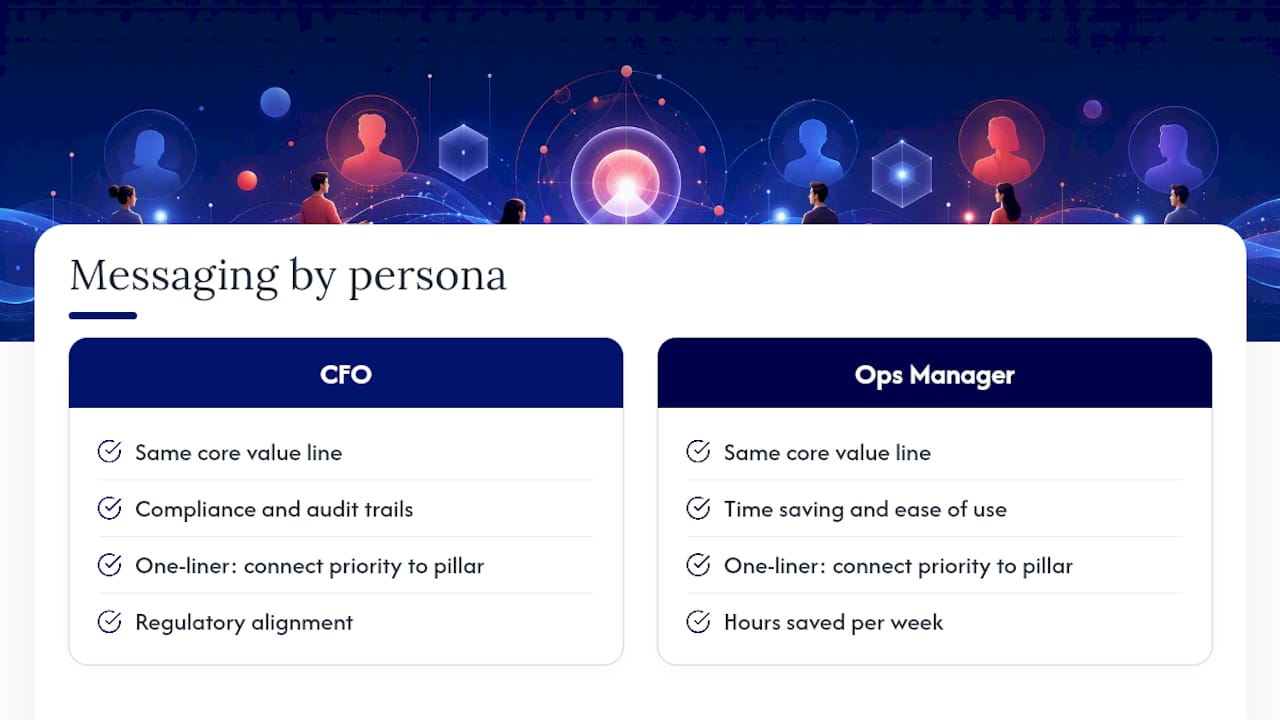
One framework does not mean one message. The core value line stays constant, but each pillar can be weighted differently depending on who you are talking to.
A fintech startup selling to both CFOs and operations managers needs the same core promise, but the CFO cares most about compliance and audit trails, while the operations manager cares about time saving and ease of use. Write one audience one-liner per persona that connects their specific priority to the relevant pillar. Keep the proof points persona-specific too: a CFO responds to regulatory alignment; an operations manager responds to hours saved per week.
The customer data guide from Michaelbell covers how to use analytics and customer quotes to build these persona-level distinctions with real evidence rather than assumptions.
What does successful post-launch adaptation look like?
Pharmacy2U, the UK’s largest online pharmacy, is a useful reference point. Their messaging shifted from a feature-led description of their dispensing service to an outcome-led promise centred on convenience and patient safety as they scaled. The language on their homepage and in their communications moved closer to how patients described their own need, not how the pharmacy described its process.
The pattern is consistent across well-run startups: the first framework is a hypothesis. User interviews and channel data reveal which pillar language resonates and which falls flat. The StoryBrand BrandScript method, developed by Donald Miller, formalises this by positioning the customer as the hero and the product as the guide — a reframe that often produces sharper pillar language after the first round of testing.
The Value Proposition Canvas from Strategyzer offers a complementary tool: map customer jobs, pains, and gains against your product’s pain relievers and gain creators. When the canvas and your messaging pillars align, you have a framework grounded in real buyer psychology rather than internal assumptions.
For early-stage startups using a Jobs To Be Done (JTBD) lens, the adaptation process is even more direct. JTBD research surfaces the functional, social, and emotional jobs your buyer is hiring your product to do. When post-launch interviews reveal a new job the product is being hired for, that is a signal to add or reweight a pillar — not to rewrite the entire framework from scratch.
Why most startup messaging fails before it starts
The conventional wisdom says messaging fails because founders are too close to their product. That is true, but it misses the deeper problem: most teams treat messaging as a writing task rather than a research task.
The frameworks that hold up — StoryBrand, Value Proposition Canvas, JTBD — all start with the same instruction: listen before you write. The reason is not philosophical. It is practical. When you write from your own assumptions, you produce pillars that reflect your internal priorities. When you write from customer language, you produce pillars that reflect the buyer’s decision criteria. Those are rarely the same list.
The other failure mode is treating the framework as a one-time deliverable. A messaging document that sits unchanged for two years is not a living framework. It is a historical artefact. The startups that get the most value from their frameworks treat them the way good product teams treat a roadmap: a current best guess, reviewed regularly, updated when the evidence changes.
What Michaelbell brings to this process is the combination of external creative and internal alignment. The workshop produces the framework. The rollout work makes it stick. Both matter equally, and most DIY attempts get the first part right and skip the second entirely.
Ready to build your messaging framework with Michaelbell?
Building a messaging framework yourself is absolutely possible with the templates and workshop above. Where founders consistently tell us they get stuck is the gap between a draft document and a framework the whole team actually uses. That is exactly where Michaelbell comes in.
We run a focused workshop with your key stakeholders, produce a living messaging document with rollout templates, and train your team to apply it across your website, sales materials, and campaigns. You get the dedication of an in-house creative team without the overhead, and a framework built on real customer language rather than internal assumptions.
To get started, view our services or get in touch with a short brief covering your ICP, your current homepage headline, and the channels you are prioritising. We will come back to you quickly with a scoped proposal.
Useful sources and further reading
The resources below support the frameworks, templates, and process covered in this article.
- Product Messaging Framework: A Guide for Ambitious PMMs
- Communicating about the social determinants of health
- Messaging Framework & Template for Founders Building Brands | Heavybit
- The Ultimate SaaS Messaging Framework for early-stage Startups
- Key Components of an Effective Messaging Strategy | Mailchimp
- Startup Positioning Frameworks: 7 Best Models for Growth
- Messaging strategy: How to create an effective communications plan | RingCentral
From Michaelbell’s own blog:
- How to write a brand messaging guide for your startup
- Develop a brand positioning framework that works
- How to position a startup brand in a competitive market