
The role of modernising brand voice in 2026

Brand voice modernisation is the process of updating how a company communicates, so its tone, language, and personality remain credible, consistent, and relevant as markets, technology, and customer expectations shift. The role of modernising brand voice has never been more pressing. 72% of consumers report feeling deceived by undisclosed AI-generated content. That single figure tells you everything about where trust sits right now. Brand managers who treat voice as a static asset, set once and left alone, are already losing ground. The evolution of brand voice is no longer optional. It is a core function of marketing leadership.
What is brand voice drift and why does it matter?
Brand voice drift is the gradual, often invisible, divergence between how a brand intends to sound and how it actually sounds across its content. It happens slowly. A social post here, a product description there, each one slightly off-tone, until the cumulative effect is a brand that feels inconsistent and untrustworthy.
The causes are predictable. Teams grow. Freelancers rotate. AI tools get introduced without proper constraints. Each new contributor pulls the voice in a slightly different direction. Without brand constraints, AI generates content that deviates 60–70% from actual brand voice. With brand-specific constraints in place, that drift reduces to just 10–15%. The gap between those two figures is the cost of doing nothing.
The consequences compound quickly. Brand voice drift over 18 months can cost a startup approximately six weeks of marketing output to audit and repair. That is not a minor inconvenience. That is a significant operational loss for any team running lean.
What makes drift particularly dangerous is its invisibility. Voice drift is often invisible to leadership for three to six months. By the time it surfaces in performance data, the damage is already embedded across multiple channels. The fix requires a controlled rollback and a systematic sweep of every content touchpoint.
Common signs of drift include:
- Inconsistent sentence structure across channels (formal on the website, casual on email)
- Overuse of generic phrases that could belong to any brand in the category
- AI-generated content that sounds competent but feels anonymous
- Internal teams disagreeing on what the brand “sounds like”
- Customer feedback describing the brand as confusing or impersonal
Pro Tip: Set a quarterly calendar reminder to read ten pieces of your own content back to back. If you cannot identify a consistent personality across them, drift has already begun.
Recognising the signs your brand needs a refresh early is far cheaper than repairing the damage later.
How does AI reshape the modernisation of brand voice?
AI content tools are now standard in most marketing teams. They accelerate output, reduce cost, and handle repetitive tasks well. The problem is that most large language models (LLMs) are trained on average internet text. Left unconstrained, they pull every brand’s output towards the same generic middle ground.
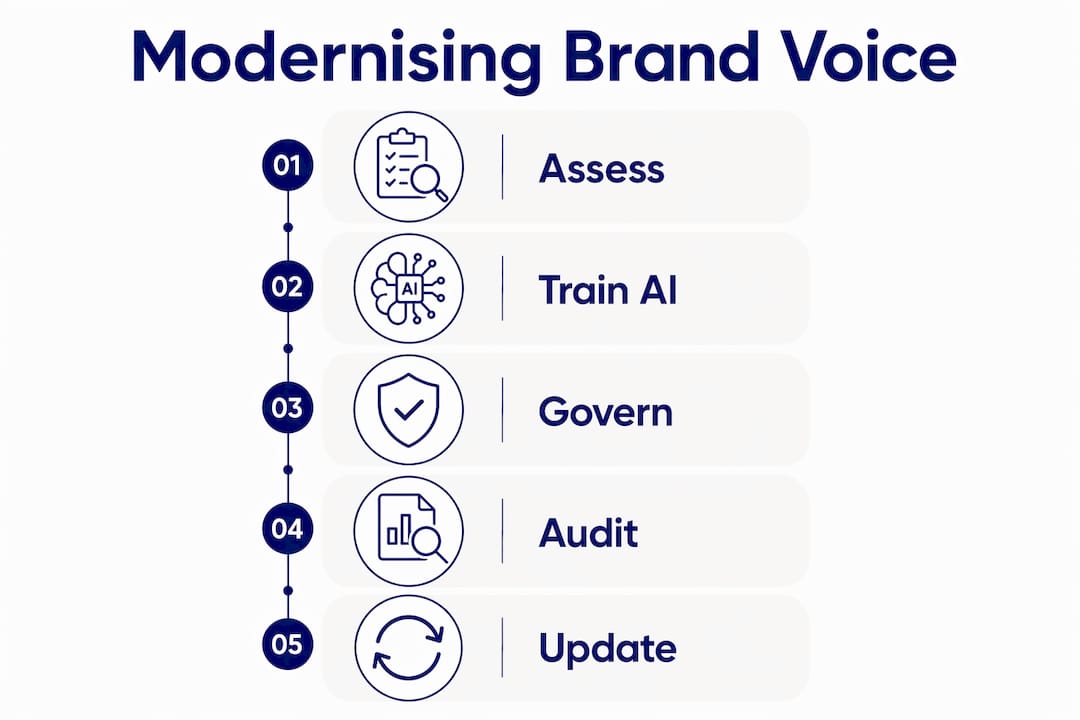
This is the homogenisation risk. When every brand uses the same AI tools with the same default settings, the resulting content sounds the same. Tone flattens. Personality disappears. The brand voice that once differentiated you becomes indistinguishable from your category.

The solution is not to avoid AI. It is to train AI on your brand. Brand-specific LLMs trained on a company’s own assets can yield up to 25% revenue uplift and 60% cost efficiency gains within two years. Those are substantial returns for what is essentially a governance investment. Building a brand online with AI-driven strategies requires this kind of intentional customisation, not just plugging in a generic tool.
The five-level model proposed in academic research on brand voice management offers a practical framework for structuring AI integration. It covers:
| Level | Function |
|---|---|
| Voice core | Defines the fixed, non-negotiable personality traits |
| Adaptive layer | Allows tone to flex by channel and audience |
| Instruction management | Controls how AI prompts are written and governed |
| Editorial oversight | Human review of AI-generated output |
| Ethics and transparency | Disclosure standards and responsible use policies |
This model matters because it treats brand voice as a system, not a document. Each level has a distinct role. Together they create a structure that scales with AI without losing brand identity.
Pro Tip: Before deploying any AI writing tool across your team, create a brand voice brief of 300–500 words and paste it into every prompt as a system instruction. This single step reduces generic output immediately.
Practical steps to modernise your brand voice effectively
The importance of brand voice lies not just in what it says, but in how consistently it says it across every touchpoint. Static tone-of-voice guides, the kind that live in a PDF and get updated every few years, are no longer fit for purpose. Static guidelines are insufficient for AI-scaled content production. Brand language architecture replaces them with a governable system.
Here is how to build that system in practice:
-
Extract your canonical voice profile. Gather your best-performing content from the past 12 months. Identify the patterns: sentence length, vocabulary range, tone markers, and recurring phrases. This becomes your voice baseline.
-
Build a brand language architecture. Move beyond a single document. Create modular voice assets: channel-specific guidelines, approved vocabulary lists, and example content for each content type. These become the inputs for AI tools and human writers alike.
-
Implement AI voice controls. Every AI prompt used by your team should include a voice instruction block. Standardise these prompts centrally. Treat them as governed assets, not individual workarounds.
-
Schedule quarterly re-extraction. Quarterly re-extraction and prompt auditing keep voice profiles current and prevent drift from compounding. Set a fixed review cycle and assign ownership to a named individual.
-
Assign editorial oversight. Every AI-assisted piece needs a human review step. This is not about distrust of the tool. It is about maintaining the judgement layer that keeps brand voice alive.
-
Embed ethics and transparency. Decide your disclosure policy for AI-generated content and write it into your brand governance framework. Authenticity in branding builds measurable trust. Undisclosed automation erodes it.
Pro Tip: Assign a “voice owner” within your marketing team. This person does not write all the content. They review, calibrate, and maintain the voice system. Without ownership, governance collapses.
The ways to modernise branding that actually stick are the ones built into workflow, not bolted on as an afterthought. A communications refresh cycle built into your annual planning calendar makes this sustainable.
How do you measure the impact of brand voice change?
Measuring the impact of brand voice change requires tracking both leading and lagging indicators. Most teams focus on lagging indicators: revenue, conversion rates, and customer retention. These matter, but they tell you what happened, not what is about to happen.
Leading indicators give you earlier signals. Voice drift scores, measured through regular content audits, tell you whether your output is staying on-brand before performance suffers. Customer perception surveys, run quarterly, show whether your audience experiences your brand the way you intend. Engagement rates by channel reveal whether your tone is resonating or falling flat.
Consistent brand voice increases brand loyalty and advocacy through emotional resonance and unified messaging. That connection between voice consistency and loyalty is not abstract. It shows up in repeat purchase rates, net promoter scores, and the quality of word-of-mouth referrals.
The most useful measurement framework combines three layers. First, a monthly content audit scoring consistency against your voice profile. Second, a quarterly customer perception survey with a fixed set of brand personality questions. Third, an annual review of how voice changes correlate with commercial outcomes. Together, these layers give you a picture that is both current and strategic.
Key takeaways
Modernising brand voice is a governance discipline, not a creative exercise, and the brands that treat it as a system will outperform those that treat it as a document.
| Point | Details |
|---|---|
| Voice drift is measurable | Uncontrolled AI output deviates 60–70% from brand voice without specific constraints in place. |
| Drift has a real cost | Repairing 18 months of brand voice drift takes approximately six weeks of marketing output. |
| AI needs brand-specific training | Brand-specific LLMs reduce drift to 10–15% and can deliver up to 25% revenue uplift within two years. |
| Static guidelines are obsolete | Brand language architecture replaces tone-of-voice PDFs with a governable, scalable system. |
| Measure leading indicators | Monthly content audits and quarterly perception surveys catch drift before it hits commercial performance. |
Brand voice in 2026: what I have actually learned
The conversation around brand voice modernisation tends to focus on tools and frameworks. That is useful, but it misses the harder truth: most voice problems are organisational before they are technical.
I have seen teams invest in brand-specific AI tools, build detailed voice profiles, and still produce inconsistent content. The reason is almost always the same. No one owns the voice. Guidelines exist, but accountability does not. The moment a deadline arrives, the voice brief gets skipped.
The brands that get this right treat voice governance the same way they treat financial governance. There is a named owner, a review cycle, and consequences for deviation. That sounds formal, but it does not have to feel formal. The best voice systems I have encountered are lightweight enough that teams actually use them.
The other thing worth saying plainly: AI is not the enemy of brand voice. Unmanaged AI is. A well-constrained tool, trained on your best content and governed by a clear prompt architecture, produces better on-brand output than a junior writer working without a brief. The risk is not the technology. The risk is the assumption that the technology will figure out your brand on its own.
The brands winning on voice right now are the ones who have stopped asking “what should we sound like?” and started asking “how do we make sure we always sound like that?” That shift, from aspiration to system, is where the real work happens. If you are refreshing brand messaging for an existing audience, start there.
— Calum
How Michaelbell supports brand voice modernisation
Brand voice work is most effective when strategy and execution stay connected. Michaelbell works with marketing teams as an embedded partner, not an outside vendor, to audit, rebuild, and govern brand voice across every channel.
Whether you need a full voice audit, a brand language architecture built from scratch, or governance frameworks that hold up under AI-scaled production, Michaelbell brings the expertise and the commitment to make it work. We love a challenge, and brand voice is one of the most rewarding ones to get right. Explore Michaelbell’s brand communication services to see how we can help your team sound consistently brilliant, at every touchpoint, every time.
FAQ
What is brand voice modernisation?
Brand voice modernisation is the process of updating a brand’s tone, language, and personality to stay relevant and credible as communication channels, technology, and customer expectations evolve.
Why does brand voice drift happen?
Brand voice drift occurs when multiple contributors, including AI tools, freelancers, and growing teams, produce content without consistent voice constraints, causing gradual divergence from the intended brand personality.
How does AI affect brand voice consistency?
Without brand-specific constraints, AI tools generate content that deviates 60–70% from actual brand voice, because they default to generic average text patterns from their training data.
How often should you update your brand voice profile?
Quarterly re-extraction and prompt auditing is the recommended cadence. This keeps voice profiles current and prevents drift from compounding across channels.
What metrics show whether brand voice modernisation is working?
Track monthly content audit scores against your voice profile, quarterly customer perception surveys, and annual correlations between voice consistency and commercial outcomes such as retention and net promoter scores.