
The role of storytelling in branding: 2026 guide

Brand storytelling is defined as the use of authentic narrative to communicate a brand’s identity, mission, and values in ways that create emotional connection with customers. Unlike traditional advertising, which focuses on features and transactions, the role of storytelling in branding is to build long-term loyalty by making customers feel something real. Research from 2026 shows storytelling improves brand perception by an average of 38% over traditional advertising. That is not a marginal gain. It is the difference between a brand people remember and one they scroll past.
How does storytelling improve brand perception?
Storytelling measurably shifts how customers feel about a brand, and that shift has commercial consequences. Brand perception improves by 38% when storytelling replaces feature-led messaging. That improvement extends to purchase intentions and trust, not just awareness.

The mechanism is emotional engagement. When a narrative connects with a customer’s own experience or aspiration, it creates a memory trace that advertising copy rarely achieves. That memory trace is what drives organic advocacy. Customers who feel connected to a brand’s story share it without being prompted.
Differentiation is the other major gain. Storytelling improves brand differentiation by 55% compared to traditional advertising. In categories where products are functionally similar, narrative becomes the primary competitive advantage.
The table below summarises the key impact areas:
| Metric | Impact |
|---|---|
| Brand perception improvement | 38% over traditional advertising |
| Brand differentiation improvement | 55% over traditional advertising |
| Talent attraction | Up to 10x more job applicants vs non-storytelling brands |
| Trust and purchase intention | Measurably higher with narrative-led campaigns |
Pro Tip: Track brand sentiment scores before and after a storytelling campaign. The shift in qualitative perception often precedes any movement in conversion metrics by several weeks.
What are the core pillars of effective brand storytelling?
Effective brand storytelling relies on four pillars: character, conflict, resolution, and authenticity. Remove any one of them and the story loses its power. It becomes entertainment at best, noise at worst.
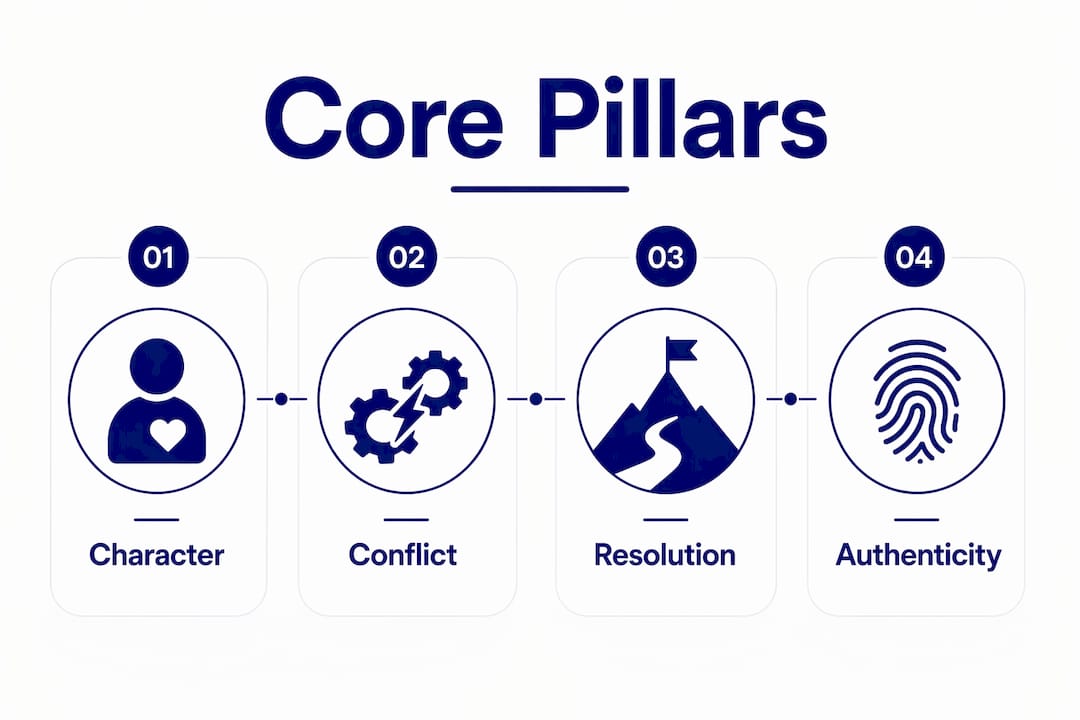
Character gives the audience someone to follow. That character is almost never the brand itself. Conflict creates tension that makes the story worth following. Without a genuine problem to solve, there is no reason to keep reading or watching. Resolution delivers the payoff, showing how the conflict was overcome. Authenticity is what makes the other three believable.
The most common structural mistake is what practitioners call the hero’s trap. Brands cast themselves as the protagonist, the hero who saves the day. The customer becomes a passive bystander. This approach consistently underperforms because customers do not see themselves in the story. The brand’s correct role is the guide or catalyst. The customer is the hero. The brand gives them the tools, knowledge, or confidence to succeed.
Specificity is what separates authentic storytelling from polished fiction. Authenticity requires real names, specific locations, and actual documentation rather than stock imagery. Younger audiences in particular detect inauthentic narratives quickly. A customer story set in “a busy city” with a stock photo carries no weight. The same story set in Leeds, featuring a named individual and a real outcome, carries significant credibility.
Pro Tip: When gathering customer stories, ask for a specific before-and-after metric. “We increased repeat orders by 30% in three months” is a story. “We saw great results” is not.
How does storytelling differ from traditional brand advertising?
Storytelling and advertising serve different functions in a brand’s communications mix. Conflating them leads to poor measurement and misaligned expectations. Advertising optimises for immediate response: clicks, conversions, cost per acquisition. Storytelling optimises for sentiment, share of voice, and organic word of mouth.
Storytelling is a long-term brand trust builder unlike transaction-focused advertising. That distinction matters when you are justifying budget. A storytelling campaign will rarely show a clean return on investment in the first four weeks. Its value compounds over time as brand recall, loyalty, and advocacy grow.
The table below clarifies the operational differences:
| Dimension | Brand storytelling | Traditional advertising |
|---|---|---|
| Primary objective | Emotional connection and trust | Immediate conversion or response |
| Key metrics | Sentiment, share of voice, recall | Click-through rate, cost per acquisition |
| Time horizon | Long-term, ongoing | Short-term, campaign-based |
| Audience role | Active participant in narrative | Passive recipient of message |
| Content type | Narrative, character-driven | Feature-led, offer-driven |
The practical implication is that storytelling requires a different approval process. Campaigns measured purely on direct response KPIs will always make storytelling look underperforming. The measurement framework must match the objective.
Pro Tip: Present storytelling initiatives to leadership with a separate measurement dashboard. Mixing sentiment metrics with cost-per-acquisition data in one report creates confusion and undermines the case for narrative investment.
How to implement brand storytelling across your organisation
Effective implementation starts with a documented story foundation. Brand storytelling requires a documented story foundation to prevent narrative drift across teams. Without it, different departments tell different versions of the brand story. Sales says one thing, marketing says another, and the customer receives a fragmented experience.
A story foundation typically covers four elements:
- Origin narrative. Why the brand exists, told through a specific moment or decision rather than a mission statement. Brand storytelling is about discovery, not invention. The real story already exists in your brand’s history and customer relationships. Your job is to find it.
- Customer hero profiles. Documented portraits of the customers whose transformation the brand enables. These are not demographic segments. They are named archetypes with real challenges and real goals.
- Channel story map. A guide showing which story formats work on which channels. Long-form narrative suits editorial and video. Micro-stories suit social. The core narrative stays consistent; the format adapts.
- Measurement framework. Agreed metrics for tracking storytelling performance over time, separate from direct response KPIs.
Consistency across video, written content, and social channels is what makes storytelling mechanically effective. Frequency matters too. A single well-crafted story published once has limited reach. The same story told consistently across channels, updated with new customer examples, builds cumulative brand equity.
Real customer and employee stories are the most powerful source material. Brand storytelling can increase job applicant volume by up to 10x compared to brands that do not use narrative in their employer communications. That figure illustrates how storytelling extends well beyond marketing into talent acquisition and internal culture.
For practical guidance on building your narrative foundation, the Michaelbell resource on revitalising brand storytelling covers the structural elements in detail. You can also explore how to align brand strategy with wider business objectives to ensure your storytelling investment connects to measurable commercial goals.
How do you measure the impact of brand storytelling?
Measuring storytelling success requires a different toolkit from standard campaign reporting. The metrics that matter are:
- Sentiment analysis. Track the emotional tone of brand mentions across social media, reviews, and press coverage. A shift from neutral to positive sentiment over three to six months indicates storytelling is working.
- Share of voice. Monitor how much of the category conversation your brand owns compared to competitors. Growing share of voice without proportional ad spend increase signals organic narrative traction.
- Organic word of mouth. Measure unprompted brand mentions and referral traffic. These are the clearest indicators that customers are retelling your story independently.
- Brand recall. Use periodic surveys to test unaided brand recall within your category. Recall growth over time is a direct measure of narrative penetration.
- Loyalty and repeat behaviour. Track repeat purchase rates, subscription renewals, and customer lifetime value alongside storytelling activity.
Storytelling strategies should be measured with sentiment, share of voice, and organic word of mouth rather than direct response metrics. Cost per acquisition is the wrong lens for evaluating a discipline designed to build trust over time. Applying it will consistently produce misleading conclusions and erode internal support for narrative investment.
Key takeaways
Effective brand storytelling is a documented, ongoing discipline that builds emotional connection, trust, and differentiation by placing the customer as the hero of the narrative.
| Point | Details |
|---|---|
| Storytelling outperforms advertising | Narrative-led campaigns improve brand perception by 38% and differentiation by 55% over traditional advertising. |
| Four pillars are non-negotiable | Character, conflict, resolution, and authenticity must all be present for a story to carry genuine impact. |
| The brand is the guide, not the hero | Placing the customer at the centre of the narrative consistently outperforms brand-centric storytelling approaches. |
| Document your story foundation | A written narrative foundation prevents drift and keeps all teams telling the same brand story. |
| Use the right measurement framework | Measure storytelling with sentiment, share of voice, and recall. Direct response metrics will always misrepresent its value. |
Why most brand stories fail before they start
I have worked with marketing teams who invest real time and budget into storytelling, then wonder why it does not move the needle. The answer is almost always the same. The story is about the brand, not the customer.
The hero’s trap is genuinely the most common and most damaging mistake in brand communications. I see it in brand films, case studies, and social content every week. The brand overcomes a challenge. The brand innovates. The brand leads. The customer is somewhere in the background, nodding along. That structure does not create connection. It creates distance.
The second failure pattern is treating storytelling as a campaign. A brand launches a beautifully produced film in october, gets some engagement, and then moves on to the next quarter’s promotion. The story dies. Storytelling only compounds in value when it is consistent and frequent across channels. One great story, told once, is a missed opportunity.
What I find genuinely exciting about the current moment is that authenticity in branding has become a measurable commercial advantage, not just a creative preference. Audiences in 2026 are sophisticated. They respond to real names, real places, and real outcomes. They disengage from polished fiction. That shift actually makes the storyteller’s job easier. You do not need to invent anything. You need to find the real story that already exists in your brand and your customers’ experiences, and then tell it consistently.
The brands that get this right treat storytelling as infrastructure, not decoration. It sits inside their brand communications strategy, informs every channel, and gets updated with new customer evidence regularly. That is the standard worth working towards.
— Calum
How Michaelbell supports brand storytelling strategy
Michaelbell works with marketing teams who know their brand has a compelling story but are not yet telling it consistently or effectively. We help develop the narrative foundations, customer journey mapping, and channel frameworks that turn scattered communications into a coherent brand voice.
Our brand communications services cover everything from story foundation development to full campaign execution, with the embedded partnership approach that means you get dedicated expertise without the overhead of an in-house team. If you want to build storytelling into the core of your brand rather than bolt it on as a campaign extra, we would love to talk. Visit our customer journey page to see how we map narrative to every stage of the customer experience.
FAQ
What is the role of storytelling in branding?
Brand storytelling communicates a brand’s identity, mission, and values through authentic narrative, creating emotional connection and long-term loyalty. It differentiates brands in crowded markets where product features alone cannot do so.
How does storytelling improve brand perception?
Research shows storytelling improves brand perception by an average of 38% over traditional advertising, with a 55% improvement in differentiation. The mechanism is emotional engagement, which drives trust and organic advocacy.
What are the four pillars of effective brand storytelling?
The four pillars are character, conflict, resolution, and authenticity. Missing any one pillar causes the story to lose impact and become mere entertainment.
How should you measure brand storytelling success?
Measure storytelling with sentiment analysis, share of voice, organic word of mouth, and brand recall rather than direct response metrics like cost per acquisition. These metrics capture long-term trust and loyalty growth.
Why should the brand be the guide, not the hero?
Placing the brand as the guide and the customer as the hero highlights customer transformation more effectively. Audiences connect with stories where they see themselves as the protagonist, not the brand.