
The role of vision in brand building

Brand vision is defined as the long-term aspirational future state a company commits to pursuing, and it is the single most powerful force in brand building. Without it, marketing becomes a series of disconnected tactics rather than a coherent strategy. The role of vision in brand building goes far beyond a framed statement on the office wall. It shapes every decision, from the tone of a campaign to the markets you choose to enter. Critically, 61% of employees are unaware of their company’s mission and vision, yet 62% say working for an organisation that creates a positive impact is a priority. That gap is where brands lose both talent and customer trust.
How does a clear brand vision influence brand identity and customer loyalty?
Brand vision conveys purpose that goes well beyond products or services. Customers do not buy what you make. They buy what you stand for and where you are going. A compelling vision gives them a reason to stay loyal even when a competitor offers a lower price or a shinier feature.

Aligned vision transforms marketing into a unified strategy rather than a collection of campaigns. When every piece of communication reflects the same future-oriented purpose, customers receive a consistent message across every touchpoint. That consistency builds trust, and trust builds loyalty.
The mechanisms through which vision drives brand identity include:
- Emotional resonance. A compelling brand vision energises employees and resonates emotionally with customers, deepening loyalty over time.
- Messaging coherence. Vision acts as a filter for every creative decision, keeping tone, language, and imagery aligned across channels.
- Decision clarity. Leaders use vision to decline opportunities that do not fit, which keeps the brand focused and credible.
- Internal alignment. When teams understand the destination, they make better daily decisions without needing constant direction from above.
“Vision is the bridge between internal alignment and external brand identity. Without it, marketing strategy fragments, and customers sense the inconsistency even when they cannot name it.”
The practical implication is direct. Brands that articulate a clear vision give their marketing teams a shared reference point. Every campaign, product launch, and customer communication pulls in the same direction. The result is a brand that feels coherent, trustworthy, and worth returning to. For a deeper look at how this works in practice, the role of storytelling in branding shows how narrative and vision combine to build lasting brand identity.
What distinguishes an effective brand vision statement from mission and values?
The three terms are frequently confused, and that confusion costs brands clarity. Each element serves a distinct purpose.
| Element | Focus | Time horizon | Example purpose |
|---|---|---|---|
| Vision | Aspirational future state | 3–5 years and beyond | Where we are going |
| Mission | Present operational purpose | Now | What we do and for whom |
| Values | Guiding principles | Permanent | How we behave along the way |
Vision is future-oriented and motivational. Mission is operational and present-tense. Values are the non-negotiable principles that govern behaviour regardless of market conditions. Conflating them produces statements that are neither inspiring nor useful.
Effective brand visions typically target outcomes 3–5 years into the future, acting as a directional North Star. That time horizon is deliberate. It is close enough to feel achievable and far enough to demand genuine ambition. A vision that describes next quarter’s targets is a plan, not a vision.
A strong vision statement shares three qualities: simplicity, clarity, and memorability. If your leadership team cannot recall it without checking a document, it is not doing its job. The statement should be short enough to say in one breath and specific enough to rule things out, not just in.
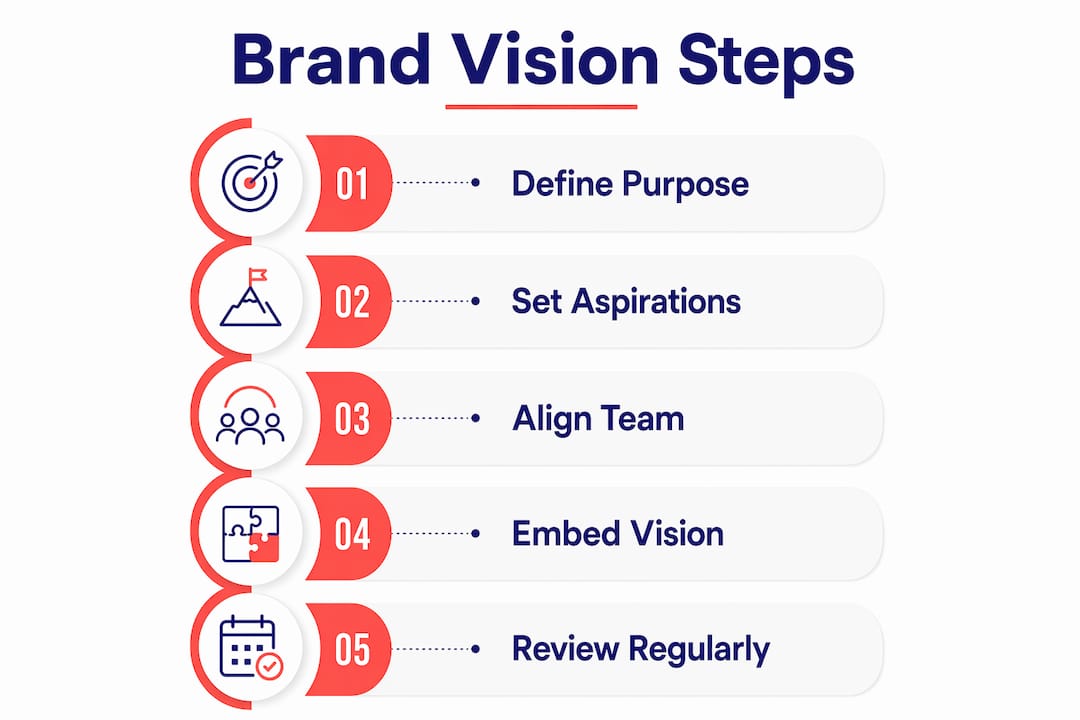
Treating the vision statement as a living document is critical. Without periodic review, it risks becoming a static slogan that employees ignore and customers never see. Markets shift, customer expectations evolve, and a vision that made sense in 2020 may need sharpening for 2026.
Pro Tip: Schedule a vision review every 18–24 months with your senior leadership team. Ask one question: does this still describe where we genuinely want to go? If the answer is uncertain, it is time to rewrite it.
How can business leaders and marketers craft and embed a compelling brand vision?
Creating a brand vision is not a branding exercise. It is a leadership exercise that happens to produce a branding asset. The process matters as much as the output.
- Start with future impact, not current capability. Ask where you want the brand to stand in 3–5 years and what difference you want to make. Capability follows ambition, not the other way around.
- Involve leadership and key employees early. Vision created in isolation by a chief executive rarely lands. When people contribute to the vision, they own it. Ownership drives the behaviour that makes vision real.
- Test it against real decisions. A useful vision acts as a filter. Present your draft vision alongside three real strategic choices your business faces. If the vision does not help you decide, it is too vague.
- Translate vision into KPIs. Connecting vision to daily KPIs and performance reviews prevents it from becoming an abstract concept. Each team should be able to point to at least one metric that reflects progress toward the vision.
- Communicate it relentlessly and consistently. Vision fades without repetition. Embed it in onboarding, team meetings, campaign briefs, and annual reviews. The goal is for every person in the organisation to be able to articulate it unprompted.
A common pitfall is over-complexity. Leaders sometimes try to capture every nuance of their ambition in a single statement, producing something that reads like a legal document. The best visions are almost uncomfortably simple. That simplicity is a feature, not a weakness.
Pro Tip: When embedding vision into your marketing team’s workflow, add a single question to every campaign brief: “How does this campaign move us closer to our vision?” It takes ten seconds and keeps creative work anchored to purpose.
For practical guidance on connecting vision to wider brand goals, the brand strategy alignment guide is worth your time.
What measurable benefits does a well-communicated vision bring to brand building?
The business case for investing in vision clarity is well supported. The outcomes span employee performance, customer retention, and marketing effectiveness.
| Benefit area | Outcome |
|---|---|
| Team performance | Vision-linked goals improve performance by 20–25% |
| Employee engagement | Teams with clear vision show stronger retention and motivation |
| Brand consistency | Aligned vision produces coherent messaging across all channels |
| Customer loyalty | Emotionally resonant vision deepens long-term customer connection |
| Strategic focus | Vision as a decision filter reduces costly strategic drift |
Teams that set clear goals inspired by vision perform 20–25% better than those without. That performance gap compounds over time, producing brands that grow faster and waste less resource on misdirected effort.
The link between brand vision and growth is not accidental. A vision that is aspirational yet achievable motivates teams without setting impossible targets. The balance matters. A vision that feels out of reach demoralises rather than energises.
“The brands that endure are not the ones with the biggest budgets. They are the ones where every person, from the chief executive to the newest recruit, can tell you exactly where the company is going and why it matters.”
For marketers, the practical benefit is consistency. When vision is clear, campaign briefs write themselves more easily. Creative teams have a reference point. Approval processes speed up because everyone is judging work against the same standard. The visual storytelling approach to brand communications shows how vision-aligned creative work produces stronger audience engagement.
Key takeaways
A clear, embedded brand vision is the single most effective tool for aligning internal teams, shaping brand identity, and building the customer loyalty that sustains long-term growth.
| Point | Details |
|---|---|
| Vision defines direction | Brand vision sets a 3–5 year aspirational future state that guides every strategic and creative decision. |
| Vision drives loyalty | Emotionally resonant vision deepens customer connection and keeps audiences engaged beyond price or product. |
| Vision differs from mission | Mission describes present purpose; vision describes future ambition. Confusing them weakens both. |
| Embed vision operationally | Connect vision to KPIs and performance reviews so it shapes daily behaviour, not just annual presentations. |
| Review vision regularly | Treat vision as a living document and revisit it every 18–24 months to keep it relevant and motivating. |
Why vision is the one thing I never let clients skip
I have worked with enough brands to know the pattern. A business arrives with a positioning problem, a messaging problem, or a campaign that is not converting. We dig in, and within a few weeks the real issue surfaces: nobody in the organisation can agree on where the brand is actually going. The marketing team is pulling in one direction, the sales team in another, and leadership is somewhere else entirely.
Vision work is often the first thing leaders want to skip. It feels abstract when there are quarterly targets to hit. But skipping it is precisely why those targets become harder to hit. Without a shared sense of direction, every campaign becomes a negotiation rather than an execution. Every creative brief becomes a debate about priorities that should have been settled at a strategic level.
The insight that changed how I approach this comes from treating vision primarily as an internal strategic filter, not an external marketing asset. Most leaders think of vision as something to put on the website. Its real value is in the decisions it prevents. When a new opportunity arrives and the leadership team can quickly ask “does this fit our vision?” and get a clear answer, they avoid the strategic drift that quietly kills brands.
My advice to leaders who are hesitant about investing time in vision work is simple. You are already paying for the absence of it, in wasted campaigns, misaligned teams, and customers who cannot tell you what you stand for. The time spent getting vision right is not a cost. It is the highest-return investment in your brand’s future.
— Calum
Michaelbell: brand communications built around your vision
Michaelbell works with marketing teams and business leaders who know their brand has more potential than their current communications are delivering.
We specialise in brand communications that connect your vision to every customer touchpoint, from campaign creative to internal alignment. Our team embeds with yours, which means we understand your direction before we write a single word or design a single asset. The result is communications that feel coherent, purposeful, and genuinely on-brand. If your vision is clear but your communications are not reflecting it, or if you are still working out what your vision should be, we would love to talk. Visit our services page to see how we work.
FAQ
What is a brand vision and why does it matter?
A brand vision is a clear, aspirational statement of where a company intends to be in the future, typically 3–5 years ahead. It matters because it aligns internal teams, guides strategic decisions, and gives customers a compelling reason to stay loyal.
How does brand vision differ from brand mission?
Brand vision describes the future state a company is working toward, while brand mission describes its present purpose and what it does today. Both are necessary, but they serve different functions and should never be merged into a single statement.
How often should a brand vision be reviewed?
A brand vision should be reviewed every 18–24 months to remain relevant as markets and customer expectations shift. Treating it as a living document prevents it from becoming an ignored slogan.
Can a clear brand vision improve employee performance?
Teams that set goals directly linked to a clear vision perform 20–25% better than those without that connection. Vision gives employees a meaningful context for their daily work, which drives both motivation and output.
How do you embed brand vision into day-to-day marketing?
Add vision as a reference point in every campaign brief and connect it to measurable KPIs. When teams evaluate creative work and strategic choices against the vision regularly, it becomes part of how the brand operates rather than an aspirational afterthought.