
What is a brand communications strategy?

A brand communications strategy is a structured plan that defines how a business consistently conveys its purpose, values, and messages to build trust and recognition with its audience. In practice, it covers everything from your tone of voice and messaging framework to the channels you use and how your internal team shows up. 81% of consumers cite trust as a prerequisite for purchase. That single statistic tells you everything about why a deliberate approach to brand communication is not optional. The industry term you will encounter most often is “brand communication strategy,” and it sits at the intersection of brand marketing strategy, PR, content, and internal alignment.
What is a brand communications strategy made of?
A brand communications strategy answers three core questions every audience asks: what is this brand, is it for me, and can I trust it? Get those three answers right, and everything else follows. Miss any one of them, and even the most creative campaign will underperform.
The foundational building blocks are:
- Brand purpose and mission. Your strategy must start here. Purpose is the “why” that gives every message its direction. Without it, communication becomes noise.
- Audience identification and segmentation. Knowing who you are speaking to shapes every word you write. A B2B SaaS audience and a consumer lifestyle audience require entirely different registers, channels, and proof points.
- Messaging framework. This is your core message, your value proposition, and the supporting claims that back it up. Think of it as the architecture beneath every piece of content you produce. A strong messaging framework keeps every team member, agency, and partner aligned.
- Tone and voice. Tone shifts with context. Voice stays consistent. A brand can be warm in a social post and authoritative in a white paper, but the underlying personality should always be recognisable.
- Channel selection. Owned media (your website, email), earned media (PR, word of mouth), and paid media (advertising, sponsored content) each play a distinct role. Choosing the right mix depends entirely on where your audience actually spends their attention.
Pro Tip: Before selecting any channel, write your core message in one sentence. If you cannot do that, your strategy is not ready to execute.
Strong brand communication builds gradually through clarity, consistency, authenticity, and alignment across every touchpoint. That means the work you do on these foundational elements compounds over time.

Which channels are integral to an effective brand communication plan?
Effective brand communication requires coordinating at least eight key types of communication channels for consistent messaging. That is not a suggestion. Brands that rely on one or two channels leave significant trust and recognition on the table.
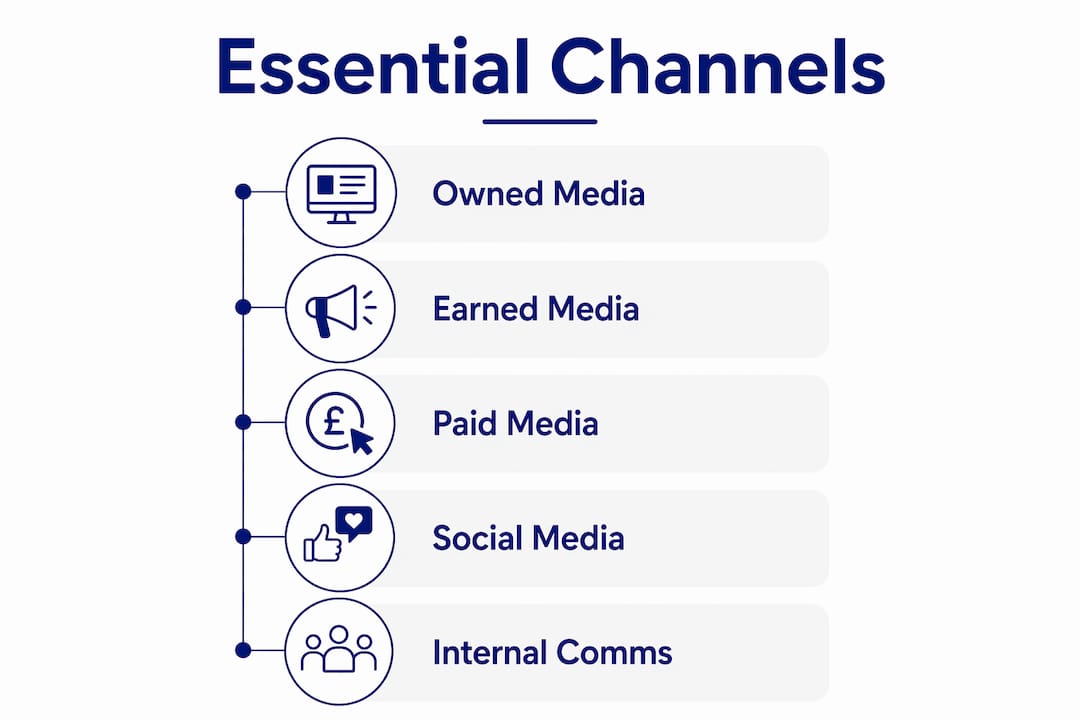
The eight core channel types and their primary roles are:
| Channel | Role in brand communication |
|---|---|
| Social media | Real-time engagement, personality, community building |
| Public relations | Third-party credibility, reputation management |
| Content marketing | Education, SEO, long-form trust building |
| Internal communications | Team alignment, consistent brand delivery |
| Customer service | Lived brand experience at every touchpoint |
| Sponsorship | Audience association, values signalling |
| Influencer marketing | Peer-to-peer trust, audience reach extension |
| Corporate social responsibility | Values in action, long-term brand equity |
The distinction between owned, earned, and paid media matters here. Owned channels give you control. Earned channels give you credibility. Paid channels give you reach. A mature brand communication plan uses all three in proportion to its goals and audience habits.
Integration is where most brands fall short. A PR story that contradicts your social tone, or a customer service script that sounds nothing like your website copy, creates friction. Audiences notice inconsistency even when they cannot name it. The result is reduced trust and lower conversion.
Pro Tip: Audit your last five customer touchpoints across different channels. If they do not feel like they come from the same brand, your integration work starts there.
Choosing channels aligned with audience habits is more important than being present everywhere. A B2B brand with a senior leadership audience will get more traction from LinkedIn and thought leadership PR than from TikTok. Prioritise depth over breadth.
How does internal alignment influence brand communication effectiveness?
Internal alignment is the hidden first step for any successful brand communication strategy. Auditing internal team alignment before launching campaigns is what separates brands that communicate coherently from those that contradict themselves in public.
The risks of skipping this step are real:
- Cognitive friction. When your advertising promises one thing and your customer service delivers another, audiences experience subconscious dissonance. Mismatch between brand promise and actual experience damages trust even when the creative work is excellent.
- Inconsistent employee advocacy. Your team is a communication channel. If they do not understand or believe in the brand message, they will not carry it authentically in client conversations, social posts, or day-to-day interactions.
- Leadership misalignment. Senior leaders set the tone for how a brand behaves internally. If leadership communication contradicts the external brand narrative, the gap becomes visible to customers and talent alike.
Internal communications is not a support function. It is a strategic one. Brands that invest in internal comms alignment before external campaigns find that their messaging lands with greater authenticity because the people delivering it genuinely believe it.
The practical implication is straightforward. Before you brief an agency or approve a campaign, ask whether your internal team can articulate your brand promise in their own words. If they cannot, the external work will carry that gap into every market it touches.
What common challenges occur with brand communication?
Brand communication fails in predictable ways. Recognising these patterns early saves significant time, budget, and reputation.
- Complexity in messaging. Brands often try to say too much. Saying less but saying it well improves both brand recall and trust. In a saturated market, a clear and simple message repeated consistently outperforms a complex one delivered loudly.
- Treating strategy as a static document. A brand communication plan is a living document. Avoiding static strategy means revisiting your messaging as market conditions, audience expectations, and competitive context evolve. Brands that set and forget their strategy find it drifts out of alignment with reality.
- Inconsistent tone across contexts. Consistency does not mean sounding identical everywhere. It means maintaining a recognisable personality while adapting register to context. A brand that sounds robotic on social media because it is copying its press release tone has confused consistency with rigidity.
- Over-sharing in the name of authenticity. Authenticity in branding builds trust and growth, but it requires judgement. Sharing every internal challenge or opinion in public can undermine the confidence audiences need to trust you with their business.
- Failing to measure and refine. Using engagement rates, conversion data, and audience feedback to adjust your strategy keeps it relevant. Brands that do not measure their communication effectiveness are making decisions based on assumption rather than evidence.
Pro Tip: Set a quarterly review date for your brand communication plan. Treat it like a financial review. Check what is working, what has shifted in your audience, and what needs updating.
The brands that get this right treat their communication strategy as a discipline, not a deliverable. They build review cycles into their planning calendar and assign ownership to specific people. If you want to understand when your strategy needs a refresh, the signals are often visible before a crisis forces the conversation.
Key takeaways
A brand communications strategy works when it aligns purpose, messaging, channels, and internal culture into a single, consistent, and measurable plan.
| Point | Details |
|---|---|
| Trust is the foundation | 81% of consumers require trust before purchase, making structured communication non-negotiable. |
| Internal alignment comes first | Audit your team’s understanding of the brand promise before launching any external campaign. |
| Eight channels, not one | Coordinating social media, PR, content, internal comms, and more creates consistent brand presence. |
| Clarity beats complexity | A simple message repeated consistently outperforms a complex one delivered at volume. |
| Strategy must evolve | Review your brand communication plan quarterly using engagement and conversion data. |
Why I think most brand communication strategies fail before they launch
I have worked with marketing teams who have produced genuinely impressive brand communication plans. Beautifully designed, thoroughly researched, strategically sound on paper. And then they go nowhere. The reason is almost always the same: the strategy was built for the boardroom, not for the people who have to deliver it.
The most common mistake I see is treating brand communication as a creative brief rather than an organisational discipline. You can have the sharpest messaging framework in your sector, but if your sales team is still using last year’s pitch deck and your customer service team has never read the brand guidelines, the strategy exists only in a document.
What actually works is starting inside out. Get your internal team aligned on the brand promise before you spend a penny on external channels. Then build your messaging framework around what your audience genuinely needs to hear, not what you want to say. The difference sounds subtle. In practice, it changes everything.
I also think brands underestimate the power of repetition. There is a tendency to refresh messaging too frequently in pursuit of relevance. But recognition builds through repetition. The brands with the strongest communication are often the ones that have been saying the same core thing, in slightly different ways, for years. That takes discipline. It is worth it.
If you are building or reviewing your strategy right now, start with one question: can every person in your organisation explain what your brand stands for in thirty seconds? If not, that is your first project.
— Calum
How Michaelbell can help you build a strategy that sticks
Building a brand communications strategy that actually works across every channel and every team is a significant undertaking. Michaelbell specialises in exactly this. We work with marketing teams and business leaders to develop messaging frameworks, align internal culture with external communication, and create plans that hold together under real-world pressure.
We are not a traditional agency. We operate as an extension of your team, which means we care about the same things you do: clarity, consistency, and results. Whether you are starting from scratch or refining an existing approach, our brand communication services are built to deliver strategy that your whole organisation can get behind. Get in touch and we will get straight back to you.
FAQ
What is a brand communications strategy in simple terms?
A brand communications strategy is a structured plan defining what a brand says, how it says it, and where it says it to build trust and recognition with its audience. It covers messaging, tone of voice, channel selection, and internal alignment.
Why is brand communication important for business growth?
81% of consumers require trust before making a purchase. Consistent, clear brand communication builds that trust over time, directly influencing conversion rates and long-term loyalty.
What are the main types of brand communication strategies?
The main types include content marketing, PR, social media, internal communications, customer service, sponsorship, influencer marketing, and corporate social responsibility. An effective plan integrates all eight rather than relying on one or two.
How often should a brand communication plan be reviewed?
A brand communication plan should be reviewed at least quarterly. Use engagement rates, conversion data, and audience feedback to identify what needs updating, as static strategies quickly fall out of alignment with market reality.
What is the difference between brand voice and brand tone?
Brand voice is the consistent personality your brand expresses across all communication. Brand tone shifts with context, for example, warmer on social media and more authoritative in a white paper, while the underlying voice remains the same.