
What is strategic brand identity? a leader’s guide

Strategic brand identity is the visible and verbal system that translates a company’s strategy into a cohesive, recognisable brand presence. It is not a logo exercise or a colour refresh. It is the deliberate expression of what your business stands for, who it serves, and how it wants to be perceived, made tangible through every visual and verbal touchpoint. For business leaders, marketing professionals, and entrepreneurs, understanding what is strategic brand identity is the foundation of effective market positioning. Get it right, and you build brand equity, command premium pricing, and create consistent customer experiences that compound over time.
What are the core elements of strategic brand identity?
Strategic brand identity consists of seven core elements: name, logo, colour palette, typography, photography style, voice and tone, and application rules. Each element plays a specific role. Together, they form a system that others inside your organisation and external partners can execute consistently.
Here is what each element does in practice:
- Name and logo are your primary identifiers. They are the first things a customer recognises and the last things you should change without strong strategic justification.
- Colour palette creates immediate visual recognition. Brands like Barclays and Cadbury have built such strong colour associations that their palettes are legally protected.
- Typography signals personality before a single word is read. A serif font communicates heritage and authority; a geometric sans-serif signals modernity and clarity.
- Photography and illustration style set the emotional tone of your brand. A financial services firm using warm, candid photography communicates approachability. The same firm using cold, clinical imagery signals precision.
- Voice and tone are the verbal equivalents of your visual choices. Voice is consistent; tone adapts to context. Your brand might always be direct and confident, but warmer in a customer service interaction than in a press release.
- Application rules are the instructions that prevent visual drift. They specify how elements combine across channels, from digital adverts to printed brochures to internal presentations.
Pro Tip: Document your application rules in a living brand guidelines document, not a PDF that sits in a shared drive. A digital-first guidelines hub means your team and agency partners always work from the current version.
Brand identity is a system, not just a logo. The moment you treat it as a collection of individual assets rather than an interconnected system, inconsistency follows.
How does strategic brand identity differ from brand strategy?
Brand strategy and brand identity are related but distinct. Confusing them is one of the most expensive mistakes a business can make.

Brand strategy defines the conceptual foundations of your brand. It answers four questions: where do you sit in the market, who are you serving, what makes you different, and what personality do you project? Brand strategy is the thinking. It lives in documents, workshops, and leadership decisions.
Brand identity is the expression of those decisions. It translates positioning, audience insight, differentiation, and personality into a visual and verbal system that stakeholders can see, hear, and experience. Strategy must exist before identity work begins. Starting identity creation before brand strategy is clear produces aesthetics without direction and rules without rationale.
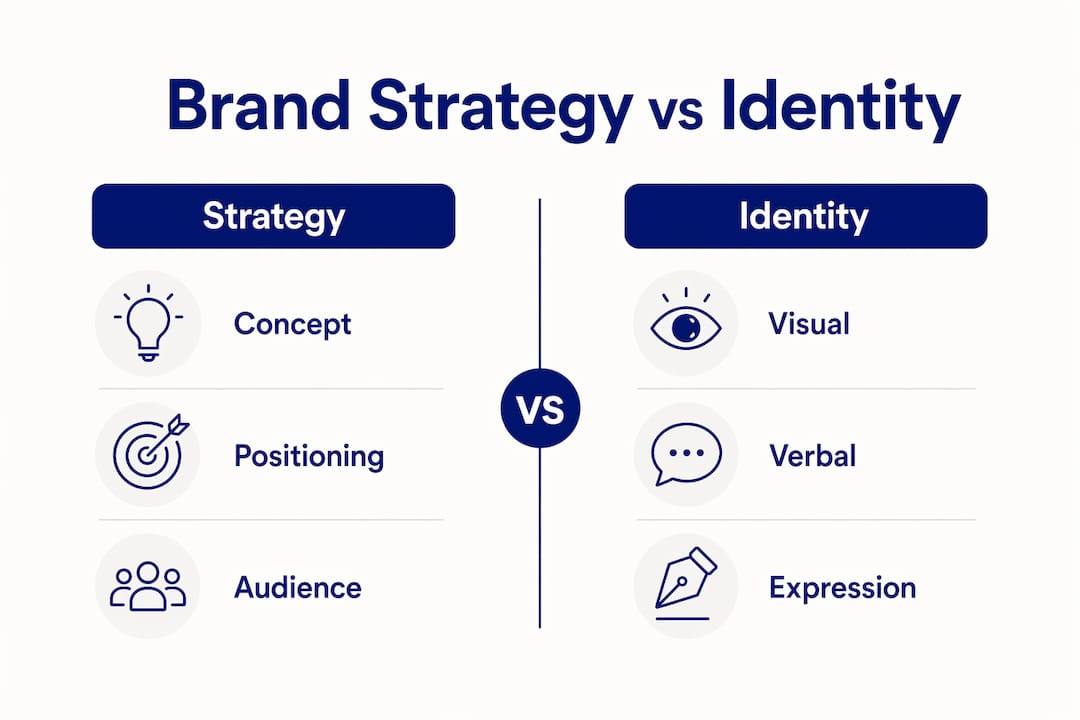
| Dimension | Brand Strategy | Brand Identity |
|---|---|---|
| What it is | The thinking and positioning decisions | The visual and verbal expression of those decisions |
| Key outputs | Positioning statement, audience definition, personality | Logo, colour palette, typography, voice guidelines |
| Who owns it | Senior leadership and marketing directors | Design teams, brand managers, agency partners |
| When it happens | Before identity work begins | After strategy is defined and agreed |
| Risk if skipped | Identity lacks direction and coherence | Strategy remains abstract and invisible to customers |
Strategic Brand Design translates business strategy into brand systems that support both internal and external communication. The downstream output of both strategy and identity is your brand guidelines document, which codifies the rules for consistent application. Think of strategy as the brief, identity as the creative response, and guidelines as the production manual.
A common mistake is treating a brand refresh as a substitute for strategic clarity. Updating your logo without revisiting your positioning is decoration, not strategy.
Why is strategic brand identity important for business?
Companies with strong brand identities can charge premium prices due to the perceived value customers associate with consistent, trustworthy brands. That is not a marketing claim. It is a commercial reality that shows up in margin, retention, and competitive resilience.
Brand identity functions as business infrastructure. Consider what happens without it. Marketing teams produce inconsistent materials. Sales teams describe the product differently to different prospects. New employees struggle to understand what the company stands for. Agency partners interpret the brief in conflicting ways. Each of these is a direct cost, whether measured in wasted creative budget, lost deals, or confused customers.
The business case for investing in defining brand identity is clear:
- Brand equity grows when customers consistently recognise and trust your brand. That equity tolerates minor service failures and supports price premiums that competitors without strong identity cannot match.
- Operational efficiency increases when teams have clear application rules. Fewer revision cycles, faster approvals, and lower creative costs are direct results of a well-documented identity system.
- Internal alignment improves when leadership owns the brand. Leaders owning brand identity reduces downstream creative delays and increases business alignment across functions.
- Stakeholder trust builds through consistent experience. Whether a customer encounters your brand on LinkedIn, in a pitch deck, or on a product label, the experience should feel coherent.
A strong brand identity supports loyalty, trust, and competitive advantage by creating consistent customer experience and clear communication. That consistency is not accidental. It is the product of deliberate system design and leadership commitment. For more on how brand consistency drives growth, the evidence is compelling across sectors and business sizes.
How do you develop a strategic brand identity?
Developing a strong brand identity follows a clear sequence. Skipping steps is where organisations lose time and money.
-
Define your brand strategy first. Conduct audience research, competitive analysis, and internal workshops to agree on positioning, differentiation, and personality. This is not a design brief. It is a business decision. Your identity cannot be coherent if your strategy is not.
-
Engage design professionals with strategic experience. Not all designers build identity systems. Look for partners who ask about your strategy before they open a design tool. The role of external creative in brand development is most valuable when the creative team understands the business context.
-
Build the full system, not just the logo. Commission all seven elements: name, logo, colour palette, typography, photography style, voice and tone, and application rules. A partial system creates partial consistency.
-
Document everything in accessible brand guidelines. Documenting application rules prevents visual drift and supports consistent execution by internal teams and external partners alike. The guidelines should cover digital, print, social, and internal communications.
-
Secure executive alignment before launch. Effective strategic brand identity requires executive alignment and a documented system to ensure consistent application across channels. Without leadership buy-in, brand standards erode quickly.
-
Train your internal teams. Brand guidelines are only useful if people know they exist and understand how to apply them. Run onboarding sessions for new starters and refresher workshops when the brand evolves.
-
Review and refresh regularly. Brand identity is not permanent. Markets shift, audiences evolve, and businesses grow. Schedule a formal brand review every two to three years to assess whether your identity still reflects your strategy.
Pro Tip: When briefing a design agency, share your brand strategy document before the first meeting. Agencies that receive a strategic brief produce work that is more aligned and requires fewer revision rounds. It saves time and budget on both sides.
Brand identity is distinct from brand image, which is how customers actually perceive you. Your identity is what you put out; your image is what they take in. The gap between the two is where brand management work lives. Closing that gap requires both a strong identity system and consistent execution over time. Exploring visual storytelling as part of your identity development can help close that gap faster.
Key takeaways
Strategic brand identity is the deliberate visual and verbal system that expresses business strategy, and it requires leadership ownership, sequential development, and consistent application to deliver commercial results.
| Point | Details |
|---|---|
| Definition is foundational | Strategic brand identity translates business strategy into a seven-element visual and verbal system. |
| Strategy precedes identity | Define positioning, audience, and personality before any design work begins to avoid costly rework. |
| Identity is infrastructure | A documented identity system reduces creative costs, improves team alignment, and builds brand equity. |
| Leadership ownership matters | Executives who own brand identity reduce creative delays and increase consistency across the organisation. |
| Review is ongoing | Formal brand reviews every two to three years keep identity aligned with evolving strategy and markets. |
Brand identity is a leadership decision, not a design task
I have worked with enough businesses to know where brand identity projects go wrong. The pattern is almost always the same. A leader decides the brand looks tired, commissions a design agency, approves a new logo, and calls it done. Six months later, the sales team is still using the old deck, the website has not been updated, and the new identity exists only on the homepage.
The mistake is treating brand identity as a creative output rather than a business system. The most effective brand identities I have seen are the ones where the chief executive or managing director was in the room when the strategy was being defined. Not delegating it to marketing. Not rubber-stamping a design presentation. Actually engaged in the positioning decisions that the identity would need to express.
That leadership involvement changes everything downstream. When the people running the business understand why the colour palette was chosen, why the voice sounds the way it does, and what the brand is trying to communicate, they reinforce it in every meeting, every hire, and every customer interaction. Brand identity scales with the organisation because it is embedded in how leaders think, not just how designers work.
The other thing I would say is this: do not underestimate the internal dimension. External brand communications get most of the attention, but the way your team talks about the brand internally shapes how they represent it externally. Internal alignment and external identity are two sides of the same coin. Get both right, and the brand takes care of itself.
— Calum
How Michaelbell can help you build a stronger brand identity
Michaelbell works with marketing teams and business leaders who know their brand needs to work harder. We connect strategic thinking with creative execution, so your identity reflects your business goals and communicates them clearly to every audience.
Whether you are defining your brand identity from scratch, refreshing an existing system, or aligning your internal and external communications, our team brings the strategic and creative expertise to get it right. We work as an extension of your team, not an outside vendor, which means faster decisions, fewer revision cycles, and a brand system your whole organisation can use with confidence. Explore our brand communications services to see how we approach identity development, or take a look at our customer journey to understand what working with us looks like in practice.
FAQ
What is strategic brand identity in simple terms?
Strategic brand identity is the visual and verbal system that expresses a company’s business strategy to its stakeholders. It includes seven core elements: name, logo, colour palette, typography, photography style, voice and tone, and application rules.
What is the difference between brand identity and brand image?
Brand identity is what a company deliberately puts out through its visual and verbal system. Brand image is how customers actually perceive the brand. The gap between the two is where brand management work focuses.
Why must brand strategy come before brand identity?
Starting identity work before strategy is defined produces aesthetics without direction. Strategy answers the questions of positioning, audience, and differentiation that the identity system must express. Without those answers, design decisions lack rationale.
How long does it take to develop a strategic brand identity?
A thorough brand identity development process, from strategy definition to documented guidelines, typically takes three to six months depending on organisational complexity and the number of stakeholders involved.
Who should own strategic brand identity in an organisation?
Senior leadership should own brand identity, not just the marketing team. Executive alignment ensures the identity is applied consistently across functions and that brand decisions are treated as business decisions rather than creative preferences.