
Why data hygiene directly shapes your marketing accuracy

Poor data hygiene directly undermines marketing accuracy, attribution, targeting, personalisation, and ROI. Gartner estimates the average cost of poor data quality at $12.9 million per organisation annually, and Adverity’s 2025 research found that CMOs estimate roughly 45% of the data their teams use is incomplete, inaccurate, or outdated. That is not a marginal problem. It means nearly half your marketing decisions are built on a foundation that cannot be trusted.
The five most immediate effects on marketing performance:
- Misattributed conversions: broken UTMs and missing source fields push revenue into “direct/none,” hiding which channels actually work.
- Wasted ad spend: duplicate records and stale contacts inflate audience sizes and drive spend toward people who have already converted or no longer exist.
- Poor personalisation: incomplete or inconsistent fields mean segmentation fails before a campaign even launches.
- Lower email deliverability: unvalidated addresses accumulate, bounce rates climb, and sender reputation suffers.
- Faulty segmentation: format mismatches and free-text inconsistencies create phantom segments that distort every downstream report.
Key takeaways
Poor data hygiene directly distorts attribution, inflates costs, and degrades every marketing decision that depends on accurate measurement.
| Point | Details |
|---|---|
| Data decays fast | Contact records decay at roughly 30% per year; without active hygiene, your database is unreliable within 18 months. |
| Attribution depends on clean inputs | Broken UTMs and missing source fields push revenue into “direct/none,” making channel ROI invisible. |
| Audit four metrics first | Duplicate rate, field completeness, attribution match rate, and field validity tell you where to focus remediation effort. |
| Governance prevents recurrence | Named owners, required fields, and ingestion validation stop new errors entering the system. |
| Measure the ROI of cleanup | Track attribution match rate, duplicate rate, and CPA before and after; these are the numbers that justify the investment. |
Table of Contents
- Why data hygiene affects marketing accuracy: definition and scope
- How dirty data breaks your attribution, targeting, and measurement
- Where marketing data most commonly breaks down
- A practical data hygiene framework: audit, clean, govern, monitor
- Which tools and roles own data quality in your team
- What does a data cleanup project actually cost and how long does it take?
- KPIs and dashboards that prove your data quality is improving
- Three measures Michaelbell uses to protect client data accuracy
- The part most teams get wrong about data hygiene
- Sources
Why data hygiene affects marketing accuracy: definition and scope
Data hygiene, in marketing terms, is the continuous process of cleaning, validating, normalising, and deduplicating records across every data source your team touches. That scope is wider than most teams realise. It covers your CRM, marketing automation platform (MAP), analytics stack, ad platforms, first-party web data, offline records, and any third-party enrichment feeds.
A field failure can take several forms: a missing value where one is required, a malformed entry (a phone number in an email field), a duplicate record, or a contact that has not been updated in 18 months. Each type causes a different class of error downstream.
The five standard quality dimensions, mapped to marketing use cases:
- Accuracy: the value is correct. Affects personalisation, deliverability, and conversion attribution.
- Completeness: required fields are populated. Affects segmentation and routing.
- Consistency: the same data is formatted the same way across systems. Affects CRM-to-MAP sync and reporting joins.
- Uniqueness: no duplicate records exist. Affects MQL counts, CPA calculations, and audience sizing.
- Timeliness: records reflect the current state of the contact or account. Affects targeting and suppression lists.
“Sixty-six per cent of B2B marketers rank improving data quality among their top three go-to-market priorities — not because it is a technical nicety, but because it is the prerequisite for every commercial decision that follows.” Integrate and Demand Gen Report
How dirty data breaks your attribution, targeting, and measurement
The mechanisms are specific, and each one maps to a measurable business loss.

Broken UTM tagging is the most common attribution killer. When campaign URLs are built inconsistently, traffic lands in analytics as “direct” or “none.” You cannot optimise what you cannot see, and research on attribution model reliability confirms that timeliness and data quality materially affect the accuracy of multi-touch models.
Duplicate records inflate MQL counts and distort CPA. If a single prospect appears three times in your CRM, your pipeline report overstates demand and your cost-per-acquisition looks artificially low. Contact records decay at roughly 30% per year, and duplicate inflation of key metrics typically runs in the 10–30% range.
Missing source fields mean you cannot close the loop between ad spend and revenue. A lead with no source attached is invisible to attribution models.
Format mismatches between your CRM and MAP break sync jobs silently. A date field formatted differently in two systems means records fail to update, suppression lists fall out of sync, and contacts receive messages they should not.
| Failure type | Metric distorted | Typical impact |
|---|---|---|
| Broken UTMs | Attribution match rate | Revenue misattributed to “direct” |
| Duplicate records | MQL count, CPA | 10–30% metric inflation |
| Stale contacts | Deliverability, audience size | Bounce rate increase, wasted spend |
| Missing source fields | Attribution coverage | Blind spots in channel ROI |
| Format mismatches | CRM-MAP sync, segmentation | Suppression failures, phantom segments |
Data-Axle’s analysis links each of these failure types directly to reduced campaign performance and measurable ROI loss. The pattern is consistent: dirty data does not just produce bad reports. It produces bad decisions made with confidence.
Where marketing data most commonly breaks down
Knowing the failure types is one thing. Knowing where to look first saves weeks of audit time. These are the highest-yield triage points:
- Inconsistent UTM conventions: no shared template means every campaign manager builds URLs differently, fragmenting attribution data from day one.
- CRM-to-MAP sync errors: field mapping mismatches, API rate limits, and schema drift cause records to sync partially or not at all.
- Duplicate contact records: created by form submissions that bypass deduplication logic, manual imports, or multiple system integrations writing to the same database.
- Missing required fields: lead source, lifecycle stage, and consent status are routinely left blank when forms and import templates do not enforce them.
- Free-text fields used where dropdowns belong: “London,” “london,” “LDN,” and “Greater London” are four values for the same thing, and they will never join cleanly.
- Manual spreadsheet imports: the single most reliable way to introduce formatting errors, duplicates, and missing values at scale.
- Weak or absent ingestion validation: data enters the system without any check, so errors compound silently over months.
Operational causes matter as much as technical ones. No named data owner, no agreed naming conventions, and ad hoc integrations built without schema documentation are the conditions in which all of the above thrive.
Pro Tip: The three highest-impact quick wins are: enforce a UTM template at the campaign brief stage, set required fields on every lead capture form, and add an automated validation job that flags records failing format rules at ingestion. None of these require a data engineering team.
A practical data hygiene framework: audit, clean, govern, monitor
This is the sequence that works. Run it as a series of short sprints rather than a single large project.
Step 1: Audit (weeks 1–2)
Measure four things first: duplicate rate, field completeness percentage, source attribution coverage (what proportion of records have a valid lead source), and field validity (how many records fail format rules). These four numbers tell you where the pain is worst.
Step 2: Corrective action (weeks 3–8)
- Deduplicate records using a merge rule that preserves the most complete version.
- Normalise formats: standardise date fields, phone formats, country codes, and lifecycle stage values.
- Validate email addresses and phone numbers against a verification service.
- Close missing fields: backfill lead source from UTM data where available, enrich high-value accounts using a third-party data provider.
- Replace free-text fields with controlled picklists for any field used in segmentation or routing.
Step 3: Governance and prevention (months 2–3)
- Publish a naming convention document and make it part of the campaign brief template.
- Set required fields on all forms, imports, and API integrations.
- Assign a named data owner for each system (marketing ops for the MAP, CRM admin for the CRM, data engineering for pipelines).
- Document every integration’s field mapping and review it quarterly.
Step 4: Monitoring and automation (month 3 onwards)
Automated monitoring is what separates a one-off cleanup from a sustainable programme. HubSpot recommends hygiene dashboards, required fields, and scheduled cleanses as the foundation. Combine those with anomaly alerts (a sudden spike in “direct/none” traffic, a drop in field completeness) and a monthly enrichment cadence for high-value accounts.
Pro Tip: *Prioritise records by commercial value, not raw record count. Score your database by pipeline impact: accounts in active opportunity stages, high-intent leads, and top-tier segments deserve remediation first.
For a practical guide to embedding hygiene into your automation workflows, the marketing automation checklist for SMBs is a useful operational reference.
Which tools and roles own data quality in your team
Tool categories map directly to the framework above. No single platform solves the whole problem.
- CRM (e.g. Salesforce): the master record for contacts and accounts; owns deduplication logic, routing rules, and lifecycle stage management.
- Marketing automation platform (e.g. HubSpot): owns form validation, list segmentation, email deliverability, and campaign attribution fields.
- Email validation and enrichment (e.g. Experian): Experian’s data hygiene tools cover deduplication, verification, and normalisation, linking clean data directly to improved segmentation and ROI.
- ETL and data pipelines: move data between systems with schema enforcement; owned by data engineering or IT.
- CDP (Customer Data Platform): unifies identity across channels; useful for enterprise teams with fragmented data sources.
- Tag management (e.g. Google Tag Manager): controls UTM capture and event tracking at the point of data creation.
- Monitoring and observability tools: flag anomalies in data quality metrics before they corrupt a campaign.
Ownership by role:
- Marketing ops: naming conventions, ingestion rules, MAP configuration, hygiene dashboards.
- CRM admin: deduplication, routing, field mapping, lifecycle stage governance.
- Data engineering/IT: pipeline schema, API integrations, validation jobs.
- Compliance/legal: consent status, data residency, suppression list management.
Pro Tip: If your team lacks a dedicated marketing ops resource, assign data ownership as a named responsibility within an existing role. Ambiguity about who owns the CRM is the single most reliable predictor of data decay.
What does a data cleanup project actually cost and how long does it take?
Realistic expectations matter. Here is a staged view:
- Quick wins (weeks 1–4): UTM template, required fields, basic deduplication pass. Minimal cost; primarily internal time.
- Tactical clean (weeks 4–12): full deduplication, format normalisation, email validation, backfill of missing source fields. Small teams typically spend £2,000–£8,000 on tooling and external support; mid-market teams £10,000–£30,000 depending on database size and integration complexity.
- Governance and automation (months 3–6): naming conventions, ingestion validation, monitoring dashboards, owner assignments. Ongoing tooling costs vary by platform; budget for internal resource time.
- Continuous maintenance (ongoing): monthly enrichment, quarterly field audits, anomaly alert reviews. The lowest-cost phase if governance is in place.
ROI signal metrics to track against investment:
- Reduction in duplicate rate (target: below 5%)
- Improvement in attribution match rate (records with a valid lead source)
- Change in email bounce rate
- Ad spend efficiency: cost per qualified lead before and after cleanup
Analytics-driven marketing consistently shows measurable ROI gains when data quality improves, which makes the cleanup cost straightforward to justify to a CFO.
KPIs and dashboards that prove your data quality is improving
Measurement is what turns a hygiene project into a business case. Track these in two tiers.
Primary KPIs:
Secondary KPIs: time spent on manual data fixes per sprint, number of campaigns launched with incomplete segments, and the proportion of web sessions attributed to “direct/none.”
Adverity’s finding that 45% of marketing data is poor quality gives you a useful benchmark: if your field completeness is below 55%, you are at or below the industry average for dysfunction. That is a number worth putting in front of a board.
Dashboard structure: one panel for data quality KPIs (completeness, duplicate rate, attribution match), one for deliverability (bounce rate, unsubscribe rate), and one for downstream performance (CPA, ROAS, conversion rate). Any drift beyond that threshold warrants an immediate investigation.
For more on testing in data-driven marketing, including how to validate tracking before a campaign goes live, the Michaelbell blog covers the methodology in practical detail.
Three measures Michaelbell uses to protect client data accuracy
At Michaelbell, we have built data hygiene into the campaign process itself rather than treating it as a remediation task after something breaks. Three measures we apply on every engagement:
- UTM governance at brief stage: every campaign brief includes a UTM template with locked parameters for source, medium, campaign, and content. No URL goes live without it. This eliminates the attribution gaps that accumulate when teams build links ad hoc.
- Required field validation before launch: we require lead source, consent status, and lifecycle stage to be populated before any campaign activates. Forms, imports, and API connections are all checked against this rule. HubSpot’s guidance on required fields and hygiene dashboards aligns directly with this approach.
- Pre-launch data validation test: we run a structured check across UTM capture, form field population, CRM sync, and suppression list accuracy before any campaign goes live. It takes less than two hours and has caught attribution-breaking errors on more than one occasion.
Marketing leaders can paste this into a project brief as a pre-launch checklist:
- UTM template confirmed and distributed to all campaign contributors.
- Required fields enforced on all lead capture forms and import templates.
- CRM-to-MAP field mapping reviewed and confirmed.
- Suppression list updated and tested.
- Pre-launch validation job run; results reviewed by marketing ops.
Our customer journey work is built on the same principle: clean data is not a prerequisite we hope clients bring to us. It is something we help establish from the start.
The part most teams get wrong about data hygiene
Most articles on this topic frame data hygiene as a technical problem with a technical solution: buy a CDP, run a deduplication tool, hire a data engineer. That framing is not wrong, but it misses the more important truth.
Data quality is a process problem before it is a technology problem. The organisations with the cleanest data are not the ones with the most sophisticated tooling. They are the ones that decided, at some point, that data ownership is a real job with a real name attached to it. They built naming conventions into their campaign briefs. They made required fields non-negotiable. They treated a broken UTM as a campaign error, not a reporting quirk.
The conventional advice also tends to overweight the cleanup phase and underweight prevention. A one-off deduplication pass feels productive. It is also temporary. Without governance, the same errors return within a quarter. The audit-to-clean sprint is necessary, but the governance layer is what makes it permanent.
For UK marketing teams specifically, there is an additional dimension that rarely appears in US-authored guides: consent status is a data quality field. If your suppression lists are incomplete or your consent records are stale, you are not just running inefficient campaigns. You are running non-compliant ones. That is a different order of risk.
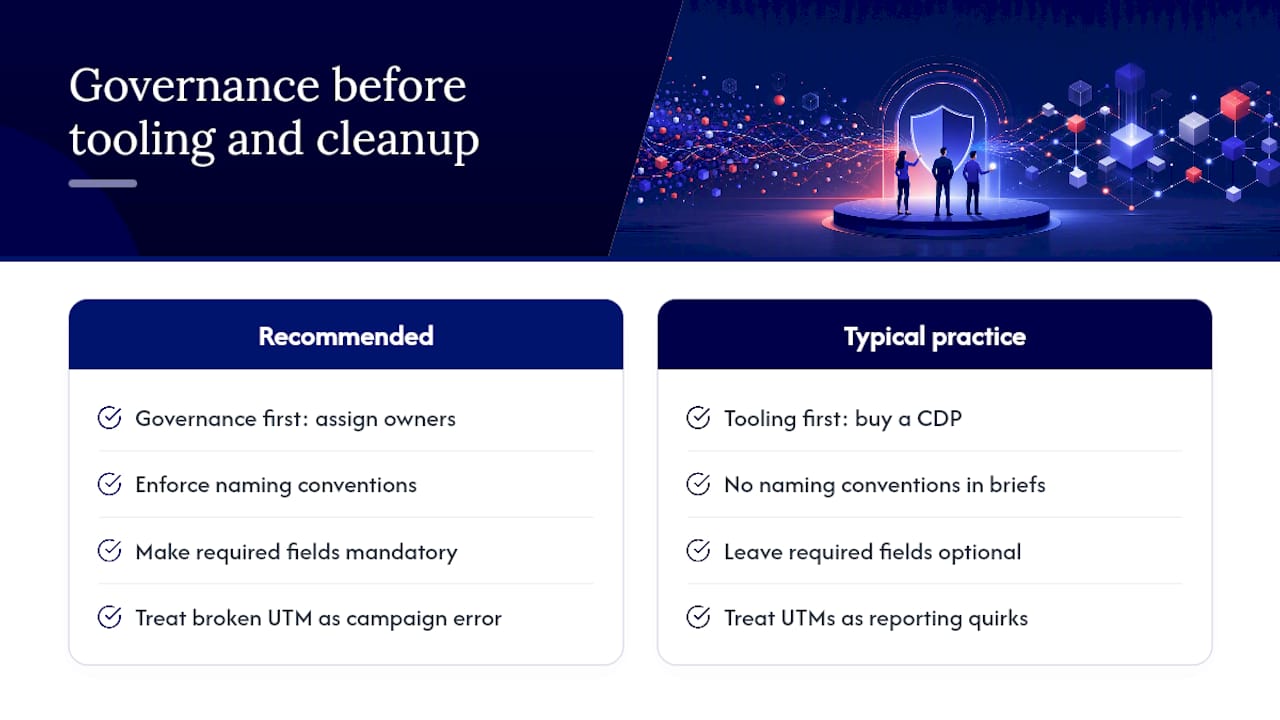
The practical priority order: governance first, tooling second, cleanup third. Most teams do it in reverse, which is why they are back in the same position 12 months later.
Sources
- How to improve your data quality
- Fixing the Foundation: The State of Marketing Data Quality 2025
- How data hygiene improves marketing ROI | Data‑Axle