
Align brand strategy with business goals: 2026 guide

Brand strategy alignment is the practice of connecting every brand decision directly to measurable business outcomes, from revenue growth to market expansion. Without this connection, brand activity becomes decorative rather than functional. The good news is that the frameworks to align brand strategy with business goals exist, they are proven, and they are within reach for any organisation willing to commit to the work. This guide covers the tools, steps, and measurement methods that business leaders and marketers need to make alignment stick.
What does it take to align brand strategy with business goals?
Effective brand strategy alignment starts with clearly defined business objectives. You cannot connect brand activity to outcomes you have not defined. Before any creative work begins, your organisation needs measurable targets: revenue pipeline, market share, customer retention, or new segment penetration.
The most practical tool for this is Marketing OKRs (Objectives and Key Results). The OKR Institute defines Marketing OKRs as a framework that answers what marketing needs to achieve and how success is measured, using quantitative Key Results tied directly to business outcomes. That means every campaign, every piece of content, and every brand touchpoint has a measurable reason to exist.

Brand audits are equally important at this stage. An audit maps the gap between where your brand currently sits in the market and where your business strategy needs it to be. Stakeholder interviews, customer perception research, and competitive analysis all feed into this picture. Without an audit, you are guessing.
Pro Tip: Involve cross-functional teams, including sales, product, and HR, in your brand audit from the start. Brand alignment fails most often when it is treated as a marketing department project rather than an organisational one.
Here is a comparison of the core frameworks and tools used to prepare for brand strategy alignment:
| Framework or tool | Primary purpose | Best used for |
|---|---|---|
| Marketing OKRs | Link brand activity to business KPIs | Setting measurable brand goals |
| Brand audit | Identify gaps between brand and strategy | Baseline assessment |
| Brand Operating System (Brand OS) | Embed brand rules into daily workflows | Operational consistency |
| Stakeholder interviews | Surface internal misalignment | Governance and buy-in |
How do you execute brand strategy alignment step by step?
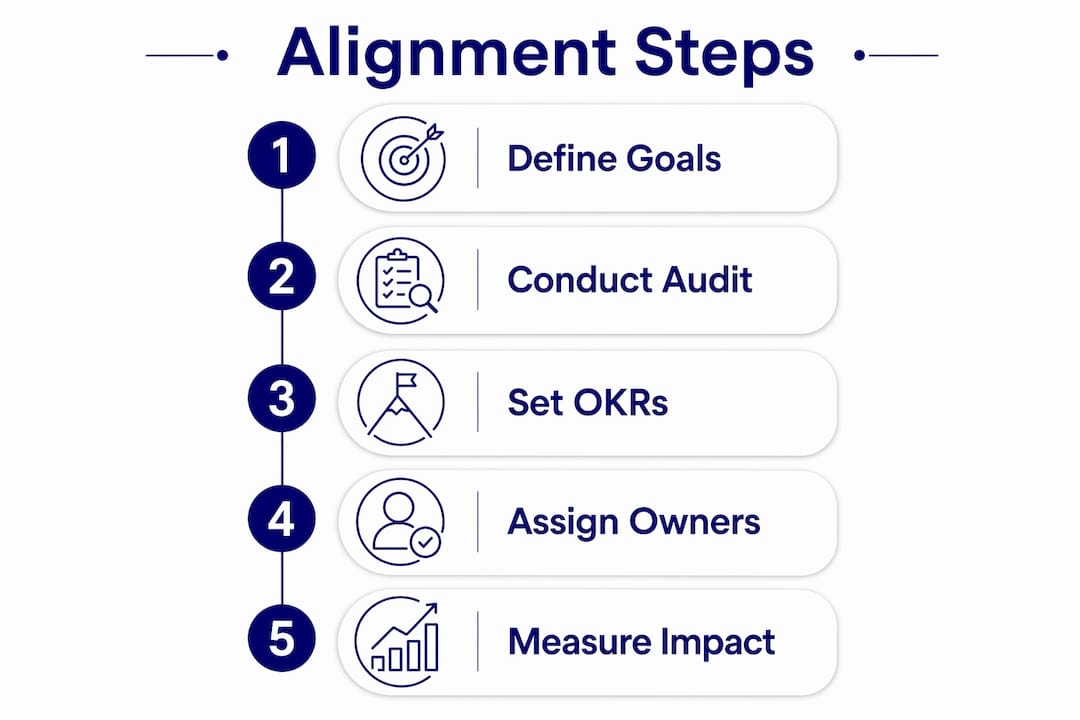
Execution is where most organisations fall short. They complete the audit, set the OKRs, and then return to business as usual. The following steps prevent that outcome.
-
Set inspiring Objectives with measurable Key Results. Each Objective should connect directly to a business need, such as entering a new market or improving customer retention. Each Key Result must be quantitative. “Increase brand awareness” is not a Key Result. “Achieve 30% unaided brand recall in the 25–44 demographic by Q3” is.
-
Build a Brand Operating System. Bttr defines a Brand OS as continuous infrastructure that embeds design tokens, voice rules, and governance into everyday production systems. This is the difference between a brand guide that sits in a folder and a brand that actually ships consistently across every surface.
-
Embed brand rules into daily workflows. Brand alignment is not a quarterly review. It lives in the tools your teams use every day. That means your brand voice guidelines sit inside your content management system, your design tokens are built into your component library, and your messaging framework is part of your sales enablement platform.
-
Cascade alignment from company goals to individual targets. Goal alignment works best as a chain from company objectives through team outcomes to individual goals. Each person in the organisation should be able to trace their daily work back to a company-level objective. This traceability is what makes alignment real rather than theoretical.
-
Review and correct regularly. Alignment is not a one-time event. Schedule quarterly alignment reviews where OKR progress, brand consistency, and market feedback are assessed together. Adjust Key Results when the market shifts.
Common mistakes at this stage include treating the Brand OS as a design project rather than an operational one, and failing to assign clear ownership for brand decisions across teams. Both errors lead to brand drift, where execution gradually diverges from strategy without anyone noticing until the damage is visible.
Pro Tip: Assign a named brand owner in every function, not just in marketing. When sales, product, and HR each have a designated brand point of contact, adoption accelerates and drift slows.
How do you measure the impact of brand strategy alignment?
Measurement is the proof that alignment is working. The right metrics connect brand activity to financial performance, not just awareness scores.
Marketing OKRs provide the primary measurement structure. When Key Results are set correctly, they link brand metrics to revenue pipeline, retention rates, and market share. These are the numbers that matter in a board conversation.
The financial case for brand alignment is well established. A study across 135 international companies spanning 2005 to 2024 found that a £1 increase in brand value correlates with a £1.76 increase in turnover and a £0.16 gain in net income. That is a direct financial return on brand investment, not a soft metric.
Bain’s analysis of retail and CPG brands adds further evidence. Customers acquired through brand-related rewards showed 22% higher first-time acquisition, a 20.7% sales uplift, and a 7.1% increase in customer base over 12 months. Brand experience, when aligned to business goals, produces measurable commercial results.
Here is a comparison of measurement methods and the KPIs they track:
| Measurement method | KPIs tracked | Business outcome |
|---|---|---|
| Marketing OKR review | Pipeline contribution, retention rate | Revenue and growth |
| Brand value tracking | Turnover impact, net income change | Financial performance |
| Alignment score audit | Goal cascade completeness | Organisational transparency |
| Customer acquisition analysis | First-time acquisition rate, sales uplift | Market expansion |
An alignment score audit, as recommended by Goalite, measures how completely goals cascade from company level to individual level. It detects misalignment early, even when execution appears healthy on the surface.
What are the biggest challenges in brand strategy alignment?
The most common challenge is misunderstanding what alignment actually requires. Harvard Business Review warns that misalignment stems from treating alignment as a one-time communication exercise rather than a multi-dimensional integration across market strategy, capabilities, people, culture, and systems. Sending a brand deck to the team is not alignment.
Here are the most frequent pitfalls and how to address each one:
- Brand rules exist but are not used. Many organisations build detailed brand guides that teams never consult. The solution is a Brand OS that puts brand rules inside the tools teams already use, not in a separate document.
- Disjointed ownership. When brand review sits only in the marketing function, decisions are delayed and execution becomes inconsistent across sales, product, and HR. Assign brand ownership across every function.
- Outdated governance. Brand assets go stale when there is no review pathway. Bttr notes that poor Brand OS adoption is the main failure mode when governance is absent. Build a scheduled review cycle into your Brand OS from day one.
- Alignment treated as a marketing project. When leadership does not sponsor alignment, other functions do not prioritise it. Executive commitment is not optional.
- Metrics that measure activity, not outcomes. Tracking impressions and click-through rates without connecting them to pipeline or retention gives a false sense of progress. Shift every metric to a business outcome.
Fast-moving organisations face an additional challenge: the pace of execution outstrips the pace of governance. The answer is not to slow down execution. It is to build governance that is light enough to keep up, with clear decision rules, named owners, and a Brand OS that makes the right choice the easy choice.
Key takeaways
Aligning brand strategy with business goals requires operational infrastructure, measurable OKRs, and cross-functional ownership, not just a brand guide.
| Point | Details |
|---|---|
| Start with measurable objectives | Define business goals in quantitative terms before any brand work begins. |
| Use Marketing OKRs | Connect every brand activity to revenue, retention, or market share targets. |
| Build a Brand Operating System | Embed brand rules into daily tools so teams ship consistent work without extra effort. |
| Cascade goals across the organisation | Trace every individual target back to a company-level objective using an alignment score. |
| Measure financial impact | Track brand value, acquisition rates, and sales uplift to prove commercial return. |
Why operationalising alignment changes everything
I have worked with organisations that had genuinely excellent brand strategies. Beautiful positioning, clear values, compelling messaging. And then I have watched those same strategies dissolve within six months of launch because nobody built the infrastructure to keep them alive.
The uncomfortable truth about brand strategy alignment is that the strategy itself is rarely the problem. The problem is that most organisations treat alignment as a communications task. They brief the team, share the deck, and move on. Six months later, the sales team is using off-brand slides, the product team has invented its own tone of voice, and the marketing team is wondering why nothing feels cohesive.
What actually works is treating alignment as an operational discipline. That means building a Brand OS, assigning named owners in every function, and running quarterly alignment audits. It means connecting brand metrics to financial outcomes so that leadership sees brand investment as a business lever, not a cost centre.
Leadership commitment is the variable that determines whether any of this succeeds. When the CEO treats brand alignment as a board-level priority, every other function follows. When it is delegated entirely to marketing, it stays in marketing. The organisations I have seen achieve lasting alignment all share one thing: a senior leader who understands that brand is infrastructure, not decoration.
My advice to any business leader reading this is simple. Do not commission another brand strategy until you have a plan for how it will live inside your organisation’s daily operations. The strategy is the easy part. The governance is where the work is.
— Calum
How Michaelbell helps you connect brand to business outcomes
Michaelbell works with marketing teams and business leaders who know their brand needs to do more commercial work. We specialise in brand communications strategy and the operational frameworks that make alignment real, not just aspirational.
Our team acts as an extension of yours, bringing the expertise of a specialist agency without the overhead of an in-house function. From brand audits and OKR integration to Brand OS implementation, we build the infrastructure that keeps your brand consistent and your business goals in sight. If you are ready to make your brand work harder, explore our services and let us get started.
FAQ
What is brand strategy alignment?
Brand strategy alignment is the process of connecting brand decisions, messaging, and identity directly to measurable business objectives such as revenue growth, market share, and customer retention.
How do Marketing OKRs support brand alignment?
Marketing OKRs link every brand and marketing activity to quantitative business outcomes, including pipeline contribution and retention rates, replacing activity metrics with results that matter to leadership.
What is a Brand Operating System?
A Brand Operating System (Brand OS) is operational infrastructure that embeds brand rules, design tokens, and voice guidelines into the tools teams use daily, preventing brand drift and inconsistent execution.
How do you measure the success of brand strategy alignment?
Measure alignment through Marketing OKR reviews, brand value tracking, customer acquisition analysis, and alignment score audits that trace goal cascades from company level to individual targets.
Why does brand alignment fail in most organisations?
Brand alignment fails most often because it is treated as a one-time communication rather than an ongoing operational discipline, with no governance, no named owners across functions, and no infrastructure to keep brand rules active in daily work.