
Brand refresh vs rebrand: a strategic guide for leaders

A brand refresh is defined as a targeted update to a company’s visual identity, tone, or messaging that preserves its core positioning, while a rebrand is a fundamental transformation of mission, audience, or market identity. Understanding the role of brand refresh vs rebrand is not a semantic exercise. It is a strategic decision that determines how much capital you commit, how much risk you absorb, and whether you protect or discard the equity your organisation has spent years building. Getting this wrong costs far more than a design budget.
How do brand refreshes and rebrands differ in scope, cost, and risk?
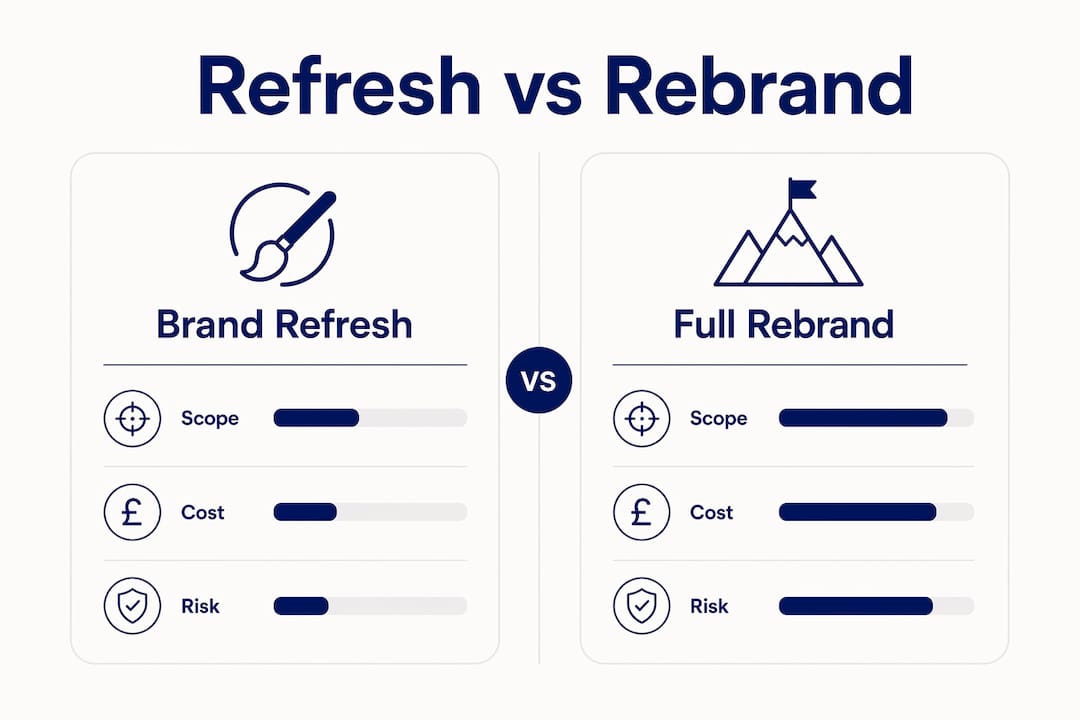
The practical gap between a refresh and a rebrand is significant. A brand refresh typically takes 3 to 6 months and costs between £40K and £400K, whereas a full rebrand requires 12 to 24 months and can exceed £8M for mid-market organisations. That cost differential reflects the depth of strategic and operational work involved, not simply the volume of design assets produced.
A refresh updates the surface: typography, colour palette, photography style, tone of voice guidelines, and digital templates. The brand’s core promise, positioning, and audience remain intact. A rebrand, by contrast, reaches into the foundations. It questions who the organisation is for, what it stands for, and sometimes what it is called. Think of Airbnb’s 2014 identity shift, which introduced the Bélo symbol and repositioned the company around belonging rather than accommodation. That was a rebrand. When Penguin Books updated its logo proportions and refined its typeface in 2003, that was a refresh.

| Factor | Brand refresh | Full rebrand |
|---|---|---|
| Scope | Visual and messaging updates | Mission, positioning, identity overhaul |
| Typical duration | 3 to 6 months | 12 to 24 months |
| Cost range | £40K to £400K | £800K to £8M+ |
| Risk level | Low to moderate | High |
| Brand equity impact | Preserved | Reset or rebuilt |
| Best suited for | Tired look, minor drift | Broken positioning, new audience |
The risk profiles are equally distinct. A refresh carries low disruption risk because customers still recognise the brand. A rebrand, described by Pine & Marsh as a “nuclear option” that discards accumulated trust and search presence, is appropriate only when existing brand equity has become a liability rather than an asset.
Pro Tip: Before scoping any brand project, run a brand audit that separates visual performance from strategic performance. Many organisations discover their strategy is sound and only their visual execution needs updating.
What strategic signals indicate a brand refresh is the right choice?
A refresh is the right call when the brand’s core values, positioning, and audience are fundamentally sound but the look and messaging feel tired. The challenge is recognising the specific signals that point to evolution rather than transformation.
The five most common triggers are:
- Visual fatigue. The brand looks dated relative to competitors or category norms. Fonts, colour palettes, and photography styles that felt contemporary a decade ago now signal stagnation to prospects.
- Audience demographic shift. Your core customer has aged or evolved in values, and the brand’s tone no longer resonates. A financial services firm whose clients have moved from baby boomers to millennials will feel this acutely.
- Portfolio expansion. New products or services sit awkwardly within the existing brand architecture, creating inconsistency across touchpoints without any change to the underlying strategy.
- Digital performance issues. The logo does not render well at small sizes, the colour palette fails accessibility contrast standards, or the visual system breaks down across social media formats.
- Merger or acquisition activity. Two brands need visual harmonisation without either party losing their established market recognition.
Visual fatigue, audience evolution, and digital mismatch are the clearest indicators that a refresh will solve the problem without the disruption of a full rebrand. The critical test is whether the brand’s foundational promise remains aligned with what customers actually value. If it does, protect that equity and update the presentation.
Pro Tip: Survey your existing customers before committing to any brand change. Ask them what words they associate with your brand. If those words align with your intended positioning, a refresh is almost certainly sufficient.
When and why should an organisation pursue a full rebrand?
A full rebrand is warranted when the existing identity actively works against the organisation’s goals. Rebrands involve deep strategic discovery including stakeholder interviews, competitive analysis, and repositioning work before any design begins. This is not a process that can be compressed without producing superficial results.
The business situations that genuinely justify a rebrand include:
- Negative brand equity. The brand carries associations that cannot be overcome through messaging alone. A company recovering from a public scandal or product failure may need to reset recognition entirely.
- Fundamental business model change. When an organisation pivots from B2B to B2C, or from product to service, the existing brand often fails to communicate the new value proposition credibly.
- Target audience replacement. If the organisation is deliberately moving into a new market segment with different values and expectations, the existing brand may be invisible or actively off-putting to that audience.
- Post-merger integration. When two organisations of comparable size merge, neither brand may be strong enough to absorb the other. A new unified identity is sometimes the only equitable solution.
- Competitive repositioning. When a category leader redefines the competitive frame, followers may need to reposition fundamentally rather than incrementally.
Rebrands carry higher operational disruption including costs to update all materials, internal alignment efforts, and communicating change to partners and clients. These impacts require genuine leadership commitment. A rebrand that lacks executive sponsorship at the highest level rarely succeeds because the internal adoption phase, which is as demanding as the external launch, gets deprioritised when competing business pressures emerge.
How do you evaluate brand equity and decide between refresh and rebrand?
Brand equity is defined as the combination of recognition, trust, search presence, and customer relationships that a brand has accumulated over time. Protecting valuable equity argues for the least disruptive change that solves the real problem. The decision framework begins with an honest assessment of whether that equity is an asset or a liability.
A practical evaluation covers four areas:
- Customer perception audit. Qualitative research with existing customers, lapsed customers, and target prospects reveals whether the brand’s current associations support or undermine the desired positioning.
- Competitive mapping. Plot your brand against competitors on the dimensions that matter most to your audience. If you occupy a distinct and valued position, protect it. If you are indistinguishable, the problem may be strategic rather than visual.
- Internal alignment check. Brand strategy clarity and leadership alignment are prerequisites for a successful rebrand. If your leadership team cannot agree on what the brand stands for, no amount of design work will resolve that ambiguity.
- Financial impact modelling. Estimate the cost of rebranding all customer-facing materials, digital properties, signage, and partner communications. Compare this against the projected revenue impact of improved brand performance.
Failing to accurately diagnose the underlying brand issue leads to costly mistakes. Organisations that use a refresh to solve a strategy problem end up repeating the exercise within three years. Those that rebrand unnecessarily discard equity they cannot easily rebuild. The diagnostic work is not optional. It is the most important investment in the entire brand evolution process.
Pro Tip: Use a simple decision matrix with two axes: brand equity strength (low to high) and strategic alignment (broken to sound). Brands in the high equity, sound strategy quadrant need a refresh. Brands in the low equity, broken strategy quadrant need a rebrand. The other two quadrants require a more nuanced conversation.
Key takeaways
A brand refresh preserves equity and updates presentation; a rebrand resets identity and should only be pursued when existing positioning is fundamentally broken or the audience has changed entirely.
| Point | Details |
|---|---|
| Refresh preserves equity | Update visual identity and messaging without abandoning the brand’s accumulated trust and recognition. |
| Rebrand resets recognition | Reserve full rebrands for situations where existing brand equity is a liability, not an asset. |
| Cost and time differ significantly | Refreshes cost a fraction of rebrands and complete in months rather than years. |
| Diagnosis drives the decision | Audit brand equity, customer perception, and strategic alignment before committing to either path. |
| Internal adoption is non-negotiable | A two-wave rollout starting internally prevents inconsistent brand execution after launch. |
Why I think most organisations rebrand when they should refresh
After working across brand communications for well over a decade, the pattern I see most often is this: an organisation feels uncomfortable with its brand, commissions a rebrand, and six months into the process realises the strategy was never the problem. The logo was. The colour palette was. The tone of voice was. But the positioning, the audience, and the promise were all perfectly sound.
The rebrand then becomes an expensive way to arrive at a refresh. Worse, the organisation has now disrupted its search equity, confused its existing customers, and exhausted its marketing team in the process. I have seen this happen with organisations that had genuinely strong brand recognition. They traded it in because someone in the boardroom felt the brand looked tired, and nobody pushed back with data.
The uncomfortable truth is that rebrands are often driven by internal discomfort rather than external necessity. A new CMO wants to put their mark on the brand. A board wants to signal change after a difficult year. These are understandable human impulses, but they are not strategic justifications. The question to ask is always: does our audience have a problem with this brand, or do we? If the answer is the latter, a refresh will almost always serve you better.
What I recommend is investing properly in the diagnostic phase before any creative brief is written. Talk to your customers. Map your competitive position. Audit your brand equity honestly. The brand evolution process should be led by evidence, not by the preferences of whoever holds the budget. When you do that work thoroughly, the right answer tends to become obvious.
— Calum
How Michaelbell supports your brand refresh or rebrand
At Michaelbell, we work with marketing teams and business leaders who are facing exactly this decision. We bring the strategic rigour to diagnose whether a refresh or a full rebrand is genuinely warranted, and the creative expertise to execute whichever path is right for your organisation.
We do not start with a design brief. We start with your brand equity, your audience, and your business objectives. Our brand communications services cover everything from brand audits and strategy refinement through to creative execution and internal rollout. We operate as an extension of your team, which means you get the commitment of an in-house agency without the overhead. If you are weighing up a brand update and want a clear-eyed view of what you actually need, we would love to talk.
FAQ
What is the main difference between a refresh and a rebrand?
A brand refresh updates visual identity and messaging while preserving core positioning, whereas a rebrand transforms the foundational elements including mission, audience, and sometimes the organisation’s name. The difference is one of depth and disruption.
How much does a brand refresh cost compared to a rebrand?
A brand refresh typically costs between £40K and £400K and takes 3 to 6 months, while a full rebrand can exceed £8M and require up to 24 months for mid-market organisations. Rebrands cost significantly more because they involve deep strategic discovery before any design work begins.
When should a company consider a full rebrand?
A full rebrand is appropriate when existing brand equity is a liability, when the business model has fundamentally changed, or when the organisation is deliberately targeting an entirely new audience. If the core positioning and audience remain sound, a refresh is the lower-risk choice.
How do you protect brand equity during a brand update?
Protecting brand equity requires retaining the brand elements that customers most strongly associate with the organisation, such as a distinctive colour, mark, or name, while updating the elements that feel dated or inconsistent. A thorough customer perception audit before the project begins identifies which assets to preserve.
What is the first step in deciding between a refresh and a rebrand?
The first step is a brand audit that separately evaluates visual performance and strategic performance. Many organisations discover their strategy is sound and only their creative execution requires updating, which points clearly to a refresh rather than a full rebrand.