
Evolve brand identity for market shifts: a practical playbook

The right approach to evolving your brand identity in a shifting market is to protect your core purpose and values while updating the flexible elements of your system — visual language, tone, channel presence, and messaging — in response to evidence, not instinct. This is not a rebrand. It is a disciplined, iterative process that keeps brand equity intact while making your identity work harder in changed conditions.
Here is the six-step sequence to get started:
- Diagnose your current brand health across commercial, perceptual, and cultural signals
- Protect the core by documenting what must never change (mission, values, purpose)
- Prioritise flex by identifying which touchpoints are underperforming or misaligned
- Pilot changes with a controlled audience before committing to full rollout
- Measure outcomes against pre-agreed KPIs at each stage
- Govern the evolution with clear decision rights and a living brand guidelines document
Your immediate next step is a 2–6 week diagnostic. It costs little, surfaces the evidence you need, and gives you a defensible brief for whatever comes next.
Table of Contents
- Brand evolution versus rebrand: how do you decide?
- What signals tell you it is time to adapt your brand identity?
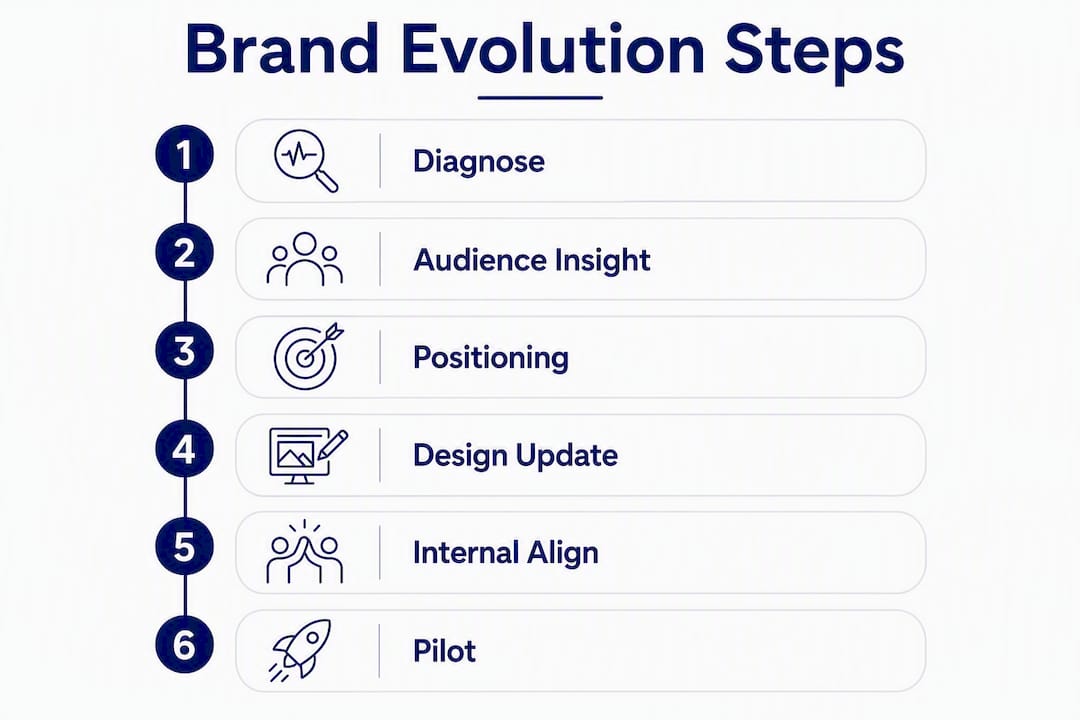
- A six-step roadmap to evolve your brand identity
- How Burberry and Lego evolved without losing themselves
- How do you measure success and govern the evolution?
- What timelines and costs should you realistically plan for?
- Regulatory cautions: what claims do you need to verify in the UK?
- How a specialist integrated brand communications agency runs an identity evolution
- Key takeaways
- The balance between core and flex is where most brand evolutions succeed or fail
- MB Brand Communications: your partner for brand evolution
- Useful sources and further reading
Brand evolution versus rebrand: how do you decide?
These two terms are often used interchangeably, but the distinction matters enormously for budget, risk, and stakeholder management. Understanding what brand repositioning actually involves before you commit to a path will save you significant time and money.
Brand evolution is systemic and iterative. You adapt the flexible elements of your identity — visual language, tone of voice, messaging architecture, channel mix — while the core (purpose, values, name, fundamental positioning) stays fixed. It is the right choice for most market-shift scenarios.
Rebrand is structural and radical. The name, logo, positioning, or fundamental audience definition changes. It carries higher risk, higher cost, and a longer recovery period for brand recognition.
| Dimension | Evolve | Rebrand |
|---|---|---|
| Trigger | Audience drift, channel shift, visual ageing, messaging misalignment | Merger, acquisition, fundamental audience change, reputational crisis |
| Core identity | Preserved | Replaced or substantially restructured |
| Typical timeline | 3–9 months | 12–24 months |
| Cost band | Lower (asset refresh, system update) | Higher (full identity creation, legal, global rollout) |
| Stakeholder risk | Moderate | High — recognition loss is real |
| Brand equity impact | Additive when managed well | Can reset equity to zero |
Decision checklist: ask yourself these four questions before choosing a path.
- Is the core purpose still relevant to the audience we want? If yes, evolve.
- Has the name or fundamental positioning become a barrier to growth? If yes, consider a rebrand.
- Are the problems commercial and perceptual, or structural and reputational? Commercial and perceptual problems almost always call for evolution.
- Do we have 12–24 months and the budget for a full rebuild? If not, evolve and plan a longer-term review.
Pro Tip: Before any change programme begins, audit which brand assets carry the highest recognition value — a specific colour, a typographic style, a sonic cue. These are your non-negotiables. Changing them without evidence is where brand equity gets lost.
What signals tell you it is time to adapt your brand identity?
Most brand managers sense something is off before the data confirms it. The discipline is knowing which signals to trust and how quickly to act. If you want a structured checklist, these nine diagnostic signals are a useful starting point.
Commercial signals
Declining conversion rates, falling customer retention, or a widening gap between your acquisition cost and lifetime value are the clearest commercial indicators. A sustained dip in repeat purchase or contract renewal — particularly if competitors are not experiencing the same trend — points to a brand perception problem, not just a product one.
Perceptual signals
Brand tracking data, Net Promoter Score trends, and share of voice in your category are your perceptual dashboard. Watch for a growing gap between prompted and unprompted brand awareness: when people recognise you but do not think of you first, your identity is losing distinctiveness. Qualitative research often surfaces this faster than quantitative tracking.
Cultural signals
Consumer value shifts move faster than most brand calendars. Cohort behaviour — particularly among 25–40-year-olds who now hold significant purchasing authority in B2B and B2C — has shifted materially toward purpose, transparency, and authenticity. Purpose-led brands have grown twice as fast as peers over the past decade, according to Kantar BrandZ analysis, which makes purpose preservation a commercial argument, not just an ethical one.
Operational signals
Channel performance data tells you where your identity is failing in execution. If your brand reads well in print but falls apart on social or in digital environments, the system is not adaptive enough. Partner and customer friction — complaints about inconsistent communications, confusion about what you stand for — are early operational signals that internal alignment has broken down.
A 2–6 week diagnostic timetable
| Week | Activity |
|---|---|
| 1 | Pull commercial data: conversion, retention, NPS, SOV |
| 2 | Run qualitative interviews (6–10 customers, 4–6 internal stakeholders) |
| 3 | Audit brand touchpoints across channels for consistency and performance |
| 4 | Review competitor and adjacent-category positioning for emerging signals |
| 5–6 | Synthesise findings into a diagnostic report and prioritised action list |
Look for early edge signals in adjacent categories and fringe audiences. The behaviours that will define your mainstream market in two years are often visible in niche communities today.
A six-step roadmap to evolve your brand identity
This process is designed for a small-to-medium internal team, with clear outputs at each stage and a built-in pilot phase to reduce waste. Refreshing your brand messaging is often the fastest win within this sequence.
Step 1: Diagnose
Objective: Establish a clear, evidence-based picture of where your brand is today.
Core activities: Brand audit across all touchpoints; commercial and perceptual data review; stakeholder interviews; competitor mapping.
Outputs: Brand health report, gap analysis, prioritised list of flex elements to address.
Owner: Brand manager or strategy lead, with input from sales, customer success, and research.
Step 2: Audience insight
Objective: Understand how your target audience has shifted and what they now expect.

Core activities: Qualitative research (interviews, focus groups, social listening); cohort analysis; persona refresh.
Outputs: Updated audience profiles, insight summary, evidence base for positioning decisions.
Owner: Insight or research lead, briefed by brand manager.
Step 3: Positioning update
Objective: Sharpen or reframe your positioning statement to reflect the evolved audience and market context. A solid brand positioning framework makes this step faster and more defensible.
Core activities: Positioning workshop with senior stakeholders; competitive whitespace analysis; messaging hierarchy review.
Outputs: Updated positioning statement, revised messaging architecture, tone of voice guidance.
Owner: Brand strategy lead and marketing director.
Step 4: Design system adaptations
Objective: Update the flexible visual and verbal elements of your identity system without touching the core.
Core activities: Visual audit; adaptive palette and typography review; motion and sonic identity assessment; adaptive brand identity systems — fluid logos, variable palettes, and sonic cues — are now the dominant design paradigm, so your system should be built to perform across diverse touchpoints.
Outputs: Updated style guide, adaptive design system rules, asset templates.
Owner: Creative director or design lead, working within the updated positioning brief.
Pro Tip: Invest in design systems as infrastructure — not as a one-off deliverable. A well-built system with clear rules and templates makes every future update faster and cheaper. Treat it like a codebase: version-controlled, documented, and owned.
Step 5: Internal alignment
Objective: Get your team behind the evolution before it goes public.

Core activities: Internal briefing sessions; updated internal brand guidelines; training for customer-facing teams; leadership sign-off.
Outputs: Internal launch pack, updated intranet or brand hub, training materials.
Owner: Internal communications lead and HR, briefed by brand manager.
Step 6: Pilot and iterate
Objective: Test the evolved identity with a real audience before full rollout.
Pilot test plan template:
- Scope: Select 2–3 channels (e.g. paid social, email, one physical touchpoint)
- Audience: Matched cohorts — existing customers and a new prospect segment
- Metrics: Brand preference shift, click-through rate, conversion rate, cohort retention
- Timebox: 4–6 weeks
- Learn criteria: Define success thresholds before launch (e.g. 10% uplift in brand preference, no significant drop in conversion)
Run a controlled approach across channels where possible, and use cohort retention as the primary success metric rather than reach or impressions. Vanity metrics will mislead you at this stage.
Pro Tip: Keep the pilot scope tight. Testing too many variables at once makes it impossible to know what drove the result. Change one or two elements per cohort, measure cleanly, then expand.
How Burberry and Lego evolved without losing themselves
These two cases are worth studying not because they are unusual, but because they are disciplined. Both brands faced genuine market pressure and chose evolution over reinvention.
Burberry: from heritage to cultural relevance
Burberry entered the 2000s with a serious brand problem. Its iconic check pattern had been adopted by a demographic that was actively damaging its luxury positioning. The brand had not changed — the market had moved around it.
The evolution, led by Angela Ahrendts and Christopher Bailey from 2006 onwards, was deliberate and systematic. The check was not abandoned; it was restricted and repositioned. Digital channels became the primary expression of the brand’s cultural ambition, with Burberry becoming one of the first luxury houses to live-stream runway shows and invest in social media as a brand-building tool. The visual identity was modernised — cleaner, more minimal — while the heritage narrative was preserved and amplified rather than discarded.
The result was a brand that felt contemporary without feeling unfamiliar. Revenue grew substantially over the following decade, and Burberry reclaimed its position as a credible luxury brand in key global markets.
The lesson from Burberry is not that you should go digital or go modern. It is that you should identify which elements of your identity are being used against you, restrict or reframe them, and then invest in the channels where your audience is forming its opinions.
Lego: from near-bankruptcy to cultural institution
By the early 2000s, Lego was losing money and relevance. It had diversified aggressively into theme parks, clothing, and video games, and in doing so had diluted the core identity that made it distinctive: the creative, open-ended building system.
The evolution was a return to core, not a departure from it. Lego stripped back its product range, refocused on the brick, and then used that clarity to expand into partnerships — Star Wars, Harry Potter, Technic — that amplified the core identity rather than competing with it. The visual and verbal identity became more confident and consistent as a result.
The transferable lesson is counterintuitive: sometimes the most powerful brand evolution is subtraction. Removing what does not belong to the core makes the core stronger.
Lessons brand teams can apply immediately:
- Identify which brand elements are being used in ways that undermine your positioning, and act on them first
- Use digital channels as a testing ground for cultural relevance before committing to full-system changes
- Partnerships and collaborations can extend a core identity without diluting it, if chosen carefully
- Subtraction is a legitimate creative strategy — fewer, stronger brand expressions beat many weak ones
How do you measure success and govern the evolution?
Measurement without governance is just reporting. You need both: a clear set of KPIs at each stage, and a decision-rights framework that stops the evolution from drifting or stalling. Aligning brand strategy with business goals is the foundation for making KPIs meaningful to leadership.
KPIs by stage
| Stage | Recommended KPIs |
|---|---|
| Diagnostic | Brand awareness (prompted/unprompted), NPS baseline, SOV, conversion rate |
| Pilot | Brand preference shift, cohort retention, engagement rate, A/B conversion delta |
| Rollout | Consideration rate, employee alignment score, partner feedback, media coverage quality |
| Mature | Brand equity score, customer lifetime value, retention rate, revenue per channel |
Governance RACI template
| Decision | Marketing | Brand/Creative | Legal | Leadership |
|---|---|---|---|---|
| Approve positioning update | Consulted | Responsible | Informed | Accountable |
| Sign off design system changes | Responsible | Accountable | Informed | Consulted |
| Approve sustainability claims | Informed | Consulted | Accountable | Responsible |
| Launch pilot | Responsible | Accountable | Informed | Consulted |
| Approve full rollout | Consulted | Responsible | Informed | Accountable |
Rollout governance by programme scale
Small programme (light refresh): Brand manager approves with marketing director sign-off. Legal review for any new claims. One stakeholder review gate before launch.
Medium programme (phased evolution): Marketing director leads with monthly steering group. Legal and HR involved from positioning stage. Two review gates: post-pilot and pre-full rollout.
Large programme (system overhaul): Executive sponsor accountable. Cross-functional working group with monthly reporting to board. External agency governance integrated into project plan. Three review gates minimum.
Embed a quarterly learn-and-iterate cycle into your governance from day one. A brand evolution that launches and then goes quiet will drift. Schedule a 90-day post-launch review, a six-month brand health check, and an annual positioning review as standing commitments. Communications refresh cycles work best when they are planned, not reactive.
What timelines and costs should you realistically plan for?
There is no universal answer, but there are honest ranges. The variables that drive cost are agency fees, asset production volume, localisation requirements, and legal or verification costs for regulated claims.
Timeline and cost bands by scale
| Scale | Typical timeline | Cost drivers | Budget band |
|---|---|---|---|
| Light refresh | 6–12 weeks | Design updates, copywriting, asset refresh | Lower |
| Phased evolution | 4–9 months | Strategy, design system, pilot, phased rollout | Mid-range |
| System overhaul | 12–24 months | Full strategy, identity system, global rollout, governance | Higher |
Cost bands are intentionally qualitative here because the range within each tier is wide. A light refresh for a ten-person business and a light refresh for a 500-person business are very different briefs. What matters is understanding the drivers so you can scope accurately.
Budget-reduction approaches that actually work:
- Phased rollouts: update highest-impact touchpoints first (digital, sales collateral, key customer communications) and defer lower-priority assets to later phases
- Asset templating: invest in a well-built template system early; the upfront cost pays back quickly in reduced production time across the life of the programme
- AI-enabled production: generative AI can reduce content production costs by 60–80% at scale, per Bain-cited analysis, when used for execution while human strategic control is maintained. This is particularly useful for localised asset variants and social content at volume
- Modular design systems: build identity components that can be recombined rather than recreated for each new context
On internal resource: most teams underestimate the internal time required to manage an evolution programme. A phased evolution typically needs a dedicated 0.5–1 FTE internal brand manager to coordinate agency work, manage stakeholder reviews, and own governance. Factor this into your resource plan before you brief an agency.
Regulatory cautions: what claims do you need to verify in the UK?
If your brand evolution involves any sustainability, environmental, or purpose-driven claims — and most do, given where consumer expectations have moved — you need to verify before you publish. This is not optional.
The EU Green Claims Directive, effective from 2026, requires independent verification of environmental claims and prohibits vague language such as “eco-friendly,” “sustainable,” or “green” without substantiating evidence. While this is EU legislation, UK regulators are moving in the same direction.
In the UK, the Competition and Markets Authority (CMA) and the Advertising Standards Authority (ASA) both actively enforce against unsubstantiated environmental claims. The CMA’s Green Claims Code sets out six principles for compliant claims, and the ASA has upheld complaints against major brands for greenwashing in recent years.
Pre-rollout verification checklist:
- Assemble lifecycle data, supplier declarations, and third-party verification evidence before drafting any sustainability copy
- Involve legal and procurement during the discovery phase, not at the end
- Submit claims to the ASA’s Copy Advice service for pre-clearance where possible
- Check that any comparative claims (“more sustainable than,” “lower carbon than”) are substantiated against a named baseline
- Document your evidence trail so you can respond to a regulatory challenge quickly
Which bodies to consult:
- CMA: for claims about environmental benefits, circular economy, or carbon neutrality
- ASA: for advertising copy including sustainability language in any paid or owned media
- Legal counsel: whenever a claim involves a quantified environmental benefit or a certification you do not yet hold
Pro Tip: While you are assembling verification evidence, use transitional language that is defensible: “We are working towards [specific goal] by [specific date]” is far safer than “We are a sustainable brand.” Specificity protects you; vagueness exposes you.
How a specialist integrated brand communications agency runs an identity evolution
The process Michaelbell uses follows a clear sequence: discovery, strategy, creative system development, pilot, implementation, and governance. Each phase has defined outputs and decision gates, so clients always know where they are and what comes next.
The most common mistake we see is brands trying to evolve their identity without first establishing what must not change. Without that clarity, every creative decision becomes a negotiation, and the process takes twice as long as it should.
What to prepare before your first agency conversation
A good brief saves weeks. Before you engage an external partner, prepare the following:
- Business goals: — what commercial outcomes does this evolution need to support?
What Michaelbell delivers and what to expect
Michaelbell’s integrated brand communications services cover the full evolution cycle: customer journey analysis, competitor research, brand guidelines, tone of voice development, copywriting, internal alignment communications, and creative campaign execution. For teams running a phased evolution, the agency can operate as an embedded partner — handling strategy and creative while your internal team manages stakeholder relationships and governance.
Expected outcomes from a well-scoped engagement include a refreshed positioning statement, an updated design system with adaptive rules, a pilot brief and results summary, and a governance framework your team can own long-term.
Authority-first marketing — building long-term credibility through rich content, repeatable brand signals, and a clear strategic point of view — is increasingly valuable in an AI-mediated discovery landscape. Michaelbell builds this into every engagement from the outset.
Pro Tip: Ask any agency you are considering to show you how they handle the internal alignment phase. External creative that does not land internally will not land externally either. The best agencies treat internal comms as part of the brief, not an afterthought.
Key takeaways
Evolving your brand identity in response to market shifts requires protecting your core purpose while systematically updating the flexible elements of your identity system, governed by evidence and clear decision rights.
| Point | Details |
|---|---|
| Protect the core | Mission, values, and purpose must stay fixed; only flex elements should change in response to market signals. |
| Diagnose before you act | A 2–6 week diagnostic gives you the evidence base to prioritise changes and build a defensible brief. |
| Pilot before full rollout | Test evolved identity elements with matched cohorts and use cohort retention as your primary success metric. |
| Govern with a RACI | Assign clear decision rights across marketing, creative, legal, and leadership to stop the evolution from stalling or drifting. |
| Michaelbell as your partner | Michaelbell runs the full evolution cycle — from discovery and strategy through to creative systems, pilot, and governance — as an embedded agency partner. |
The balance between core and flex is where most brand evolutions succeed or fail
There is a tendency in brand work to treat evolution as a creative problem. It is not. It is a strategic and organisational problem that happens to have a creative output.
The brands that get this right — Burberry, Lego, and many less-celebrated examples — share one characteristic: they were ruthlessly clear about what was non-negotiable before they touched anything. That clarity gave their creative teams permission to be bold with the flexible elements, because everyone knew the boundaries.
What I see most often is the opposite: teams that start with the visual refresh and work backwards to the strategy. The result is a new logo sitting on top of an unchanged positioning, which is neither evolution nor rebrand. It is decoration.
The other underestimated factor is internal alignment. A brand evolution that your own team does not understand or believe in will not survive first contact with the market. The internal launch is not a formality — it is where the evolution either takes root or withers.
If you are a brand manager reading this, the most useful thing you can do this week is not commission new creative. It is to write down, in one paragraph, what your brand stands for and what it will never compromise on. If you cannot do that without a workshop, that is your diagnostic finding right there.
MB Brand Communications: your partner for brand evolution
Brand evolution done well requires external perspective, creative rigour, and the kind of embedded partnership that keeps your internal team in control. That is exactly what Michaelbell offers — not a traditional agency relationship where you hand over a brief and wait, but a working partnership where our team operates as an extension of yours.
We cover the full evolution cycle: discovery and audience insight, positioning strategy, design system development, internal alignment communications, pilot planning, and rollout governance. Our clients get the creative expertise of a specialist agency at a fraction of the cost of building that capability in-house. Whether you are running a light messaging refresh or a full phased evolution across multiple markets, we scope to fit your situation.
To start a conversation, explore our services or come to your first call with the brief outline above. We will get straight back to you.
Useful sources and further reading
- Brand Evolution Strategy | TMLA Knowledge Hub — A practical overview of brand evolution strategy with frameworks for UK marketing teams.
- The importance of brand evolution | Socially Grown — Accessible explanation of why brands must evolve and the risks of standing still.
- How to build a brand that adapts to changing trends | Fluer — Practical guidance on building adaptive brand systems for dynamic markets.
- How to evolve your brand identity for a dynamic market | LinkedIn Advice — Practitioner perspectives on fast-changing market identity challenges.
- Brand evolution: how to keep your business relevant | BBDirector — Detailed look at brand evolution tactics and real-world examples.
- Top branding and design trends for 2026 | The Branding Journal — Covers adaptive identity systems, sonic branding, and AI-mediated discovery trends.
- Future-proofing your brand adaptation strategies | BrandsDad — Core/flex model and principled adaptation frameworks explained clearly.
- How to adapt a brand strategy to build recognition globally | Forbes — Forbes Agency Council guidance on localisation and global brand consistency.
- CMA Green Claims Code — The UK’s official guidance on compliant environmental claims; essential reading before any sustainability copy goes live.
- How authenticity in branding builds trust and growth | Babylove Growth — Useful perspective on why authentic brand signals build long-term commercial value.
- Creating an effective brand strategy: faster growth with AI | Babylove Growth — Practical look at using AI to scale brand strategy execution without losing strategic control.