
How to lead a brand transformation initiative

A brand transformation initiative is defined as the strategic process of realigning your corporate brand with evolving business goals, culture, and market positioning to drive measurable growth. It goes far beyond a logo refresh or a new colour palette. McKinsey’s 2026 global brand platform, which reached 2 million senior executives in three months, proves that the most effective brand transformation strategy unifies storytelling, partnerships, and positioning under one coherent platform. For business leaders and marketing executives, the challenge is not creativity. It is coordination, leadership, and measurement.
What do you need before you lead a brand transformation initiative?
The foundation of any successful brand transformation is an honest audit of where your brand stands today. You need to understand your current brand equity, your commercial impact, and where the gaps are between how you present yourself and how the market perceives you. Without this baseline, you are making expensive decisions without evidence.
Once you have your audit, the next step is assembling the right team. Brand transformation is not a marketing department project. It requires cross-functional leadership spanning HR, sales, communications, and the C-suite. Appointing dedicated brand transformation champions within each function keeps momentum alive and prevents the initiative from stalling in committee.

BCG emphasises that a clear and consistent case for change is the single most critical factor in securing organisational buy-in. Leaders must articulate not just what is changing, but why it matters and what stays the same. Ambiguity at this stage breeds resistance later.
The key frameworks to have in place before launch include:
- Brand architecture review: Clarify how your portfolio of brands or sub-brands relate to each other. A guide to brand architecture for leaders is a useful starting point.
- Employer value proposition (EVP): Your EVP must align with the new brand direction. Misalignment here creates confusion in recruitment and retention.
- Strategic narrative: Develop a clear story that connects your brand purpose to your business ambitions. This narrative drives every communication that follows.
- Stakeholder diagnostic research: Survey employees, customers, and partners to identify where perception gaps exist before you go public.
Pro Tip: Run a brand perception survey with at least three stakeholder groups before finalising your transformation strategy. The gaps between internal and external perceptions are almost always more significant than leadership expects.
How to execute a coordinated internal and external rollout
The rollout phase is where most brand transformation efforts succeed or fail. The sequence matters enormously. Getting it wrong means employees read about your new brand in a press release before anyone has explained the rationale to them internally. That creates cynicism, not commitment.
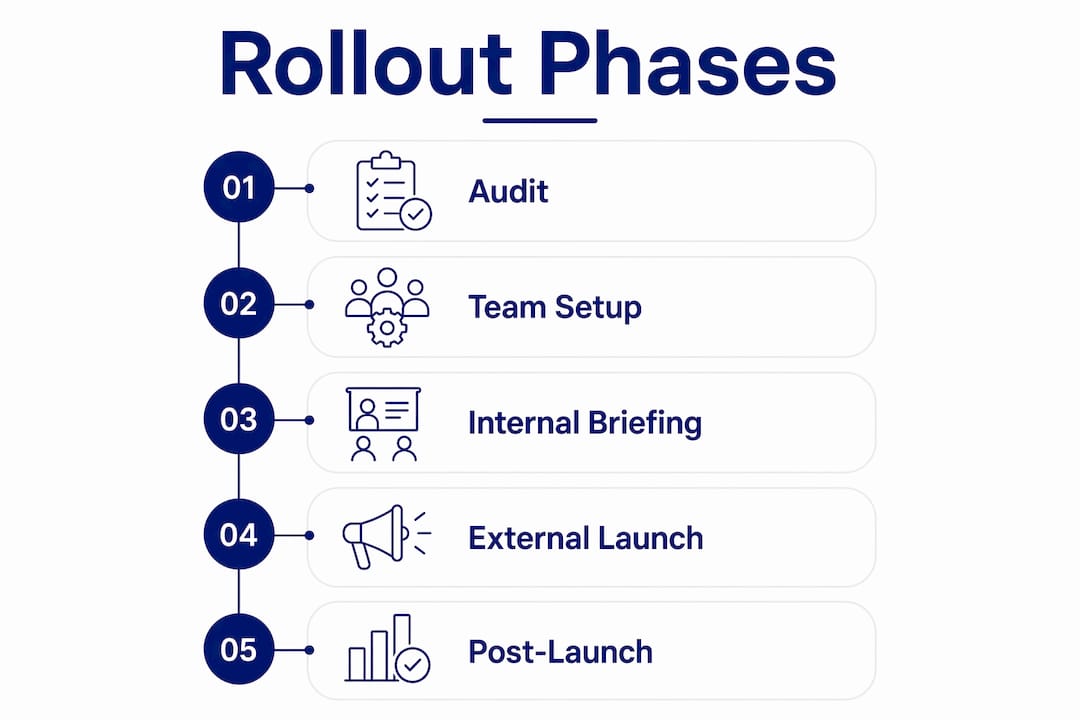
Shadow recommends briefing employees 48–72 hours before the public launch. This briefing must include the rationale for change and create space for genuine two-way conversation. A one-way announcement is not a briefing. Employees who see external messaging before receiving an internal explanation typically interpret the change negatively.
A structured rollout follows this sequence:
- Internal leadership briefing (week minus two): Equip your senior team with the full story, the key messages, and answers to the questions they will face.
- All-employee briefing (48–72 hours before launch): Share the rationale, the vision, and what changes in practice. Make it a conversation, not a presentation.
- Public launch day: Release the new brand across all channels simultaneously. Coordinate PR, social media, and digital assets to go live together.
- Post-launch asset update phase (3–6 months): Update every customer-facing touchpoint systematically. This is not optional. Missed touchpoints break brand coherence and confuse customers.
- Recognition continuity: Keep the previous brand name in parentheses on key digital assets during the transition period to preserve search discoverability.
Pro Tip: Build a master asset checklist before launch day. Include every digital and physical touchpoint from email signatures to vehicle livery. Assign an owner and a deadline to each item.
The table below maps each rollout phase to its primary purpose and key risk.
| Rollout phase | Primary purpose | Key risk if skipped |
|---|---|---|
| Internal leadership briefing | Equip leaders to communicate confidently | Mixed messages from senior team |
| All-employee briefing | Secure internal buy-in before public exposure | Employee cynicism and negative reactions |
| Public launch day | Unified market presence | Fragmented brand signals across channels |
| Post-launch asset update | Consistent customer experience | Broken brand coherence at touchpoints |
| Recognition continuity | Preserve SEO and brand equity | Loss of search discoverability |
What leadership strategies align brand with corporate strategy and culture?
Brand transformation is not complete when the new logo goes live. The deeper work is embedding the new brand values across the organisation so that every customer interaction reflects the change. Brand Council defines brand transformation as the strategic realignment of positioning, employer brand, EVP, and culture, not just visual identity.
The most common failure mode is treating the brand as a communications project rather than an organisational one. When brand values live only in the marketing department, customers experience inconsistency. A sales team that pitches differently from the way the brand presents itself online destroys trust faster than any competitor can.
Effective leadership strategies for embedding brand transformation include:
- Communicate the commercial rationale. Show every team how the brand change supports the organisation’s growth ambitions. People commit to change when they understand the business case.
- Align the EVP with the new brand direction. Your employer brand must reflect the same values you are presenting externally. Inconsistency here is visible to candidates and current employees alike.
- Use diagnostic research to detect gaps early. Stakeholder research before and after launch identifies where the brand is landing well and where it is not. Act on the findings quickly.
- Simplify brand architecture. Complex brand portfolios confuse customers and internal teams. Rationalise where possible and clarify the relationships between brands in your portfolio.
- Govern the brand actively. Appoint a brand governance lead with authority to enforce standards across all markets and functions.
Brand Council notes that failure to embed brand purpose alongside visual change leads to inconsistent customer experiences. The visual change becomes noise without the cultural change to back it up. Developing a strong brand storytelling approach is one of the most effective ways to carry culture through the transformation.
How do you measure the ROI of a brand transformation initiative?
Measurement is the discipline that most brand transformation programmes underinvest in. Utsubo warns that organisations which measure only traffic or short-term conversion lifts consistently underprove the financial value of their brand investment. A comprehensive measurement framework tracks brand equity signals alongside commercial outcomes.
The key metrics to track are branded search volume lift, direct and branded traffic, earned media value, Net Promoter Score, and sales win-rate alongside sales cycle length. Each of these signals tells a different part of the story. Win-rate improvement, in particular, is hard evidence that the brand is doing commercial work.
Utsubo advises treating brand equity signals as leading indicators with built-in time lags. Early indicative results appear at 60–90 days post-launch. Fuller attribution takes around six months. This timeline matters when you are making the case to a board that wants to see returns quickly.
| Metric | What it measures | Typical signal lag |
|---|---|---|
| Branded search volume | Market awareness and recall | 60–90 days |
| Direct traffic | Unprompted brand recognition | 60–90 days |
| Net Promoter Score | Customer loyalty and advocacy | 3–6 months |
| Sales win-rate | Commercial impact of brand perception | 3–6 months |
| Earned media value | PR reach and brand authority | Ongoing |
Accenture’s work on the Huggies global creative platform achieved category leadership in organic search volume alongside measurable shifts in consumer perception. That combination of brand equity and commercial outcome is the standard to aim for.
What common pitfalls should leaders avoid in brand transformation?
The most expensive mistake in leading brand evolution is treating it as a design project. A new visual identity without strategic realignment is a cosmetic change. It will not shift market perception, and it will not change how employees behave.
The pitfalls that derail brand transformation programmes most consistently are:
- Compressing the internal rollout timeline. Cutting the employee briefing period to save time creates the exact negative reaction you are trying to avoid. The 48–72 hour window before public launch is a minimum, not a target.
- Underestimating post-launch asset governance. Hitachi Energy’s global brand refresh required managing thousands of assets across 140+ markets under tight deadlines. Without a repeatable governance model, consistency breaks down at scale.
- Ignoring recognition continuity. Removing all references to the previous brand name too quickly damages search discoverability and confuses long-standing customers. Keep the old name in parentheses on key digital assets during the transition.
- Measuring too early. Pulling the plug on measurement at 30 days because results look flat misses the point. Brand equity signals take 60–90 days to show early movement.
- Treating brand transformation as a one-time event. Brand governance is an ongoing discipline. The organisations that sustain brand equity are those that treat standards enforcement as a permanent function.
Pro Tip: Assign a dedicated post-launch brand guardian with the authority to flag and fix inconsistencies across all markets. Without clear ownership, standards drift within weeks.
Knowing when your brand needs a refresh in the first place is equally important. Acting too late makes the transformation harder and more expensive.
Key takeaways
A brand transformation initiative succeeds when leadership aligns internal culture, external positioning, and measurement frameworks from the outset, not after the logo goes live.
| Point | Details |
|---|---|
| Audit before you act | Map brand equity and stakeholder perceptions before committing to a direction. |
| Internal briefing is non-negotiable | Brief employees 48–72 hours before public launch with rationale and space for dialogue. |
| Embed values across the organisation | Brand transformation requires cultural alignment, not just visual change. |
| Measure with patience | Track brand equity signals at 60–90 days and 6 months, not just short-term traffic. |
| Govern the brand actively | Appoint a brand guardian with authority to enforce standards across all markets and functions. |
What I have learned from leading brand transformation efforts
Brand transformation is one of the most misunderstood disciplines in marketing leadership. The conversations I have with senior executives often reveal the same blind spot: they have invested heavily in the visual identity and the launch event, and very little in the internal alignment that makes the change stick.
The organisations that get this right share one characteristic. Their leadership team treats the brand as a business asset, not a marketing deliverable. They connect brand equity directly to commercial outcomes, they measure with patience, and they govern standards with genuine authority. The ones that struggle treat brand transformation as a project with an end date.
The McKinsey example is instructive here. Reaching 2 million senior executives in three months did not happen because the creative was good. It happened because the strategy, the partnerships, and the storytelling were unified under one coherent platform. That kind of coordination requires leadership commitment that goes well beyond the marketing function.
My honest view is that most brand transformation programmes are underpowered at the governance stage. The launch gets the budget and the attention. The 3–6 month post-launch period, where brand coherence is either built or broken at every customer touchpoint, gets a fraction of both. If you are planning a transformation, put as much rigour into the post-launch governance model as you put into the creative brief.
— Calum
How Michaelbell supports your brand transformation programme
Michaelbell works with marketing teams and business leaders who need more than a creative agency. We bring together brand strategy, internal communications, and external rollout support under one joined-up approach, so your brand change lands consistently inside and outside the organisation.
Whether you are at the audit stage, preparing for launch, or managing a complex post-launch asset update, our team operates as an extension of yours. We are passionate about the detail that makes brand transformation work in practice, not just in the boardroom. Take a look at our brand transformation services to see how we can support your programme from strategy through to execution.
FAQ
What is a brand transformation initiative?
A brand transformation initiative is the strategic process of realigning a company’s brand with its evolving business goals, culture, and market positioning. It encompasses brand architecture, EVP, positioning, and internal culture, not just visual identity.
How long does a brand transformation take?
The public launch is the beginning, not the end. Post-launch asset updates typically take 3–6 months, and meaningful brand equity signals appear at 60–90 days, with fuller attribution around six months after launch.
Why does internal communication matter in brand transformation?
Employees who encounter external brand messaging before receiving an internal explanation typically react negatively. Briefing staff 48–72 hours before the public launch with clear rationale prevents this and builds genuine commitment.
What metrics prove the ROI of a brand transformation?
The strongest indicators are branded search volume lift, direct traffic, Net Promoter Score, and sales win-rate. Win-rate improvement is particularly compelling evidence of commercial impact for board-level reporting.
What is the biggest mistake leaders make in brand transformation?
Treating brand transformation as a design project rather than an organisational one. Without embedding brand values across culture, EVP, and governance, visual changes fail to shift market perception or employee behaviour.