
How to position a startup brand in a competitive market

Brand positioning is defined as the specific place your startup occupies in a customer’s mind relative to every other option they could choose. Get it right, and it directs your marketing, sales, and product decisions from a single, coherent point of view. Get it wrong, and you spend money on messaging that resonates with nobody. To position your startup brand in a competitive market, you need three things working together: a clear understanding of the market structure, a precise positioning statement built on honest differentiation, and a brand strategy that precedes any investment in visual identity. This article gives you the frameworks and sequence to do exactly that.
How to analyse a competitive market before you position your startup brand
The first step is understanding the market you are entering, not just who your competitors are, but how the market itself is structured. That structure determines how hard it will be to carve out a defensible position.
Reading market concentration
Market fragmentation can be measured quantitatively: if the top 50 firms control under 10% of establishments in a sector, the market is highly fragmented. A fragmented market signals genuine niche opportunities for a startup. An oligopoly, where a handful of players dominate, demands a sharper differentiation strategy because switching costs and brand loyalty are already entrenched.
Porter’s Five Forces, developed in 1979, remains the foundational framework for assessing industry profit potential and rivalry intensity. Apply it to your sector before writing a single line of positioning copy. The five forces are: competitive rivalry, threat of new entrants, bargaining power of buyers, bargaining power of suppliers, and threat of substitutes. Each one shapes how much room you have to price, differentiate, and grow.
Going deeper than surface-level research
Most founders scan competitor websites and stop there. That is not competitive analysis. Real analysis means reading user reviews on third-party platforms, signing up for competitor products, and talking to customers who have switched. Competitive analysis is not a one-off document. It underpins ongoing sales and marketing and requires continuous updating as the market shifts. Treat it as a living asset, not a slide in your pitch deck.

Pro Tip: Use an SEO competitor analysis to identify the exact search terms your rivals rank for. This reveals where they are investing attention and where gaps exist that your positioning can fill.
The table below summarises the key tools and data sources for a thorough competitive market analysis.
| Tool or method | What it reveals | Best used for |
|---|---|---|
| Porter’s Five Forces | Industry profit potential and rivalry intensity | Market entry decisions |
| Establishment concentration data | Fragmentation vs. oligopoly conditions | Niche opportunity identification |
| User review platforms | Real customer pain points and unmet needs | Positioning language and gaps |
| Product trials and demos | Feature gaps and UX weaknesses | Differentiation claims |
| SEO keyword analysis | Competitor content investment and search demand | Messaging and content strategy |
How do you craft a sharp brand positioning statement?
A positioning statement is not a tagline. It is an internal strategic document that answers four questions with precision.
The four pillars are: who is your target customer, what is your frame of reference (the category you compete in), what is your point of difference, and what is your reason to believe that claim. Every word in a positioning statement should be specific enough to exclude someone. A narrow, specific customer profile sharpens positioning and messaging, improving resonance and reducing wasted marketing spend. “Small businesses” is not a customer profile. “Founders of B2B SaaS companies with fewer than 20 employees and no dedicated marketing function” is.
Maintaining a singular, consistent position is non-negotiable. Multiple competing positions dilute brand clarity and confuse buyers. Pick one and defend it.
One of the most underused positioning moves is acknowledging where you are not the best fit. Admitting trade-offs increases credibility and pre-qualifies the right customers. A buyer who self-selects out is not a lost sale. They are a saved sales cycle.
Common positioning mistakes to avoid:
- Positioning against a competitor by name rather than on your own terms
- Using category language that every rival also uses (“fast,” “reliable,” “easy to use”)
- Writing for an audience so broad that the message resonates with nobody
- Claiming a point of difference you cannot substantiate with evidence
- Updating positioning every quarter in response to competitor moves
Pro Tip: Mine your sales call recordings and support tickets for the exact phrases customers use to describe their problem. That language belongs in your positioning statement, not the language your team invented internally.
Why brand strategy must come before brand identity
Founders frequently invest in logos, colour palettes, and typography before they have a clear positioning statement. This is the single most expensive mistake in early-stage branding. Brand strategy must precede brand identity. A strong strategy drives identity. Without it, design choices are arbitrary, and rebranding costs compound quickly.
A strong brand provides pricing power and long-term competitive advantage that features and pricing alone cannot sustain. That is the case for treating brand as a durable asset, not a cosmetic exercise. Your brand’s purpose and values shape how customers perceive you over years, not quarters.
At the MVP stage, the right call on visual identity is deliberate restraint. A simple, clean wordmark is cheaper, more scalable, and avoids “visual debt” before product-market fit is confirmed. A complex custom logo designed before you know your customer is a liability. You will likely rebrand within 18 months, and that costs time, money, and consistency.
Key principles for building an MVP brand system:
- Start with a wordmark, not a custom logomark
- Choose a type system and two brand colours maximum
- Build visual identity components that scale across digital and print from day one
- Bake in WCAG AA contrast compliance from the start to grow your reachable market and avoid costly retrofits later
- Document brand guidelines before you brief any external designer
Pro Tip: Treat your brand guidelines as a living document. Review them every six months against your positioning statement. If they no longer reflect your position, update the guidelines before you update the logo.
A step-by-step approach to competitive brand positioning
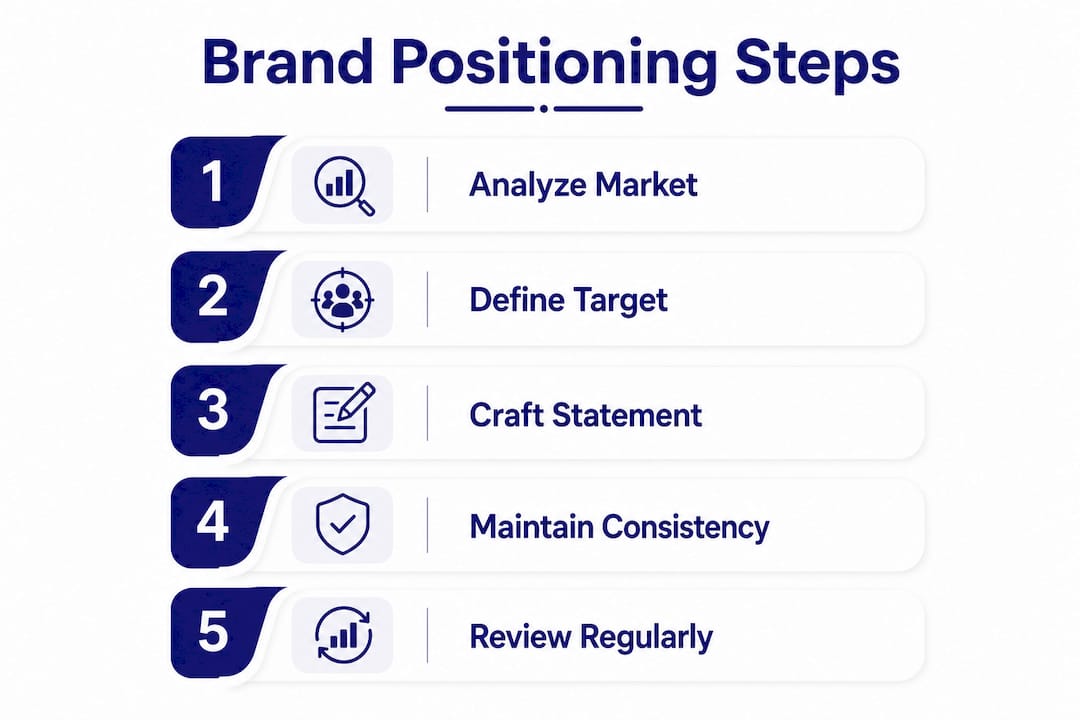
Positioning is a process, not a moment. The sequence below gives you a repeatable method for building and refining your market position.
- Gather your inputs. Collect customer interview notes, sales call recordings, user reviews of your product and competitors, and market concentration data. Do not start writing until you have real data.
- Run a Five Forces analysis. Map rivalry intensity, entry barriers, and buyer power for your specific market. This tells you where leverage exists and where it does not.
- Profile your competitors honestly. For each main rival, document their strengths, weaknesses, pricing, and the customer segment they serve best. Understanding competitors deeply is the foundation for positioning on your own honest terms.
- Define your target customer with precision. Name the role, company type, size, and specific problem. Vague profiles produce vague positioning.
- Draft your positioning statement. Use the four-pillar structure: target customer, frame of reference, point of difference, reason to believe. Write three versions and test each with five customers.
- Align your messaging. Translate the positioning statement into homepage copy, sales deck language, and email subject lines. Every channel should echo the same core claim.
- Verify through feedback. Run the messaging past customers who fit your target profile. If they do not immediately recognise their problem in your language, revise the statement, not the customer.
- Iterate quarterly. Markets shift. Your brand positioning framework should be reviewed every quarter against new competitor data and customer feedback.
Pro Tip: When testing positioning with customers, ask “Does this sound like it was written for you?” rather than “Do you like this?” The first question reveals fit. The second reveals preference, which is far less useful.
The table below compares common positioning approaches and their practical trade-offs.
| Positioning approach | Strength | Weakness |
|---|---|---|
| Category leader claim | High recall, clear frame of reference | Requires proof; hard to sustain early on |
| Niche specialist | Strong resonance with a defined segment | Limits perceived total addressable market |
| Price-based positioning | Easy to communicate | Erodes margin and attracts wrong buyers |
| Values-led positioning | Builds loyalty and brand affinity | Slower to convert; harder to measure |
| Problem-specific positioning | High relevance; drives urgency | Narrow; may need to evolve as product grows |
Key takeaways
Effective startup brand positioning requires honest competitive analysis, a singular and specific positioning statement, and a brand strategy that precedes any investment in visual identity.
| Point | Details |
|---|---|
| Analyse market structure first | Use Porter’s Five Forces and concentration data before writing any positioning copy. |
| Build a singular positioning statement | One precise position, built on four pillars, outperforms broad or multiple competing claims. |
| Acknowledge where you are not the best fit | Admitting trade-offs builds credibility and pre-qualifies the right buyers. |
| Strategy before identity | Define purpose and positioning before commissioning logos or colour palettes. |
| Treat positioning as continuous | Review and update your competitive position every quarter as the market evolves. |
What I have learned about honest positioning under competitive pressure
Most founders I speak with feel anxious about competition. That anxiety usually produces one of two bad responses: they attack rivals by name, or they pretend the competition does not exist. Both approaches fail. Attacking rivals shifts the conversation to your competitor’s territory. Ignoring them leaves buyers without a clear reason to choose you.
The approach that actually works is the one that feels counterintuitive: understand your competitors better than they understand themselves, then position entirely on your own terms. When you know precisely where a rival is strong, you can acknowledge it without fear. That honesty signals confidence. It also tells buyers you have done the work.
I have also seen founders treat brand strategy as something they will “sort out later,” once the product is more mature. That delay is costly. The startup brand strategy you build early shapes how customers talk about you, how sales conversations go, and how much you can charge. Waiting until you have traction to think about positioning means you have already let the market define you by default.
The most durable brands I have seen built by founders share one quality: they are grounded in a genuine point of view about the customer’s problem. Not a feature list. Not a price point. A clear, specific claim about who they help and how. That is the foundation. Everything else, the identity, the messaging, the campaigns, follows from it.
Authenticity in branding is not a soft concept. It is a commercial one. Brands that say what they mean, and mean what they say, earn trust faster and retain customers longer. Start there.
— Calum
How Michaelbell supports startup brand positioning
Positioning a startup brand in a competitive market is one of the most demanding strategic challenges a founder faces. Michaelbell works with founders at exactly this stage, helping you move from market analysis to a clear, defensible position before a single design brief is written.
Our brand communications services cover competitive market analysis, positioning statement development, and the sequencing of strategy and visual identity to avoid expensive rebrands. We work as an extension of your team, not an outside vendor, so the thinking stays connected to your business reality. If you are ready to build a brand position that holds up under competitive pressure, we would love to talk.
FAQ
What is brand positioning for a startup?
Brand positioning is the specific place a startup occupies in a customer’s mind relative to all available alternatives. It is defined by a clear target customer, a frame of reference, a point of difference, and a reason to believe that claim.
How do I analyse my competitive market as a founder?
Apply Porter’s Five Forces to assess rivalry intensity and profit potential, then measure market concentration to identify fragmentation or oligopoly conditions. Supplement this with user reviews, product trials, and customer interviews for qualitative depth.
When should a startup invest in brand identity?
Brand identity investment should follow a confirmed positioning statement and brand strategy. At the MVP stage, a simple wordmark is sufficient. Investing in complex visual identity before product-market fit is confirmed typically leads to costly rebranding.
How specific should a positioning statement be?
A positioning statement should be specific enough to exclude someone. Name the exact customer role, company type, and problem. Broad statements like “we help businesses grow” carry no competitive weight and resonate with nobody in particular.
How often should a startup review its brand positioning?
Competitive positioning should be reviewed every quarter. Markets shift, competitors evolve, and customer language changes. Treating positioning as a continuous activity, rather than a one-off document, keeps your messaging relevant and your sales conversations sharp.