
How to revitalise your brand storytelling approach

A brand storytelling approach is defined not by the quality of a single campaign, but by the architecture of a repeatable narrative system that every creator, channel, and touchpoint can draw from. Most marketing teams treat storytelling as a creative exercise. The ones pulling ahead in 2026 treat it as operational infrastructure. Brands like Hexclad, Olipop, and Graza have demonstrated that narrative consistency compounds brand equity faster than any isolated campaign. This article explains how to build, align, and measure that system so your brand narrative works harder across every channel you own.
What are the essential components of a scalable brand storytelling system?
A scalable brand storytelling system is built from four operational components that work together to keep your narrative coherent whether you have two creators or two hundred. Without these components, even a compelling story fractures the moment it passes through multiple hands.
The four components are:
- Brand Narrative Document. This captures your origin tension, the hero (your customer, not your brand), the villain (the problem or status quo), the transformation, and the proof. It is the single source of truth every brief draws from.
- Creative Expression Matrix. This maps narrative themes to specific content formats and channels. It tells your team which story angle suits a 15-second paid social ad versus a long-form email versus packaging copy.
- Brief-to-Publish Pipeline. Templated briefs that embed narrative context before any execution detail. Narrative-led briefs open with brand origin tension and assign creators a role within the story rather than treating them as product spokespeople.
- Performance Feedback Loop. Regular audits that use data to refine which story angles are gaining traction and which are losing relevance.
| Component | Primary function |
|---|---|
| Brand Narrative Document | Defines characters, tension, and proof for all content |
| Creative Expression Matrix | Matches story themes to formats and channels |
| Brief-to-Publish Pipeline | Embeds narrative context into every creator brief |
| Performance Feedback Loop | Tracks narrative resonance and flags when stories need updating |
Pro Tip: Build your Brand Narrative Document before you write a single brief. Teams that skip this step end up briefing execution before alignment, which is the most expensive mistake in brand storytelling.
The goal of this system is not uniformity. It is coherence. Creators still bring their own voice and style. The system simply ensures they are all telling chapters of the same story.
How do narrative arcs improve storytelling effectiveness?
Narrative arcs are the structural backbone of any compelling brand story, and the performance data behind them is striking. Story-based ads have a 30% chance of landing in the top third of performers, compared to just 15% for ads that deliver value without a story. That is a doubling of effectiveness simply by introducing characters and outcomes. Storytelling encodes brand meaning in memory at the moment of choice, which is why the impact compounds over time rather than fading after a single exposure.
An effective brand narrative arc contains four elements:
- A protagonist who is the customer, not the brand. The brand is the guide. The customer is the one with the problem and the journey.
- Genuine tension. Not a vague inconvenience. A specific, felt frustration that your audience recognises in their own life.
- A turning point. The moment the protagonist encounters your brand and something shifts. This is where transformation becomes believable.
- Concrete proof. A specific result, not a generic claim. “Lost 8kg in 10 weeks” beats “feel better every day.”
“Most organisations don’t lack a good story. They have a discovery problem. The story exists in customer tensions and must be systematically surfaced.” — Andi Cross, 2026
Hexclad’s narrative overhaul is the clearest recent proof of this in action. After rebuilding its creative system around character-driven tension and transformation, Hexclad reduced prospecting CPA by 34%, increased landing page conversion by 19%, and improved video thumb-stop rate by 41%. These were not marginal gains. They came directly from shifting the story’s centre of gravity away from product features and towards human experience.
Pro Tip: When auditing your existing creative, ask one question of every piece: “Who is the hero of this story?” If the answer is your product or brand, rewrite it with the customer in that role.
Narrative arcs also build empathy. When audiences see their own tension reflected in a story, they identify with the protagonist and carry that emotional connection into their purchase decision. This is not soft marketing theory. It is the mechanism behind the performance numbers.
What tools and approaches align creative teams with your brand story?
Aligning creative teams and external creators with your brand story requires more than a style guide. It requires a briefing framework that puts narrative first and execution second. The most common failure point is briefing hooks before narrative alignment. When a creator receives a brief that opens with “we need a 15-second hook about our new product,” they default to their own storytelling instincts, which may have nothing to do with your brand’s core tension or character arc.

A narrative-led brief works differently. It opens with the brand’s origin tension, establishes the customer as the protagonist, and defines the emotional outcome the content should produce. Only then does it specify format, length, and platform. Assigning creators a role within the story, rather than treating them as product advocates, gives them creative freedom within a defined story frame. The result is content that feels authentic and on-brand simultaneously.
Practical tools for maintaining alignment across a creator network include:
- Narrative tagging taxonomies. Tag every piece of UGC and creator content by which story element it activates: tension, transformation, or proof. This makes it easy to identify gaps in your content mix.
- Story-context onboarding documents. A one-page narrative brief that every new creator receives before any execution brief. It covers the brand’s origin story, the customer’s villain, and the transformation the brand enables.
- Shared proof libraries. A curated bank of specific customer results and emotional outcomes that creators can draw from to add credibility to their content.
The customer journey is also a useful frame for briefing. Each stage of the journey calls for a different chapter of the story, from awareness content that surfaces tension to post-purchase content that reinforces transformation.
Pro Tip: Before briefing any creator, send them three examples of content that perfectly captures your brand’s narrative tone. Examples communicate story context faster and more accurately than written descriptions alone.
How can you measure the impact of your brand storytelling?
Measuring narrative impact means going beyond standard engagement metrics and tracking whether your story is actually landing with the right audience. Narrative alignment scores and belief cluster momentum tracking are more meaningful than follower counts or raw impressions. They tell you whether your audience is adopting your brand’s language and framing, which is the clearest signal that your story is working.
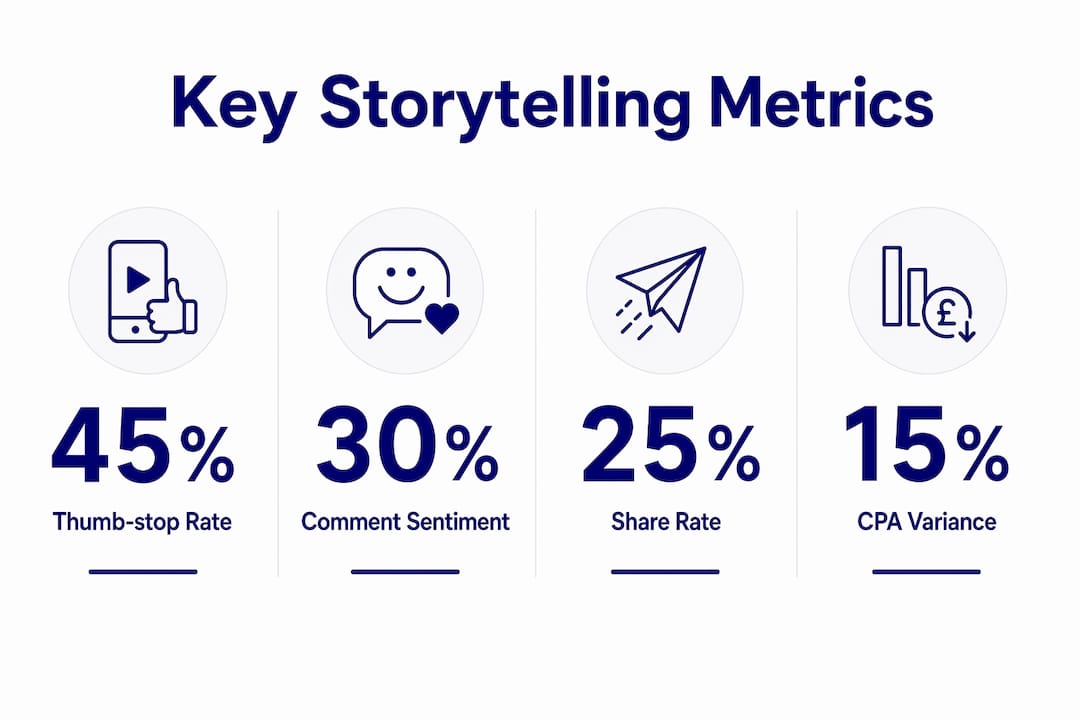
The metrics that matter most for narrative performance fall into two categories:
Resonance metrics track whether the story is connecting emotionally:
- Thumb-stop rate on video content
- Comment sentiment and the specific language audiences use in responses
- Share rate as a proxy for “this story is worth telling someone else”
Conversion metrics track whether the story is driving behaviour:
- New versus returning customer response to specific creative
- Landing page conversion rate segmented by story angle
- CPA variance across narrative themes
| Metric | What it tells you |
|---|---|
| Thumb-stop rate | Whether your opening tension is immediately recognisable |
| Comment sentiment | Whether audiences are identifying with the protagonist |
| New vs returning response | Whether the story attracts new audiences or reinforces existing ones |
| CPA by narrative theme | Which story angles are most commercially effective |
Narrative evolution becomes necessary when hook rates decline, creator language drifts from your core tension, or competitor narratives start to resemble yours. The fix is not a rebrand. It is layering a new tension onto your existing story architecture, keeping the original character and transformation intact while introducing a fresh conflict that reconnects with your audience’s current reality.
What are the most effective modern storytelling techniques for 2026?
Fresh storytelling techniques in 2026 centre on specificity, surprise, and integration across every touchpoint. Generic emotional appeals no longer cut through. Audiences have developed strong filters for vague brand warmth, and the brands winning attention are the ones with stories specific enough to feel true.
The most effective techniques to apply right now are:
- Lead with sensory and emotional specificity. “The pan that doesn’t stick when you’re cooking at 6am half-awake” is more compelling than “premium cookware for everyday use.” Concrete proof points and emotional outcomes increase both memorability and perceived authenticity.
- Introduce a misfit narrative element. Unexpected, slightly illogical story details boost memorability because they disrupt pattern recognition. Olipop’s framing of soda as a health product is a textbook example. It is counterintuitive enough to create genuine curiosity.
- Move from product-first to tension-first. Open every story with the problem, not the solution. The solution only earns attention once the audience has recognised the tension as their own.
- Treat every touchpoint as a story chapter. Packaging, email subject lines, post-purchase sequences, and organic social posts are all chapters in a unified narrative. Packaging and UX copy treated as part of the story architecture strengthen post-purchase emotional alignment and reduce buyer’s remorse.
Research on green brand storytelling confirms that authentic, concise narratives with humour and reversal produce stronger consumer engagement and purchase intent. The principle applies well beyond sustainability marketing. Reversal, the moment a story defies expectation, is one of the most underused tools in brand communications.
Pro Tip: Run a “touchpoint audit” once a quarter. Read every customer-facing piece of copy in sequence, from first ad to post-purchase email, and ask whether it reads as a coherent story or a collection of disconnected messages.
Why brand storytelling is strategic infrastructure, not marketing spin
I have worked with enough marketing teams to know that the biggest storytelling problem is rarely a lack of creativity. It is a lack of architecture. Teams produce genuinely good individual pieces of content, but without a shared narrative system, those pieces do not accumulate into anything. Each campaign starts from scratch. Each creator interprets the brief differently. The brand’s story never compounds.
What changed my thinking was seeing how the brands with the most consistent narrative performance, Hexclad, Olipop, Graza, all treat storytelling as an operational discipline. They have documents, pipelines, and feedback loops. They audit their narrative the way a finance team audits a budget. That rigour is what separates brands that grow through storytelling from brands that just produce content.
The uncomfortable truth is that most brand books are not storytelling systems. They are style guides with a mission statement attached. A real narrative system defines the customer’s tension, assigns roles, maps story themes to channels, and has a process for evolving the story when it starts to lose traction. That is a fundamentally different kind of document, and building it requires editorial discipline, not just creative enthusiasm.
My advice to any marketing leader reading this: treat your next brand narrative review as an infrastructure project, not a creative refresh. The creative systems that produce consistent, on-brand content at scale are built on clear story architecture, not talent alone.
— Calum
Ready to build a brand narrative that actually scales?
At Michaelbell, we work with marketing teams and business leaders who know their brand has a strong story but struggle to get it working consistently across channels, creators, and campaigns. We specialise in building the narrative systems, creative briefs, and alignment frameworks that turn a good story into a repeatable engine for growth.
Whether you need a full narrative architecture built from scratch or a structured review of your existing brand story, our team operates as an extension of yours. Explore our brand communications services to see how we approach narrative development, creative alignment, and storytelling systems that deliver measurable results. We love a challenge and we would be glad to help you turn your brand comms into brand love.
Key takeaways
Revitalising your brand storytelling approach requires building a narrative system with defined components, not producing better individual campaigns.
| Point | Details |
|---|---|
| Build a narrative system | Create a Brand Narrative Document, Creative Expression Matrix, and brief-to-publish pipeline before briefing any creator. |
| Put the customer as hero | Story-based ads are twice as effective when they centre on customer tension and transformation, not product features. |
| Brief narrative before execution | Briefing hooks before story alignment produces content that lacks durable impact and compounds inconsistency across creators. |
| Measure narrative coherence | Track belief cluster momentum, comment sentiment, and CPA by story theme rather than relying on engagement volume alone. |
| Evolve the story, not the brand | When hook rates decline or competitor narratives converge, layer new tensions onto your existing story architecture rather than rebranding. |
FAQ
What does it mean to revitalise a brand storytelling approach?
Revitalising a brand storytelling approach means replacing ad hoc campaign thinking with a scalable narrative system that includes a Brand Narrative Document, a Creative Expression Matrix, and a brief-to-publish pipeline. The goal is coherent, compounding storytelling across every channel and creator.
How much can narrative arcs improve brand performance?
Ads built around story with characters and outcomes are twice as likely to land in the top third of performers compared to non-story ads, based on Ipsos analysis of 15,000 ads. Hexclad’s narrative overhaul produced a 34% CPA reduction and a 41% improvement in thumb-stop rate.
How do you align external creators with your brand story?
Use narrative-led briefs that open with your brand’s origin tension and assign creators a role within the story rather than briefing them as product advocates. Pair this with a shared proof library and a narrative tagging taxonomy to maintain consistency across your creator network.
What metrics should you track for brand storytelling?
Track thumb-stop rate, comment sentiment, share rate, and CPA variance by narrative theme. Belief cluster momentum and evidence of audiences adopting your brand’s language are stronger indicators of narrative success than engagement volume alone.
When should you update your brand narrative?
Update your narrative when hook rates decline, creator language drifts from your core tension, or competitor stories start to resemble yours. The approach is to layer new tensions onto your existing story architecture, not to rebrand from scratch.