
Maintain brand control with agency partnerships

Brand control is defined as the internal ownership of brand identity combined with structured governance over how external partners execute that identity. When you work with a marketing agency, you do not hand over your brand. You direct it. The distinction matters because brand identity is fully controlled internally, whilst brand image is shaped by public perception and experience beyond your direct control. To maintain brand control with agency partners, you must first own your positioning, then build the governance frameworks that keep agency execution on track. Michaelbell works with marketing teams every day on exactly this challenge.
What does brand control mean in an agency partnership?
Brand control in an agency context means retaining internal ownership of brand positioning, messaging, and approval authority whilst outsourcing specialist execution tasks. Agencies execute brand messaging but do not own brand positioning. That distinction is the foundation of every healthy agency relationship.
The risk of blurred ownership is real. When a brand team delegates positioning decisions to an agency, brand dilution follows. The agency optimises for campaign performance. You must optimise for long-term brand equity. These goals are complementary only when roles are clearly separated.

The identity-image gap is the clearest signal of lost brand control. Healthy brands manage a small, well-controlled gap between the identity they project and the image audiences hold. When that gap widens, no amount of agency activity closes it. The fix is internal, not external.
Key warning signs that brand control is slipping include:
- Agency-produced content that contradicts your core messaging or tone
- Multiple internal stakeholders giving conflicting direction to the agency
- Campaign outputs that reflect the agency’s aesthetic preferences rather than your brand standards
- No single person accountable for approving brand-related decisions
- Brand voice drifting across channels over successive campaigns
A brand communications strategy gives you the framework to prevent all five of these. Without one, even a talented agency will fill the gaps with their own judgement.
What must you prepare internally before working with an agency?
Internal readiness is the prerequisite for effective agency collaboration. Advertising a quality a company does not deliver worsens brand perception. Fix the operational experience first, then communicate it. This sequence is non-negotiable.
The four internal preparations that matter most are:
-
Comprehensive brand identity documentation. Your brand guidelines must cover logo usage, colour palette, typography, photography style, tone of voice, and messaging hierarchy. Brands must regularly audit identity elements including logos, colour usage, and voice rules to ensure third parties can implement them consistently. A voice guide is only useful if multiple writers can replicate it without your input.
-
Clear assignment of brand ownership. One person must hold final approval authority over brand decisions. A brand team as small as one accountable person can maintain control if they clearly own positioning, messaging approvals, and brand consistency. Size is not the constraint. Clarity is.
-
Alignment of experience with brand promises. If your product or service does not yet deliver on what your brand promises, fix that before briefing an agency. Campaigns built on undelivered promises accelerate negative perception, not positive brand equity.
-
An internal brand audit. Review every customer touchpoint against your brand standards before agency work begins. Identify where your identity and your customers’ actual experience diverge. Resolve those gaps internally. Then brief the agency on the brand you have, not the brand you aspire to be.
Pro Tip: Run a simple brand audit by asking three customers to describe your brand in their own words. Compare their language to your internal brand guidelines. The gap between the two is your starting point for internal alignment work.
How do you build governance frameworks with your agency?
Governance is the mechanism that keeps brand control intact throughout an active agency relationship. Unclear client briefs and poor feedback consolidation cause more agency relationship failures than agency underperformance. The problem is almost always on the client side.
Effective governance rests on five structural elements:
- Single points of contact. One person on your side owns the relationship. One person on the agency side owns delivery. Multiple contacts on either side create conflicting direction and slow decisions.
- Defined briefing documents. Every project brief must answer: what is the objective, who is the audience, what is the message, what are the constraints, and what does success look like. Ambiguity in briefs produces ambiguity in outputs.
- Formalised change control. Scope changes must go through a written change order process. Verbal agreements about additional work create disputes and dilute accountability.
- Consolidated feedback. One person collects all internal feedback before it reaches the agency. Unfiltered, contradictory feedback from multiple stakeholders is one of the fastest ways to lose brand consistency.
- Contractual IP clarity. Contract Statements of Work should clearly specify ownership of all deliverables and related data assets. Explicitly contract ownership of work-in-progress and campaign data separately from final deliverables to avoid disputes when the engagement ends.
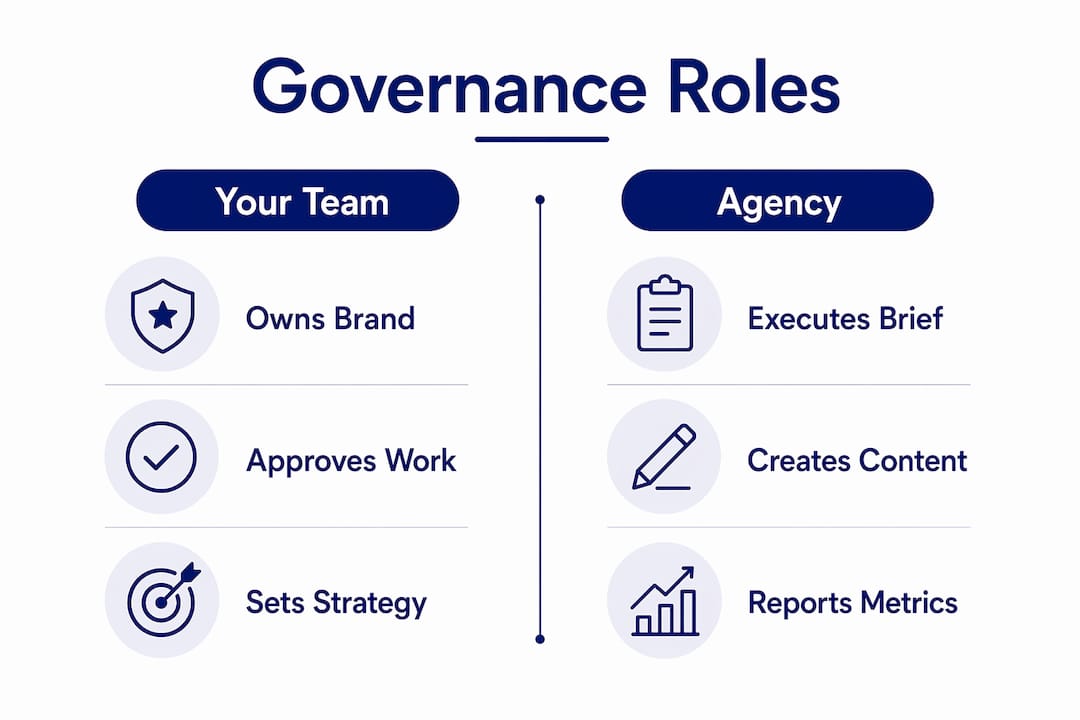
The table below shows how governance responsibilities split between your team and the agency.
| Responsibility | Your team | Agency |
|---|---|---|
| Brand positioning | Owns and approves | Executes to brief |
| Campaign messaging | Approves final copy | Drafts and iterates |
| Creative direction | Sets brand standards | Applies within standards |
| Performance data | Reviews and acts on | Reports and analyses |
| IP and deliverables | Owns all outputs | Transfers on completion |
Pro Tip: Schedule a 30-minute monthly governance review with your agency contact. Review one recent output against your brand guidelines together. This single habit catches drift early and keeps both teams aligned without micromanagement.
How do you monitor brand consistency throughout agency campaigns?
Monitoring brand consistency requires a mix of quantitative tracking and qualitative listening. Quantitative data shows what audiences think; qualitative shows why. Neither method alone gives you the full picture.
The most effective monitoring framework combines four inputs:
| Monitoring method | What it measures | Frequency |
|---|---|---|
| Brand tracking surveys | Awareness, perception, and association scores | Quarterly |
| Social listening | Spontaneous customer language and sentiment | Ongoing |
| Customer feedback audits | Experience versus brand promise alignment | Monthly |
| Agency output reviews | Compliance with brand guidelines | Per campaign |
Elite brand teams incorporate monthly reviews of agency outputs against KPIs and business results to keep brand messaging on track. Monthly reviews are not about micromanagement. They are about catching small deviations before they become patterns.
Social listening is particularly underused by marketing teams. It captures how customers talk about your brand in their own words, unprompted. That language is more honest than any survey response. When the words customers use to describe you diverge from your brand guidelines, you have an identity-image gap that needs attention. Understanding how to measure brand image through structured tracking is a core leadership skill, not an optional extra.
What are the most common pitfalls when working with agencies?
The most common pitfalls in agency collaboration are predictable and preventable. Knowing them in advance puts you in a far stronger position.
- Scope creep without change control. Projects expand informally, budgets stretch, and accountability blurs. Every change to scope must be documented and agreed in writing before work begins.
- Internal stakeholder conflicts reaching the agency. Unresolved disagreements between your own team members should never surface in agency briefings. Resolve internal alignment before the agency is involved.
- Brand voice drift across campaigns. Without a replicable voice guide and regular output reviews, agency-produced content gradually drifts toward generic category language. Your brand sounds like everyone else.
- IP ownership left unresolved. Failing to specify who owns campaign data, creative assets, and performance history creates serious problems when an engagement ends. Specify ownership in the contract before work starts.
“The agency relationship fails when the client expects the agency to own what only the client can own: brand direction, internal alignment, and the courage to make decisions.”
Qualities that distinguish agencies worth working with include a willingness to push back on unclear briefs and a preference for written agreements over verbal commitments. The qualities of an aligned creative agency are worth understanding before you sign any contract.
Key takeaways
Maintaining brand control with an agency requires internal ownership of brand identity, clear governance frameworks, and consistent monitoring of outputs against brand standards.
| Point | Details |
|---|---|
| Own brand identity internally | One accountable person must hold final approval authority over all brand decisions. |
| Fix experience before communicating | Resolve product and service gaps before briefing an agency on brand messaging. |
| Govern through structure | Use single points of contact, written briefs, and formal change control to prevent drift. |
| Specify IP ownership upfront | Contract ownership of all deliverables, data, and work-in-progress before work begins. |
| Monitor with mixed methods | Combine quarterly tracking surveys with ongoing social listening to catch perception gaps early. |
The relationship between brand leaders and agencies is evolving
I have seen a consistent pattern across brand teams of every size. The leaders who maintain the strongest brand control are not the ones who micromanage every agency output. They are the ones who do the internal work first and then trust the governance they have built.
The temptation is to treat the agency as the solution to an internal alignment problem. It never works. If your own team cannot agree on what your brand stands for, the agency will fill that vacuum with their own interpretation. That is not a failure of the agency. It is a failure of internal leadership.
What I find most interesting is how little brand control actually depends on budget or team size. A single, clear-minded brand owner with a well-documented identity and a structured briefing process will outperform a large, fragmented team every time. The role of external creative is to amplify what you have already built internally. It cannot substitute for what you have not yet built.
The leaders I respect most in this space treat their agency as an execution partner with clear boundaries, not a strategic authority. They hold the final say on positioning. They welcome agency expertise on craft and channel. And they review outputs regularly, not to catch the agency out, but to keep the relationship honest and productive. That balance is where the best brand work comes from.
— Calum
How Michaelbell supports brand control in agency partnerships
Working with an external agency does not mean giving up control of your brand. It means building the right structures so that control is never in question.
Michaelbell works as an embedded partner rather than an outside vendor, which means we help you build the internal alignment and governance frameworks that keep your brand consistent across every channel and campaign. From brand communications services that define your identity and approval workflows, to ongoing support in measuring brand health and managing agency outputs, we give marketing teams the clarity and confidence to direct agency work without losing momentum. If you want the dedication of an in-house team without the overhead, we would love to talk.
FAQ
What is brand control in an agency relationship?
Brand control is the internal ownership of brand positioning, messaging, and approval authority whilst an agency handles execution. The agency delivers outputs; the brand team owns direction.
How do I maintain brand integrity when working with an agency?
Document your brand identity fully, assign one person as the internal brand owner, and use a structured briefing and approval process for every project. Consistent governance prevents drift.
Who owns the brand when working with a marketing agency?
The client always owns the brand. Agencies execute to brief and transfer all deliverables and data to the client. Ownership of intellectual property must be specified in the contract before work begins.
How often should I review agency outputs for brand consistency?
Monthly reviews of agency outputs against brand guidelines and KPIs are the standard for teams that maintain strong brand consistency. Quarterly brand tracking surveys add a broader perception check.
What causes brand voice drift in agency campaigns?
Brand voice drift occurs when agencies lack a replicable voice guide and receive inconsistent feedback from multiple client stakeholders. A single feedback owner and a detailed tone of voice document prevent it.