
Role of agency in brand revitalization: 2026 guide

Brand revitalization is defined as a targeted renewal programme that restores a brand’s market relevance, distinct from a turnaround focused purely on financial survival. The role of agency in brand revitalization is to lead that programme with structure, expertise, and objectivity that most in-house teams cannot replicate alone. Agencies orchestrate integrated phases of advisory, creative redevelopment, and governance to rebuild distinctiveness and preference. For marketing executives and brand managers, understanding exactly what a skilled agency brings to this process is the difference between a brand that recovers and one that fades quietly into irrelevance.
What specific responsibilities does an agency undertake during brand revitalization?
An agency’s primary responsibility is to reinterpret the brand’s founding identity and realign it with current market realities. Brand revitalization is not merely cosmetic. It requires renewing brand meaning, strengthening favourable associations, and rebuilding reputation capital through integrated action across every touchpoint.
The functional responsibilities agencies carry during this process fall into four distinct areas:
- Strategic advisory. Agencies audit brand equity, map competitive positioning, and redefine the narrative. Strengthening clarity, distinctiveness, and favourability of brand associations is the core of enduring brand value. This is not a one-off workshop. It is an ongoing strategic commitment.
- Creative redevelopment. Agencies update visual identity, messaging architecture, and campaign activation to reflect the renewed positioning. The creative work must feel coherent, not like a cosmetic refresh bolted onto an unchanged brand.
- Brand governance. Narrative coherence across touchpoints is what separates successful revitalizations from alienating rebrands. Agencies establish governance frameworks that keep every channel, team, and communication aligned with the new brand direction.
- Metrics and reporting. Agencies track salience, consideration, and preference rather than vanity metrics. Revitalization focuses on metrics like salience, consideration, and preference, while a turnaround prioritises gross margin and EBITDA. That distinction matters because it defines what success actually looks like.
Agencies also play a role that PR or crisis management firms do not. Crisis management restores short-term reputation. Brand revitalization rebuilds long-term equity. The two are not interchangeable.
Pro Tip: Ask any agency you are evaluating to show you a brand metrics dashboard from a previous revitalization programme. If they cannot, they are managing campaigns, not brand equity.
How do agencies structure and implement brand revitalization programmes?
Structured brand revitalization programmes follow fixed timelines of 90, 180, or 365 days to rebuild brand value, narrative clarity, and positioning after decline. Each phase has distinct objectives, and the sequencing matters as much as the individual activities.
| Phase | Duration | Primary objective | Key activities |
|---|---|---|---|
| Discovery and strategy | Days 1–90 | Audit, diagnose, and reposition | Brand equity audit, competitor benchmarking, narrative redefinition |
| Creative redevelopment | Days 91–180 | Rebuild identity and messaging | Visual identity refresh, messaging architecture, internal alignment |
| Governance and activation | Days 181–365 | Embed and sustain | Brand governance frameworks, campaign activation, metrics reporting |
The 90-day discovery phase is where agencies earn their keep. They immerse in the client’s culture, interview stakeholders, analyse market data, and produce a positioning platform that the entire programme builds upon. Skipping this phase and jumping to creative work is the most common reason revitalization programmes fail.
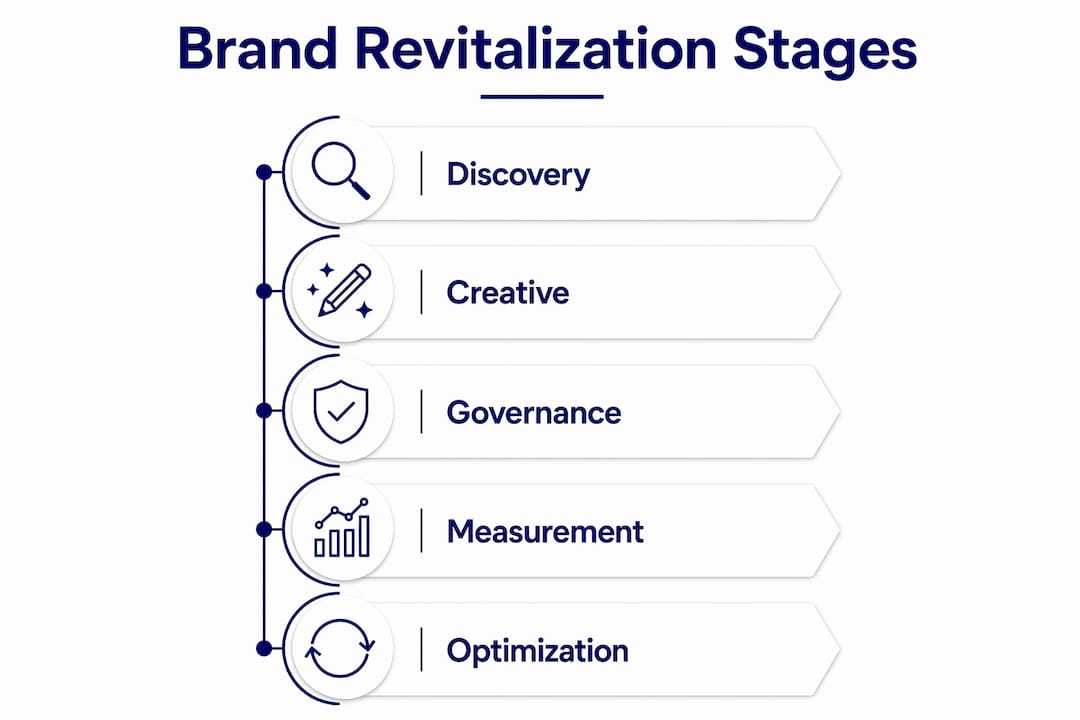
The 180-day creative phase is where narrative becomes visible. Agencies redevelop identity systems, rewrite messaging hierarchies, and begin internal communications to align teams before external campaigns launch. Internal alignment before external activation is not optional. A brand that speaks one way externally and operates differently internally loses credibility fast.
The final 365-day governance phase is where most agencies differentiate themselves. Programmes integrate strategic advisory, narrative redefinition, brand governance, and operational execution, not just PR campaigns. Continuous monitoring, stakeholder reporting, and adaptation cycles keep the revitalization on track as market conditions shift.
Pro Tip: Build a brand metrics dashboard at the start of the programme, not the end. Baseline data from day one gives you a clear before-and-after story that justifies the investment and guides mid-programme corrections.
What strategic advantages do agencies bring versus in-house efforts?
Agencies bring three advantages that in-house teams structurally cannot replicate: objectivity, cross-disciplinary talent, and market breadth.

Objectivity is the most underrated advantage. In-house teams are close to the brand’s history, internal politics, and legacy decisions. That proximity creates blind spots. An agency sees the brand as the market sees it, which is the perspective that actually matters during revitalization.
Cross-disciplinary talent is the second advantage. Agencies coordinate expertise from insight to activation, drawing on strategists, researchers, writers, designers, and channel specialists simultaneously. Building that team in-house for a finite revitalization programme is neither practical nor cost-effective.
The third advantage is market breadth. Agencies work across categories and have access to cultural storytellers, trend data, and benchmarking that no single brand team accumulates. External market insights and objective narrative evolution are crucial for balancing legacy with the kind of fresh thinking that re-engages lapsed audiences.
The specific advantages agencies bring include:
- Access to proprietary research tools and brand tracking methodologies
- Experience managing brand transitions without alienating core customers
- Ability to engage cultural influencers and category storytellers at scale
- Benchmarking data from comparable revitalization programmes across sectors
- Capacity to run advisory, creative, and governance workstreams in parallel
For a deeper look at how these advantages play out in practice, the strategies that work in brand revitalization show the patterns that consistently produce results.
How can marketing executives collaborate with agencies for revitalization success?
The quality of the agency partnership determines the quality of the revitalization outcome. Marketing executives who treat agencies as vendors get vendor-level results. Those who treat agencies as embedded partners get something closer to a brand transformation.
Effective collaboration follows a clear sequence:
- Define objectives before briefing. Agree on the specific brand metrics you are trying to move, whether that is salience, consideration, or net promoter score, before the agency writes a single word of strategy. Vague briefs produce vague strategies.
- Share culture, not just data. Culture immersion is a best practice for maximising revitalization success. Give the agency access to your people, your internal language, and your honest assessment of where the brand has failed. Sanitised briefings produce generic strategies.
- Establish governance roles early. Decide who owns brand decisions internally and who has sign-off authority. Ambiguity at this level creates delays and diluted creative work.
- Balance heritage with evolution. The agency’s job is to reinterpret the brand’s founding identity, not erase it. Marketing executives who understand this distinction avoid the most common cause of revitalization failure: abandoning what made the brand meaningful in the first place.
- Select agencies with proven frameworks. Ask for case studies that show phased programme delivery, brand metrics tracking, and governance documentation. An agency that has done this before will have evidence of it.
For organic growth through marketing strategy, the same principle applies: structure and measurement are what separate programmes that produce results from those that produce activity.
A revitalization programme is a shared endeavour. The agency brings expertise and objectivity. The marketing team brings institutional knowledge and decision-making authority. Neither succeeds without the other.
Key takeaways
The role of agency in brand revitalization is to lead structured, phased programmes that rebuild brand equity through strategic advisory, creative redevelopment, and governance, not through campaigns alone.
| Point | Details |
|---|---|
| Revitalization is not a turnaround | Agencies focus on salience, preference, and narrative clarity rather than short-term financial metrics. |
| Phased programmes drive results | 90, 180, and 365-day structures ensure each stage builds on the last with clear objectives. |
| Governance is non-negotiable | Narrative coherence across all touchpoints separates successful revitalizations from damaging rebrands. |
| Objectivity is the agency’s core value | External perspective removes the blind spots that in-house teams accumulate through proximity. |
| Partnership quality determines outcomes | Executives who share culture, set clear metrics, and establish governance roles get the best results. |
Why I think most revitalization programmes fail before they start
The most common mistake I see is executives briefing agencies on what they want the brand to look like, rather than what the brand needs to mean. Those are very different conversations, and conflating them wastes months.
A major misconception is that revitalization is about visibility. The core is strategic recommitment to relevance and narrative alignment with market realities. Visibility without relevance is just noise. I have watched brands invest heavily in campaign activation before the narrative work was done, and the result is always the same: short-term attention, no lasting equity recovery.
The agencies that genuinely move brand metrics are the ones that insist on the discovery phase even when clients push to skip it. That insistence is not stubbornness. It is professional discipline. The brands that resist it are usually the ones that come back twelve months later wondering why nothing stuck.
My honest advice to any marketing executive entering a revitalization programme: treat the agency as a brand control partner, not a supplier. Give them access, give them honesty, and hold them accountable to brand metrics rather than creative awards. That combination produces results.
— Calum
How Michaelbell supports brand revitalization programmes
Michaelbell works with marketing executives and brand managers who need more than a creative agency. We operate as an embedded partner across the full revitalization cycle: strategic advisory, creative redevelopment, internal communications alignment, and brand governance.
We do not just produce campaigns. We build the frameworks that keep your brand coherent as it evolves, and we track the metrics that tell you whether the work is actually moving equity. Our team brings the objectivity of an external agency with the commitment of an in-house partner, at a fraction of the cost of building that capability yourself. If you are planning a revitalization programme and want a partner who understands the full scope of what that requires, explore our brand communication services and see how we approach it.
FAQ
What is the difference between brand revitalization and a brand turnaround?
Brand revitalization restores relevance and equity for a brand experiencing decline, focusing on salience, consideration, and preference. A turnaround prioritises financial survival metrics such as gross margin and EBITDA.
How long does a brand revitalization programme typically take?
Structured programmes run for 90, 180, or 365 days depending on the depth of decline and scope of change required. Each phase has distinct objectives, from discovery and strategy through to governance and activation.
Why should a marketing executive use an agency rather than an in-house team?
Agencies bring objectivity, cross-disciplinary talent, and market benchmarking that in-house teams cannot replicate. They also manage advisory, creative, and governance workstreams simultaneously, which most internal teams lack the capacity to do.
What metrics should a brand revitalization programme track?
The primary metrics are brand salience, consideration, and preference. These measure equity recovery rather than short-term campaign performance and give a clearer picture of whether the revitalization is working.
How do you know if an agency is right for a revitalization programme?
Ask for evidence of phased programme delivery, brand metrics dashboards, and governance documentation from previous revitalization work. An agency with genuine experience will have all three.