
The role of agency in startup branding explained

A branding agency’s role in startup branding is to deliver strategic positioning, expert creative execution, and scalable brand systems that make your business clearer, more distinctive, and commercially effective from day one. This goes far beyond designing a logo. The most effective branding agencies for startups act as strategic partners, helping founders answer fundamental questions about who they are, who they serve, and why anyone should care. Harvard Business Review and McKinsey research confirm that companies treating branding as a core growth strategy consistently outperform those that do not, with Interbrand reporting £2.7 trillion in unrealised brand value since 2000. That figure represents the commercial cost of treating brand as an afterthought. Edelman’s 2025 brand trust study, covering 15,000 respondents across 15 countries, found that trust is now driven by personal relevance and emotional connection rather than visual polish alone.
How do branding agencies help startups clarify their positioning?
The role of agency in startup branding begins with diagnosis, not design. Before any creative work starts, a good agency conducts structured market and audience analysis to understand where your startup sits relative to competitors and what your prospective customers actually value. This process surfaces perception gaps, internal misalignments, and untested assumptions that founders often carry without realising it.
Agencies use this intelligence to build a positioning framework: a clear articulation of who you are for, what problem you own, how you differ, and what people should remember about you. Filip Konecny Enterprises describes six critical questions every branding agency should help a startup answer, covering audience, differentiation, memory, look and sound, and implementation. These questions are not rhetorical. They produce documented outputs that guide every creative decision that follows.
The messaging work that emerges from this phase is where many startups gain the most immediate value. Founders often know their product deeply but struggle to communicate it in terms their audience recognises. An agency translates internal expertise into language that resonates emotionally, which matters because emotional relevance is now a primary driver of brand trust.
- Conduct audience and competitor analysis before any visual work begins
- Identify the single problem your brand owns in the market
- Define your key differentiator in one sentence your team can repeat consistently
- Establish a messaging hierarchy: primary claim, supporting proof points, and tone of voice
- Document the positioning framework so it survives team changes and agency transitions
Pro Tip: Retain ownership of your positioning document internally. An agency can build it with you, but your founding team must be able to articulate it without referring to a deck. If you cannot, the positioning has not landed yet.
What specific services do branding agencies provide to startups?
Branding agencies for startups deliver a structured set of outputs that span strategy, identity, and implementation. Understanding the difference between a full-service branding agency and a design vendor is critical before you sign anything.

| Service | Branding agency | Design vendor |
|---|---|---|
| Positioning and messaging strategy | Yes, core deliverable | Rarely included |
| Visual identity (logo, colour palette, typography) | Yes, strategy-led | Yes, execution-led |
| Verbal identity and tone of voice | Yes | Occasionally |
| Brand guidelines document | Yes, comprehensive | Basic or none |
| Rollout planning and phased implementation | Yes | No |
| Internal adoption support | Yes | No |
The distinction matters because a design vendor produces assets. A branding agency produces a system. That system includes brand guidelines that govern how every touchpoint looks, sounds, and feels, from your website and pitch deck to your email signatures and social content. Kantar’s Meaningful, Different and Salient framework, verified by MASB, confirms that agencies delivering this kind of systemic identity work translate it directly into pricing power, market share logic, and customer memory. These are commercial outcomes, not aesthetic ones.
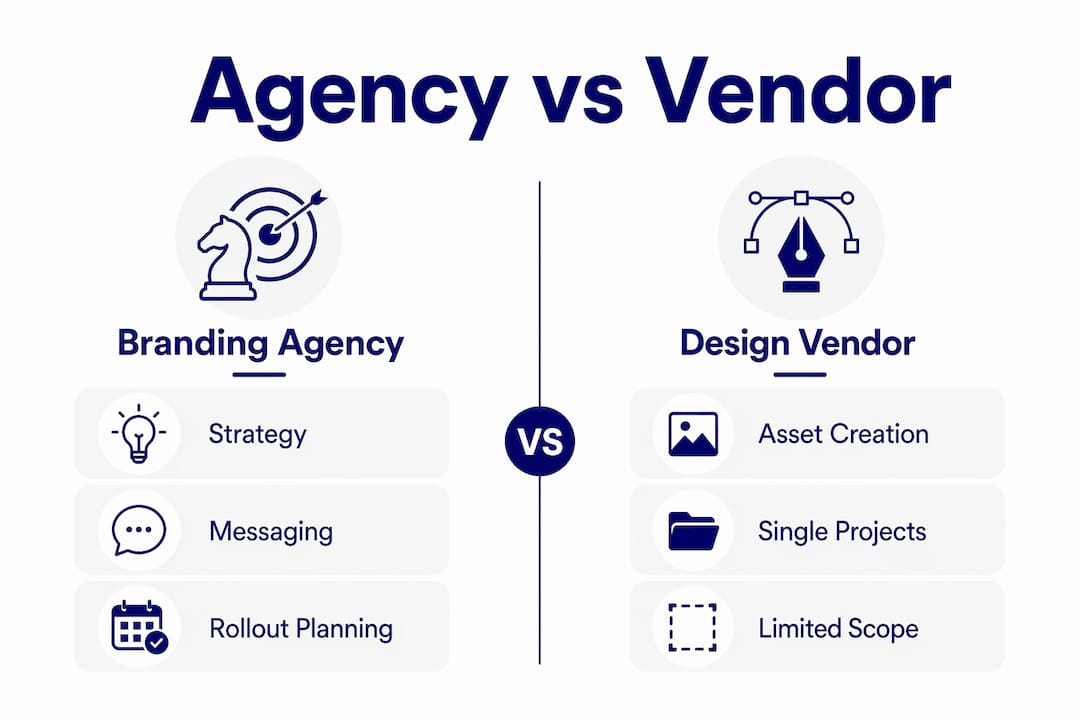
Rollout planning is one of the most undervalued agency services. Nielsen’s 2024 Marketing Report supports phased asset updates as the most effective way to avoid budget waste, minimise internal resistance, and maintain public consistency during a rebrand or initial brand launch. Agencies that skip this phase leave startups with a beautiful brand book and no clear path to implementation.
For startups managing limited resources, the prioritisation discipline that agencies bring to rollout planning is genuinely useful. You do not need every asset updated simultaneously. You need the highest-impact touchpoints addressed first, typically your website, pitch materials, and primary sales collateral.
Agency versus in-house: when should a startup choose each?
The decision to hire a branding agency or build internal brand capabilities is not binary. Most startups benefit from a hybrid model, and understanding when each approach serves you best is one of the more practical decisions you will make in your early growth phase.
- Hire an agency when you need speed, specialist skills, or output volume that your internal team cannot match. Jelo Casaul at Marketing Executions is direct on this point: agencies deliver results faster than building in-house capabilities, which is critical during rapid growth phases where brand clarity cannot wait six months for a new hire to onboard.
- Build internal capability when you need long-term brand stewardship, consistent approvals, and day-to-day brand governance. An internal brand owner or marketing lead who understands your positioning deeply is irreplaceable for maintaining consistency across hundreds of small decisions.
- Use a hybrid model when you want the specialist execution of an agency combined with the strategic ownership of an internal team. This is the most effective structure for startups scaling past their seed stage, where brand decisions multiply faster than any single agency relationship can manage.
- Avoid full outsourcing of brand ownership at all costs. Marketing Executions’ analysis is clear that startups fail when they hand over complete brand ownership to an agency. Without an internal counterpart owning final approvals, agency output drifts toward aesthetics and away from commercial alignment.
Pro Tip: Appoint a named internal brand owner before your agency engagement begins. This person does not need to be a designer. They need to understand your business goals well enough to make brand decisions that serve them.
How do agencies help startups build trust and emotional connection?
Brand trust is the commercial outcome that separates startups with loyal customers from those constantly fighting for attention. Agencies build this trust by translating your brand values into authentic visual and verbal identity that feels consistent and credible across every interaction.
Edelman’s 2025 research found that personal relevance and emotional connection now drive trust more than production quality or brand heritage. This finding has a direct implication for how agencies should approach startup branding: the goal is not to look polished, it is to feel relevant. An agency that prioritises strategic positioning over superficial creative output delivers this.
The practical steps agencies take to build authentic connection include:
- Defining brand values in behavioural terms, not abstract words like “integrity” or “innovation”
- Creating a tone of voice that reflects how your audience actually speaks, not how you want to sound
- Designing visual identity that signals the right category cues while differentiating within it
- Mapping brand expression across the customer journey to identify where trust is built or broken
- Testing messaging with real audience segments before committing to a full rollout
“Many businesses underinvest in brand until growth slows. Strong branding agencies translate identity work into pricing power, market share logic, customer memory, and future growth potential.” Kantar and MASB research
The impact on competitive positioning is significant. A startup with a clearly articulated, emotionally resonant brand commands attention in crowded markets without needing to outspend larger competitors. That is the commercial case for investing in agency expertise early.
What are best practices for working effectively with a branding agency?
The quality of your agency relationship determines the quality of your brand output. Founders who treat agencies as vendors get vendor-quality results. Founders who treat agencies as partners get something closer to a creative supercharger for their growth.
| Do | Do not |
|---|---|
| Appoint a named internal brand owner | Hand over full brand ownership to the agency |
| Share business goals and growth targets upfront | Brief on aesthetics without strategic context |
| Prioritise rollout phases by commercial impact | Try to update every asset simultaneously |
| Review brand performance against agreed KPIs | Judge success on visual preference alone |
| Maintain regular strategic check-ins | Go silent between briefs and expect alignment |
The most common failure mode in agency-startup relationships is a lack of strategic context at the brief stage. Agencies cannot build commercially effective brands without understanding your revenue model, your sales cycle, and your growth targets. The more business context you share, the more your agency can align creative decisions with outcomes that matter.
Regular performance reviews are equally important. Brand effectiveness should be measured against metrics like aided and unaided awareness, message recall, and conversion rates at key funnel stages. Internal brand ownership by a designated team member is critical to prevent agency output drifting into inconsistent or purely aesthetic approaches. Reviewing these metrics jointly with your agency keeps the relationship focused on commercial results rather than creative preference.
Key takeaways
A branding agency’s role in startup success is strategic, not decorative: agencies that combine positioning expertise with disciplined rollout planning deliver measurable commercial outcomes, not just attractive assets.
| Point | Details |
|---|---|
| Strategy before design | Agencies should diagnose positioning and messaging before any visual work begins. |
| Internal ownership is non-negotiable | Appoint a named brand owner internally to prevent agency output drifting from business goals. |
| Hybrid models work best | Combine agency specialist skills with internal brand stewardship for sustainable growth. |
| Rollout planning protects investment | Phased implementation reduces waste and maintains consistency during brand launches. |
| Trust is built through relevance | Emotional connection and personal relevance now drive brand trust more than visual polish. |
Why I think most startups get their agency relationship wrong
Most founders I speak with approach a branding agency the way they approach a printer: tell them what you want, collect the output, move on. That mindset produces expensive PDFs that nobody uses consistently.
The startups that get the most from agency partnerships are the ones that show up with business problems, not creative briefs. They say “we are losing deals to a competitor we know we are better than” or “our sales team pitches us differently every time.” Those are brand problems with commercial consequences, and they are exactly what a good agency is built to solve.
The uncomfortable truth is that brand clarity is an internal discipline before it is an external expression. An agency can build you a world-class positioning framework, but if your founding team cannot articulate it in a conversation, it will not survive contact with your market. The agency’s job is to create the system. Your job is to live it.
I have also seen founders make the opposite mistake: becoming so protective of their brand that they resist the agency’s strategic input entirely. The best outcomes come from genuine dialogue. You know your business. Your agency knows how audiences perceive and respond to brands. Neither of you has the full picture alone.
Judge your agency not on whether you love the logo, but on whether your team communicates more consistently, your sales materials feel coherent, and your customers describe you the way you want to be described. Those are the outcomes worth paying for.
— Calum
How Michaelbell supports startups with branding
Michaelbell operates as a strategic and creative partner for founders and marketing leads who need brand clarity without the overhead of a full in-house team. We combine positioning strategy, verbal and visual identity, and phased rollout planning into a single, joined-up engagement.
Our team works as an extension of yours, which means you get the specialist skills and speed of an experienced agency alongside the commercial alignment of someone who genuinely understands your growth goals. We have helped startups move from inconsistent messaging to confident, scalable brand systems that support fundraising, sales, and team growth. If you are ready to build a brand that works as hard as you do, explore our branding and communications services or visit MB Brand Communications to see how we work.
FAQ
What is the role of a branding agency for a startup?
A branding agency defines your startup’s positioning, messaging, and visual identity, then plans how to implement it consistently across all channels. The role goes beyond design to include strategic diagnosis, audience analysis, and rollout planning.
When should a startup hire a branding agency?
Hire a branding agency when you need speed, specialist skills, or output volume your internal team cannot deliver. Jelo Casaul at Marketing Executions identifies these three factors as the primary triggers for agency engagement over in-house capability building.
Can an agency boost branding for an early-stage startup?
Yes. Agencies help early-stage startups establish clear positioning and consistent identity before bad habits form. Startups that invest in brand strategy early build stronger foundations for fundraising, hiring, and customer acquisition.
What is the difference between a branding agency and a design vendor?
A branding agency delivers strategy, positioning, verbal identity, guidelines, and rollout planning. A design vendor produces assets. The distinction determines whether you receive a brand system or a collection of files.
How do you measure the impact of a branding agency?
Measure agency impact through aided and unaided brand awareness, message recall, sales conversion rates at key funnel stages, and whether your team communicates your positioning consistently without prompting. Visual preference is not a reliable metric on its own.