
The role of brand positioning strategy for leaders

Brand positioning strategy is the deliberate organisational choice that defines how a brand occupies a specific, meaningful place in the minds of target customers. It is not a tagline or a campaign. Positioning creates emotional, distinctive advantages that are strategic decisions, not communications outcomes. That distinction matters enormously for business leaders and brand strategists, because it shifts responsibility for positioning from the marketing department to the boardroom. Get it right, and every decision your organisation makes, from product development to customer experience, pulls in the same direction.
What are the strategic choices in brand positioning?
Brand positioning is the place a brand deliberately occupies in the customer’s mind, relative to competitors and customer needs. It is distinct from messaging, which is the tactical communication of that position. Understanding this separation stops organisations from confusing a new campaign with a new position.
Four strategic choices define any positioning:
- Target customer. Who is the brand for, and equally, who is it not for? Trying to appeal to everyone produces a position that resonates with no one.
- Competitive frame of reference. Which category does the brand compete in? This shapes the expectations customers bring before they even engage with you.
- Point of difference. What does the brand offer that competitors do not? This must be relevant, deliverable, and credible, not aspirational.
- Brand promise. What consistent experience does the brand commit to delivering? The promise must align with what the organisation can actually sustain.
A brand benefit must matter deeply to the target customer, be deliverable by the organisation, and not be offered by competitors. Failure on any one of these criteria means the benefit is aspirational rather than a genuine position. That is a costly mistake, because it creates a gap between what the brand claims and what customers actually experience.
Pro Tip: Write your positioning statement as an internal compass, not external copy. A strong positioning statement names the target customer, the category, the key benefit, and the competitive alternative. It resolves campaign alignment questions before they arise.

Developing a clear brand positioning framework before any creative work begins saves significant time and budget downstream. It also gives your team a shared language for evaluating every piece of communication.
How does brand positioning shape leadership and internal decisions?
Positioning is not a marketing exercise that leadership signs off on once a year. Effective brand positioning aligns leadership, strategy, culture, and execution around a shared point of view. That alignment reduces fragmented strategy and enables focused creative work, which directly improves marketing effectiveness.
The practical implications reach well beyond the marketing team. Consider four areas where positioning acts as a decision lens:
- Product development. Features that do not support the brand’s position dilute it. Positioning tells product teams what to build and, just as usefully, what to cut.
- Customer experience. Every service interaction either reinforces or contradicts the brand’s position. Positioning gives customer-facing teams a clear standard to meet.
- Organisational culture. Employees who understand the brand’s position make better daily decisions. Culture alignment is not a soft benefit; it reduces costly inconsistencies at scale.
- Operational trade-offs. When resources are limited, positioning tells leaders where to invest and where to hold back. Without it, every budget decision becomes a negotiation with no anchor.
“Organisations that treat brand positioning as an organisational competence, integrating internal and market insights, develop more distinctive, inimitable identities leading to superior performance.”
Brand positioning beyond marketing: A strategic management perspective
Integrating customer research and competitor analysis into positioning decisions removes internal bias. Leaders who rely on instinct alone often position their brand around what they are proud of internally, rather than what customers actually value. Data corrects that drift. You can read more about aligning brand strategy with business goals to see how this integration works in practice.
What is the impact of effective brand positioning on customer perception?
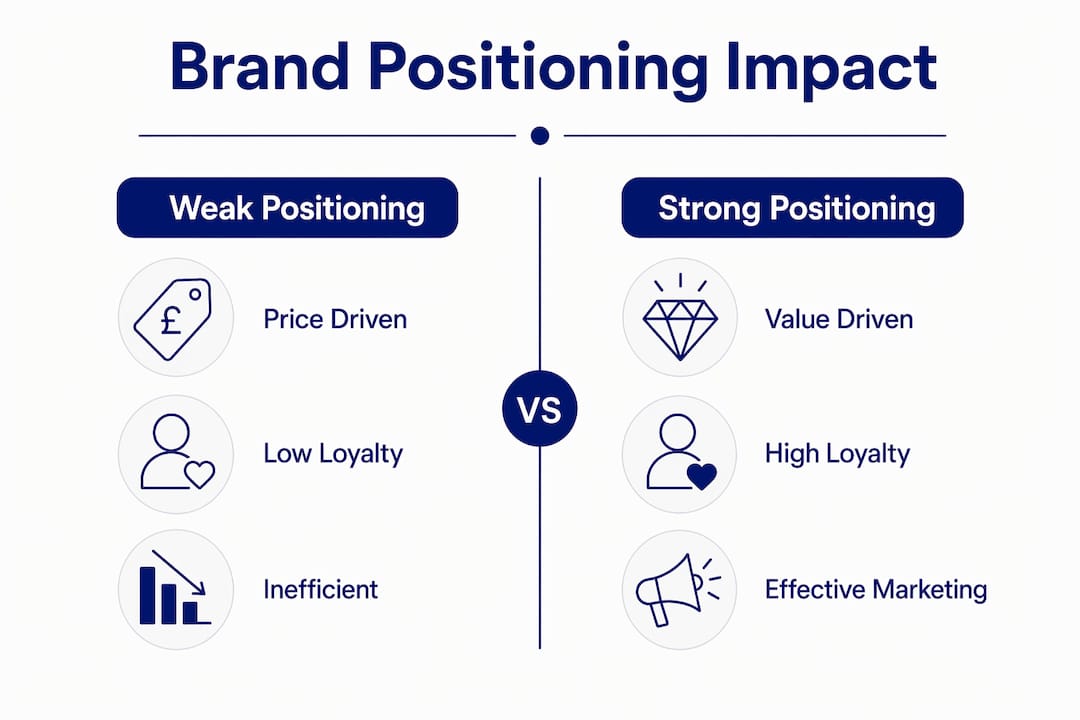
Strong positioning stops brands from competing on price alone. Weak or absent positioning forces customers to default to price-based comparisons, leading to a race to the bottom that erodes margins and brand value simultaneously. A clear position gives customers a reason to choose you that has nothing to do with cost.
The table below shows how positioning strength affects key commercial outcomes:
| Outcome | Weak positioning | Strong positioning |
|---|---|---|
| Purchase decision driver | Price | Perceived unique value |
| Customer loyalty | Transactional | Preference and insistence |
| Marketing efficiency | Low, requires heavy spend | High, consistent message amplifies spend |
| Competitive vulnerability | High, easily substituted | Low, difficult to replicate |
Consistency in reinforcing a brand’s position across all touchpoints over time is critical to maintaining a strong market presence and customer loyalty. Inconsistent positioning creates fragmented brand impressions that weaken effectiveness, even when individual campaigns are well executed. The cumulative effect of consistency is what builds genuine brand insistence, the point where customers actively seek out your brand rather than simply accepting it.
Pro Tip: Audit every customer touchpoint against your positioning statement twice a year. Gaps between the stated position and the actual experience are where brand equity quietly erodes.
The importance of brand positioning also shows up in brand recognition, which compounds over time when a position is held consistently. Brands that shift position frequently never accumulate the recognition that makes marketing efficient.
How can organisations implement and maintain brand positioning?
Defining a position is one thing. Embedding it across an organisation is another. Positioning workshops involving leadership are effective for aligning strategic choices, clarifying brand essence, and producing positioning statements used across the organisation. These workshops build competitive advantage and organisational alignment across diverse sectors.
A practical implementation follows four stages:
- Run a leadership positioning workshop. Bring together senior leaders, not just marketers. The goal is to reach consensus on the target customer, frame of reference, point of difference, and brand promise. Disagreement at this stage is valuable; it surfaces assumptions that would otherwise undermine execution.
- Write a defensible positioning statement. Keep it internal. A positioning statement serves as an internal guide rather than external marketing copy. It resolves campaign alignment and guides strategic messaging with clarity.
- Build messaging guidelines from the position. The brand messaging framework translates the positioning statement into language for different audiences and channels. This is where positioning becomes visible externally, but the position itself remains the anchor.
- Audit and adjust regularly. Markets shift. Competitors move. Customer needs evolve. A positioning audit every 12–18 months checks whether the position still holds or whether brand repositioning is warranted.
Maintaining positioning consistency requires more than guidelines. It requires accountability. Assign ownership of the positioning statement to a senior leader, not a brand manager. When positioning is owned at the top, it stays on the agenda.
- Communicate the positioning statement to every team, not just marketing and sales.
- Include positioning alignment as a criterion in product and campaign approval processes.
- Use the positioning statement to onboard new hires, so culture alignment begins from day one.
Authenticity in branding reinforces positioning by ensuring the brand’s external claims match its internal reality. Customers are perceptive. A position that the organisation cannot genuinely deliver will erode trust faster than no position at all.
Key takeaways
Brand positioning strategy is a leadership responsibility that shapes every organisational decision, from product development to culture, and its consistent application is what converts a stated position into genuine competitive advantage.
| Point | Details |
|---|---|
| Positioning is a leadership decision | Delegating positioning to marketing alone limits its impact across the organisation. |
| Four choices define any position | Target customer, frame of reference, point of difference, and brand promise must all align. |
| Strong positioning removes price pressure | Brands with clear positions give customers a reason to choose them beyond cost. |
| Consistency builds brand insistence | Reinforcing the same position across all touchpoints over time creates loyalty that is hard to replicate. |
| Regular audits protect the position | A 12–18 month review cycle keeps positioning aligned with market realities and customer needs. |
Why positioning belongs in the boardroom, not just the brief
I have worked with enough organisations to know that the most common positioning failure is not a bad strategy. It is a good strategy that never left the marketing department. Leaders approve a positioning document, hand it to the brand team, and assume the work is done. It is not.
Positioning only works when it acts as a filter for decisions across the whole business. I have seen product teams build features that directly contradict the brand’s stated point of difference, simply because no one connected the positioning statement to the product roadmap. The result is a brand that says one thing and does another. Customers notice, even when they cannot articulate why.
The organisations I have seen get this right treat positioning as a strategic branding investment, not a one-off exercise. They revisit it when market conditions shift. They use it to resolve internal disagreements about priorities. And they hold senior leaders accountable for it, not just the communications team.
The uncomfortable truth is that vague positioning is often a symptom of vague leadership. When a leadership team cannot agree on who the brand is for and what it uniquely offers, that disagreement shows up in every campaign, every product decision, and every customer interaction. Clarity at the top creates clarity everywhere else.
— Calum
How Michaelbell supports your brand positioning work
Michaelbell works with marketing teams and business leaders who know their brand needs a clearer, more consistent position but are not sure where to start.
Our team brings together strategic positioning expertise and internal communications capability, so the position you define actually lands across your organisation. From leadership positioning workshops to brand communication services that align your external messaging with your internal culture, we work as an extension of your team rather than an outside vendor. If you are ready to build a position worth owning, we would love to talk.
FAQ
What is a brand positioning strategy?
Brand positioning strategy is the deliberate process of defining how a brand occupies a specific, meaningful place in the minds of target customers relative to competitors. It guides organisational decisions across product development, culture, and customer experience, not just marketing communications.
Why is brand positioning a leadership responsibility?
Positioning determines how a brand competes and what it stands for, making it a decision that affects every part of the organisation. Leaving it solely to marketing limits its reach and reduces its impact on culture, product, and strategy.
What are the main benefits of brand positioning?
Strong positioning removes price-based competition, builds customer loyalty, and improves marketing efficiency by giving every campaign a consistent anchor. It also aligns internal teams around a shared purpose, reducing fragmented decision-making.
How often should a brand review its positioning?
A positioning audit every 12–18 months is a sound practice. Markets shift, competitors move, and customer needs evolve, so regular reviews confirm whether the current position still holds or whether adjustment is needed.
What is the difference between brand positioning and brand messaging?
Brand positioning is the strategic place a brand occupies in the customer’s mind. Brand messaging is the tactical communication of that position. Positioning is internal and enduring; messaging adapts to audiences and channels while staying anchored to the position.