
The role of creative renewal in brand equity

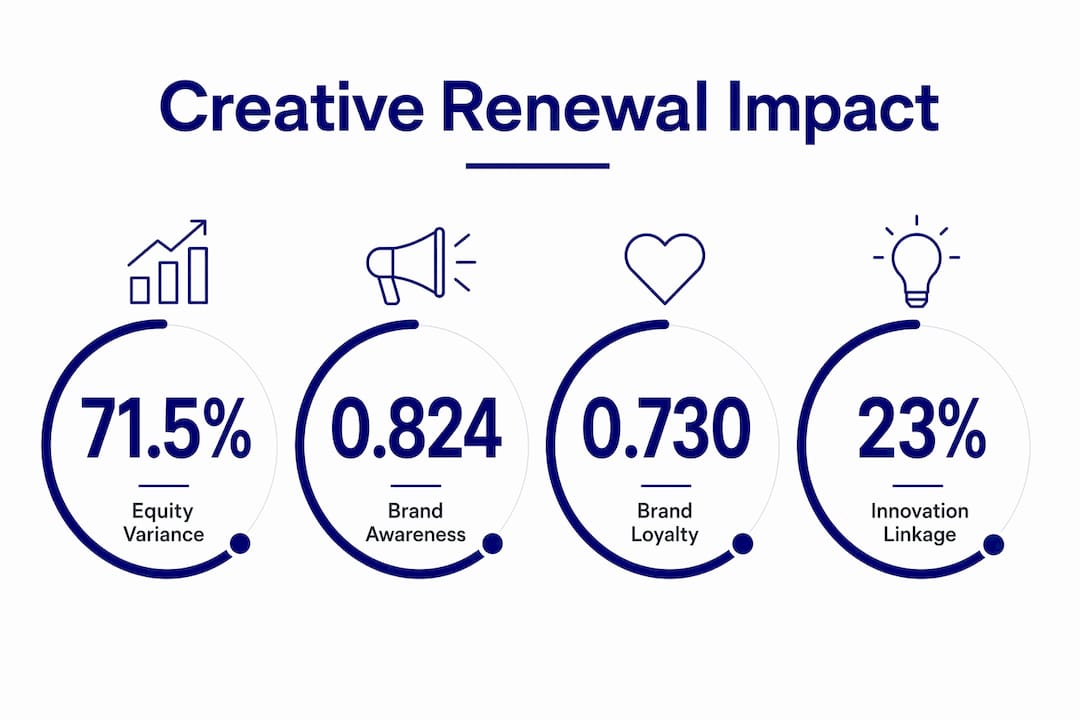
Creative renewal is defined as the deliberate process of updating a brand’s visual identity, messaging, and creative expression to maintain relevance and strengthen its perceived value over time. Research confirms that rebranding explains 71.5% of the variance in brand equity. That figure tells you something important: how a brand looks, sounds, and communicates is not cosmetic. It is structural. For marketing leaders managing long-term brand value, understanding the role of creative renewal in brand equity is the difference between a brand that compounds in value and one that quietly erodes. This guide explains the mechanisms, the evidence, and the practical steps to get it right.
How creative renewal drives brand equity
Brand equity is the commercial premium a brand commands over an unbranded equivalent. It is built from four measurable dimensions: brand awareness, brand loyalty, brand associations, and perceived quality. Creative renewal affects each of these, but not equally.
Rebranding correlates with brand awareness at β = 0.824 and with brand loyalty at β = 0.730. These are strong relationships. Brand awareness at β = 0.295 and brand loyalty at β = 0.355 then go on to positively affect overall brand equity. The implication is clear: creative updates do not just refresh appearances. They rebuild the mental availability and emotional commitment that translate directly into commercial value.

Brand associations and perceived quality respond less strongly to creative renewal. This is worth understanding. Perceived quality is shaped more by product experience and service delivery than by creative expression alone. Associations build over years of consistent behaviour. Creative renewal accelerates the dimensions that are most malleable: awareness and loyalty.
The practical takeaway for marketing leaders is to treat brand equity through creativity as a compounding investment. Each well-executed creative update raises awareness, reinforces loyalty, and sets the conditions for stronger associations over time.
What the data shows about creative renewal and loyalty
Brand loyalty responds to creative renewal because customers interpret consistent, evolving creative as a signal of organisational health. A brand that refreshes thoughtfully communicates that it is paying attention. A brand that never changes signals stagnation. A brand that changes too radically signals instability. The sweet spot is purposeful evolution, not revolution.
What role does brand DNA play in creative renewal?
Brand DNA is the set of core values, personality traits, and positioning principles that define what a brand stands for at its most fundamental level. It is the anchor that keeps creative renewal from becoming creative drift.
Only 23% of companies effectively link their brand positioning to their innovation process. That gap is where brand equity gets destroyed. When creative updates are disconnected from brand DNA, the result is fragmented communications, confused customers, and diluted equity. The brand looks busy but feels incoherent.
The concept of DNA-driven innovation treats brand DNA as a strategic anchor for every creative decision. Rather than asking “what is trending?” the question becomes “what is true to us, and how do we express that in a way that is fresh and relevant?” This shift in framing changes the quality of creative output entirely.
Product innovations aligned with brand DNA achieve 24% higher sales than those without such alignment. That premium is not accidental. It reflects the trust customers place in brands that behave consistently with their established identity.
The benefits of brand-led creative renewal include:
- Differentiation at the category level. Brands that renew from their DNA stand out because their creative feels distinctive, not derivative.
- Higher margins. Brand-led companies grow more sustainably and achieve stronger margins because customers pay a premium for brands they trust.
- Reduced creative waste. When DNA guides creative decisions, fewer executions get rejected or reworked because the brief is clearer from the start.
- Stronger internal alignment. Teams produce better work when they understand what the brand stands for and why each creative choice matters.
Pro Tip: Before any creative renewal project, write a one-page brand DNA statement that covers values, personality, tone, and visual principles. Use it as the first filter for every creative decision. If a concept cannot be traced back to that document, it does not belong in the campaign.
Brand innovation best practices consistently show that the brands with the strongest equity are those that treat their identity as a creative constraint, not a creative limitation.
How to implement disciplined creative renewal at scale
Creative renewal fails most often not because the ideas are bad, but because the process is undisciplined. At scale, with hundreds of creative variants produced monthly across paid, owned, and earned channels, brand identity drifts without anyone noticing until the damage is done.
Creative identity drift is a key performance concern at scale. Inconsistent creative reduces retention and raises acquisition costs. The fix is structural, not creative.
A disciplined approach to creative renewal follows a clear sequence:
- Establish a creative hierarchy. Define which brand elements are fixed (logo, primary colour palette, core typography) and which are flexible (photography style, tone variations, layout grids). This gives creative teams freedom within a defined range.
- Assign ownership. A creative director or equivalent must own brand identity decisions. Without a single point of accountability, creative consistency degrades under the pressure of performance marketing targets.
- Run biennial deep audits. Brand identity system audits should happen every two years to assess relevance and annually for performance calibration. These audits catch drift before it becomes a brand problem.
- Calibrate annually. Annual calibration reviews performance data against brand health metrics. The goal is to identify where short-term optimisation has compromised long-term brand expression.
- Document motion principles. Motion, including pace, transition, and energy in video and digital content, is often neglected in brand identity systems. Defining these principles prevents incoherence in dynamic content.
The most common pitfall is over-optimising for short-term performance at the expense of long-term brand health. A direct-to-consumer brand scaling past £50m will often find that its best-performing ads look nothing like its brand. That gap is expensive to close later.
Pro Tip: Build a brand consistency score into your monthly reporting. Track the percentage of live creative assets that meet your defined brand standards. A score below 80% is a signal to pause and recalibrate before scaling spend.
The comparison between brands that manage creative renewal with discipline and those that do not is stark. Disciplined brands maintain premium pricing power. Undisciplined brands compete on price because their creative no longer justifies a premium.
What creative branding strategies build lasting customer loyalty?
The most effective creative strategies for brand growth share a common characteristic: they create genuine emotional connection rather than simply communicating product features. Loyalty is an emotional state. Creative renewal that targets emotion builds equity that is far harder for competitors to erode.
Effective innovation is intentional, needs-based, and introduces meaningful difference to customers. This matters because 62% of FMCG launches are line extensions or imitations, which underperform relative to breakthrough innovations. The same principle applies to creative renewal. Refreshing a logo because a competitor did is not renewal. It is reaction. Renewal that builds equity starts with a genuine insight about what customers need and how the brand can express that more powerfully.
Specific creative branding strategies that drive loyalty include:
- Storytelling grounded in brand truth. Brand storytelling that connects to real customer experiences builds trust faster than product-led messaging. Customers remember how a brand made them feel, not what it claimed to offer.
- Renewal tied to usage occasions. Creative that reflects how customers actually use a product, rather than how the brand wishes they would, creates recognition and relevance. That recognition compounds into loyalty.
- The Tester, Creator, Scaler model. DNA-driven innovation uses three modes: Tester (small-scale experiments to validate creative directions), Creator (developing the strongest concepts into full campaigns), and Scaler (amplifying what works across channels). This model keeps renewal continuous rather than episodic.
- Consistency across the customer journey. Creative renewal that only touches acquisition channels misses the loyalty opportunity. Retention phases, including onboarding, re-engagement, and advocacy, need the same creative attention as top-of-funnel work.
Knowing the signs your brand needs a refresh is as important as knowing how to execute one. Declining engagement rates, creative fatigue in paid channels, and misalignment between brand communications and customer feedback are all signals that renewal is overdue.
Key takeaways
Creative renewal builds brand equity by strengthening awareness and loyalty, the two dimensions most directly linked to commercial value, and it works best when anchored to brand DNA and managed with structural discipline.
| Point | Details |
|---|---|
| Creative renewal drives equity | Rebranding explains 71.5% of brand equity variance, with the strongest effects on awareness and loyalty. |
| Brand DNA alignment is critical | Products and campaigns aligned with brand DNA achieve 24% higher sales than those without alignment. |
| Discipline prevents drift | Biennial audits and annual calibrations stop creative identity drift before it raises acquisition costs. |
| Loyalty requires emotional connection | Creative strategies that target emotion and reflect real usage occasions build loyalty that competitors cannot easily copy. |
| Genuine innovation outperforms imitation | 62% of FMCG launches are imitations that underperform; renewal must introduce meaningful difference to build equity. |
Why creative renewal deserves a seat at the board table
I have worked with marketing teams at every stage of growth, and the pattern I see most often is this: creative renewal gets treated as a project rather than a practice. A brand refresh happens, everyone celebrates, and then the organisation returns to optimising individual assets without any structural process to maintain what was built. Within 18 months, the brand looks fragmented again.
The research backs up what I observe in practice. Only 23% of companies link brand positioning to their innovation process. That is not a creative failure. It is a governance failure. The brands that sustain equity over time are the ones where the creative director has genuine authority, where brand DNA is a living document rather than a slide in an onboarding deck, and where renewal is budgeted and scheduled rather than reactive.
The other thing I would push back on is the assumption that creative renewal is primarily a visual exercise. The most impactful renewals I have seen change how a brand communicates, not just how it looks. Tone of voice, content strategy, and the emotional register of customer communications are all part of the creative identity. Neglecting these in favour of a logo update is like repainting a house while ignoring the foundations.
Marketing leaders in 2026 are under enormous pressure to demonstrate short-term performance. Creative renewal is a long-term investment that pays out in pricing power, retention rates, and customer lifetime value. The brands that protect that investment, even under quarterly pressure, are the ones that compound in equity year after year.
— Calum
How Michaelbell supports creative renewal and brand equity
Michaelbell works with marketing teams that want their creative to do more than look good. We align external creative with internal communications to build brands that are consistent, credible, and commercially effective.
Our brand communications services cover creative strategy, brand identity development, and communications planning, all grounded in your brand DNA. We operate as an extension of your team, which means we understand your brand as well as you do and can maintain that standard across every channel and every campaign. If you want creative renewal that builds equity rather than just refreshing appearances, we would love to talk.
FAQ
What is creative renewal in branding?
Creative renewal is the deliberate updating of a brand’s visual identity, messaging, and creative expression to maintain relevance and strengthen brand equity. It differs from a full rebrand in that it evolves existing equity rather than replacing it.
How does creative renewal affect brand loyalty?
Rebranding correlates with brand loyalty at β = 0.730, and brand loyalty in turn positively affects overall brand equity at β = 0.355. Customers interpret thoughtful creative evolution as a signal of organisational health and attentiveness.
What is brand DNA and why does it matter for creative renewal?
Brand DNA is the core set of values, personality traits, and positioning principles that define a brand’s identity. Aligning creative renewal with brand DNA produces 24% higher sales than renewal that ignores it, because customers trust brands that behave consistently with their established identity.
How often should a brand refresh its creative identity?
Brand identity systems should undergo a deep audit every two years to assess relevance, with annual calibrations to check performance against brand health metrics. This cadence prevents creative drift without requiring disruptive overhauls.
What is the biggest risk of creative renewal at scale?
The biggest risk is creative identity drift, where inconsistent execution across hundreds of monthly assets gradually erodes brand recognition. Assigning clear ownership to a creative director and maintaining a documented brand hierarchy are the most effective safeguards.