
The role of external creative in brand growth

External creative partnerships are defined as strategic collaborations between brands and outside agencies, freelancers, or specialist studios that inject storytelling expertise, fresh perspective, and production capability into a brand’s marketing output. The role of external creative in brand growth has never been more measurable: 2026 data from Ipsos and the World Federation of Advertisers confirms that narrative-led campaigns consistently outperform feature-led advertising on every business KPI that matters. Brands like CeraVe and McArthurGlen Group have demonstrated this in practice, using external creative partners to drive sales uplifts, audience growth, and localised content at scale. For marketing professionals and business leaders, the question is no longer whether to work with external creatives. It is how to do it well.
How do external creative partnerships enhance storytelling and brand messaging?
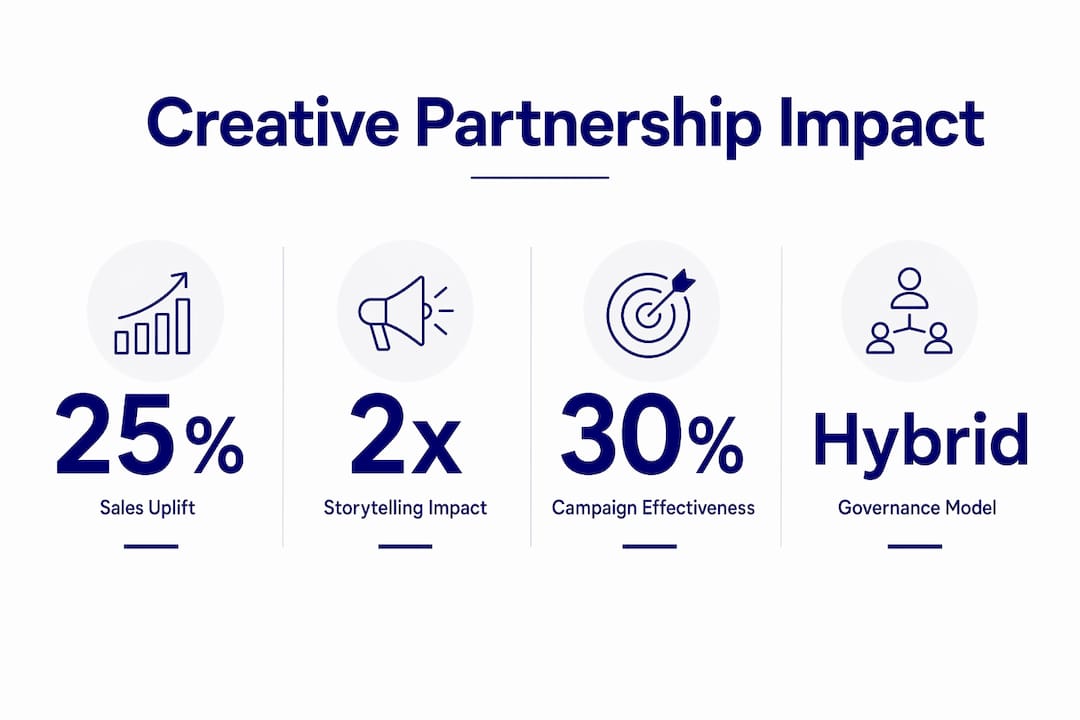
Storytelling is the single most powerful lever in creative effectiveness, and external partners are its most skilled practitioners. Ads with storytelling are twice as effective at changing behaviour compared to ads focusing only on product features, according to Ipsos analysis of 15,000 advertisements. That finding means a brand investing the same media budget but briefing for narrative rather than features can double its behavioural impact without spending an extra pound.
The gap widens further when brand value is woven into the story itself. Advertisements that deliver brand value through stories show a 30% lift in effectiveness, compared to just 15% when brand value is communicated explicitly without narrative. That 15-percentage-point difference is the commercial case for hiring external creatives who specialise in narrative construction rather than message delivery.
External creative agencies bring three storytelling capabilities that most in-house teams lack:
- Story architecture. The ability to build a protagonist, a tension, and a resolution that audiences remember and share.
- Emotional calibration. Knowing which emotional register (warmth, humour, aspiration) fits a brand’s audience and category.
- Craft at scale. Producing narrative-led content across formats, channels, and markets without losing the central story thread.
“Underinvesting in storytelling craft limits brand impact. Partnering with agencies skilled in narrative construction unlocks growth that media spend alone cannot buy.”
Pro Tip: Brief your external creative partner on how you want the audience to feel and what you want them to do differently, not just what you want them to know. Behaviour-change briefs produce stronger storytelling than message-delivery briefs.
What measurable business outcomes do external creative partnerships deliver?
Creative-led collaboration produces results that show up in sales reports, not just award shortlists. CeraVe’s Super Bowl campaign, developed with external creative partners, drove a 25% sales increase and 5% audience growth, according to the WARC Effective 100 2026 report. That is a direct commercial return attributable to creative investment, not media weight alone.

The pattern holds across categories and campaign types. McDonald’s sustained its position as one of the most effective brands globally over a seven-year period, a run directly linked to consistent investment in external creative excellence. The lesson is that creative partnerships compound. A single strong campaign builds brand memory. A sustained partnership builds brand equity that competitors cannot easily erode.
| Outcome | Example | Source |
|---|---|---|
| 25% sales uplift | CeraVe Super Bowl campaign | WARC Effective 100 2026 |
| 5% audience growth | CeraVe external creative partnership | WARC Effective 100 2026 |
| 30% effectiveness lift | Storytelling vs. explicit brand messaging | WFA / Ipsos Creative |
| 15% effectiveness lift | Explicit brand value communication | WFA / Ipsos Creative |
| Seven-year effectiveness run | McDonald’s sustained creative investment | WARC Effective 100 2026 |
The connection between creative excellence and business KPIs is direct. Sales, customer loyalty, and market share all respond to the quality of creative work, not just its volume. Brands that treat external creative partners as strategic contributors to growth, rather than production vendors, consistently outperform those that do not. The importance of creative partnerships lies precisely in this distinction: a partner invested in your brand’s long-term success will produce work that builds equity, not just impressions.
How are emerging technologies shaping external creative collaborations?
AI is transforming what external creative partnerships can deliver, particularly in speed, localisation, and content volume. The McArthurGlen Group’s partnership with Monks integrates AI into creative production workflows to scale locally relevant, high-quality content rapidly across multiple markets. That is not outsourcing production. It is transforming the operating model so that brand consistency and local relevance coexist at a pace that was previously impossible.
Governance is the critical variable that separates effective AI-enabled partnerships from chaotic ones. Publicis London and Cathay Pacific’s collaboration via the Artfair by Bria platform demonstrates what ethical AI creative governance looks like in practice: artists retained creative control and received fair compensation, while the brand gained the scale benefits of AI-assisted production. That model matters because it protects brand reputation, satisfies regulatory requirements, and maintains the trust of creative talent.
For marketing leaders evaluating AI-enabled external partnerships, the practical considerations are:
- Compliance workflows. Who approves AI-generated content before it goes live, and against what brand and legal standards?
- Localisation protocols. How does the partnership adapt global creative assets to local markets without losing brand integrity?
- Intellectual property clarity. Who owns the output, and how is the contribution of human creatives recognised and remunerated?
- Governance documentation. Are approval chains, content standards, and escalation processes written down and agreed before production begins?
Pro Tip: Treat AI governance as a creative brief requirement, not an afterthought. Agree compliance, localisation, and IP terms with your external partner before the first asset is produced, not after.
Integrating AI tools with external partners enables brands to accelerate content production while maintaining local relevance and brand governance. The brands getting this right in 2026 are those that view technology as a capability multiplier within a well-governed partnership, not a shortcut around creative quality.
What is the ideal governance and operational model for working with external creatives?
The most effective model combines internal cultural proximity with external creative independence. Hybrid creative operating models that balance in-house and external teams optimise speed, cultural knowledge, and creative ambition simultaneously. In-housing trend data from 2026 confirms this is not a threat to agencies. It is a verdict on what works: neither fully in-house nor fully outsourced, but deliberately combined.
The balance is delicate. The optimal hybrid model assigns strategic storytelling and narrative innovation to external creatives, while fast execution and channel adaptation sit internally. This preserves the creative independence that produces breakthrough work, without sacrificing the speed and brand knowledge that internal teams provide.
A practical governance framework for external creative partnerships involves four steps:
- Define the creative brief around behaviour change. Brief your external partner on the audience behaviour you want to shift, not just the message you want to deliver. This aligns storytelling craft with business outcomes from the start.
- Establish IP and credit terms upfront. Agree who owns creative output, how external contributors are credited, and what fair remuneration looks like before any work begins.
- Build repeatable capability, not one-off campaigns. Creative partnerships should be strategic engines for capability building. Cannes Lions Creative Brand Lion criteria in 2026 measure scalable infrastructure and governance, not singular campaign outputs.
- Review and embed learning. After each campaign, run a structured debrief with your external partner to identify what storytelling approaches worked, what governance friction slowed production, and what to carry forward.
The role of freelance designers in branding fits within this framework at the execution layer. Freelancers bring specialist craft skills, whether in visual identity, motion design, or typography, that complement the strategic storytelling delivered by agency partners. The governance principles apply equally: clear briefs, agreed IP terms, and structured feedback loops produce better work than ad hoc arrangements.
Key takeaways
External creative partnerships drive measurable brand growth when they are built on storytelling craft, clear governance, and a strategic commitment to capability building rather than one-off campaign production.
| Point | Details |
|---|---|
| Storytelling doubles impact | Narrative-led ads are twice as effective at changing behaviour as feature-led ads, per Ipsos. |
| Creative partnerships compound | Sustained external creative investment builds brand equity that single campaigns cannot achieve. |
| AI requires governance first | AI-enabled partnerships like McArthurGlen and Monks only work with compliance and localisation protocols in place. |
| Hybrid models outperform | Combining internal speed with external creative independence produces better outcomes than either approach alone. |
| Brief for behaviour, not message | External partners produce stronger storytelling when briefed on what audiences should do, not just what they should know. |
Why I think most brands are still briefing external creatives wrong
Most brands brief external creative partners the way they brief a printer: here is the message, here is the format, here is the deadline. That approach produces competent work. It rarely produces effective work.
What I have seen, working across brand communications for over a decade, is that the brands getting the most from external creative partnerships are the ones who treat the brief as a creative conversation, not a specification document. They share audience insight, business context, and the behaviour they want to change. They invite the external team to challenge the brief before accepting it. That collaborative tension is where the best storytelling comes from.
The AI question is where I see the most confusion right now. Marketing leaders either dismiss AI-enabled creative production as a threat to quality, or they embrace it without putting governance in place. The Publicis London and Cathay Pacific model is instructive precisely because it shows a third path: AI as a production accelerator within a framework that protects creative integrity and artist rights. That is the model worth studying and replicating.
My honest view is that the brands who will grow fastest in the next three years are those who select external creative partners for their storytelling capability first, and their production speed second. Speed without narrative craft produces volume. Narrative craft with speed produces growth. The customer journey work that connects creative output to measurable outcomes is where that distinction becomes visible in the data.
— Calum
How Michaelbell can help you grow through creative partnership
Michaelbell operates as an extension of your marketing team, not an outside vendor. We connect strategic storytelling with internal alignment so that your external creative investment produces cohesive, high-impact communications across every channel.
Our Creative Supercharger is built specifically for marketing teams who want to amplify the impact of their external creative partnerships. We bring storytelling expertise, AI-enabled production capability, and governance frameworks that keep your brand consistent at scale. Whether you are building a new creative partnership model or strengthening an existing one, we would love to talk. Explore our full range of brand communications services or get in touch directly to discuss what is possible for your brand.
FAQ
What is the role of external creative in brand growth?
External creatives accelerate brand growth by delivering storytelling expertise, fresh perspective, and specialist production capability that internal teams rarely possess. Research from Ipsos confirms that narrative-led campaigns are twice as effective at changing audience behaviour as feature-led advertising.
How do external creative partnerships improve campaign effectiveness?
Campaigns that communicate brand value through storytelling show a 30% lift in effectiveness compared to 15% for explicit brand messaging, according to WFA and Ipsos Creative|Spark data. External partners skilled in narrative construction are the most reliable way to achieve that uplift consistently.
What governance model works best for external creative collaborations?
Hybrid models that assign strategic storytelling to external partners and fast execution to internal teams produce the best outcomes. Governance should cover IP ownership, content approval workflows, localisation protocols, and fair remuneration before production begins.
How is AI changing the way brands work with external creatives?
AI-enabled partnerships like McArthurGlen Group and Monks allow brands to scale locally relevant content rapidly without sacrificing brand consistency. Effective AI integration requires compliance and localisation governance to be embedded in the workflow from the outset, not added retrospectively.
How should you brief an external creative partner for maximum impact?
Brief external partners on the audience behaviour you want to change, not just the message you want to deliver. Behaviour-change briefs produce stronger storytelling and better business outcomes than message-delivery briefs, as confirmed by Ipsos and WFA research.