
What is a brand promise? A guide for marketers

A brand promise is defined as the commitment a business makes to its customers about the experience and value they can consistently expect from every interaction with the brand. It is not a tagline, not a mission statement, and not a marketing campaign. It is the contract that sits beneath all of those things, shaping how customers feel before, during, and after every touchpoint. Brands like Tesla and Zappos have built entire reputations on the strength of this commitment. With trust in brands falling below 50% globally as of 2024, getting your brand promise right has never mattered more.
What is a brand promise and how does it differ from related concepts?
A brand promise is the external, customer-facing declaration of what your brand will reliably deliver. It answers one question from the customer’s perspective: “What can I count on from you, every single time?” That clarity is what separates high-performing brands from forgettable ones.
The confusion between a brand promise and a mission statement is common, and costly. Mission statements are internal motivational guides that articulate why a company exists. A brand promise is what the customer actually experiences as a result. Tesla’s mission is “to accelerate the world’s transition to sustainable energy.” Its brand promise, by contrast, is the expectation of performance, technological leadership, and a premium ownership experience. One is the internal “why.” The other is the external “what.”
A tagline is different again. “Just Do It” is a rallying cry, not a promise. It does not tell you what Nike will deliver to you specifically. A value proposition is closer to a brand promise but remains transactional, focused on functional benefits. Brand promises are broader commitments that value propositions must support, not replace.
| Concept | Focus | Audience | Example |
|---|---|---|---|
| Brand promise | Customer experience commitment | External (customers) | Zappos: happiness delivered |
| Mission statement | Company purpose and direction | Internal (employees) | Tesla: accelerate sustainable energy |
| Tagline | Memorable marketing phrase | External (broad market) | Nike: Just Do It |
| Value proposition | Functional benefit offered | External (buyers) | Geico: save 15% or more |
Pro Tip: Write your brand promise before you write your tagline. The promise is the strategic foundation. The tagline is the creative expression of it, not the other way around.
Why does a brand promise matter for customer trust and loyalty?
Trust in brands has fallen below 50% globally, according to the 2024 Edelman Trust Barometer. That means more than half of consumers now assume brands will over-promise and under-deliver. In that environment, a credible brand promise is not a nice-to-have. It is a competitive differentiator.
Brand consultant Walter Landor put it plainly: a brand is a promise, and failing to uphold that promise risks market valuation loss, a decline in employee morale, and lasting reputational damage. That framing matters because it shifts brand promise from a marketing exercise to a board-level responsibility.
The emotional dimension is equally significant. Brand promises that evoke emotional connection drive customer loyalty beyond transactional benefits. Customers who feel personally connected to a brand’s promise become advocates. They forgive minor service failures. They recommend without being asked. That kind of loyalty cannot be bought through discounting or advertising spend alone.
A well-crafted and consistently delivered brand promise produces measurable business outcomes:
- Repeat purchase behaviour driven by predictable, trusted experiences
- Reduced customer acquisition costs as advocacy replaces paid acquisition
- Higher employee engagement when internal teams understand and believe in the promise
- Stronger differentiation in crowded markets where product parity is common
- Greater resilience during crises, because trust acts as a buffer against reputational shocks
“Products are made in the factory, but brands are created in the mind.”
Walter Landor
How to create an effective brand promise
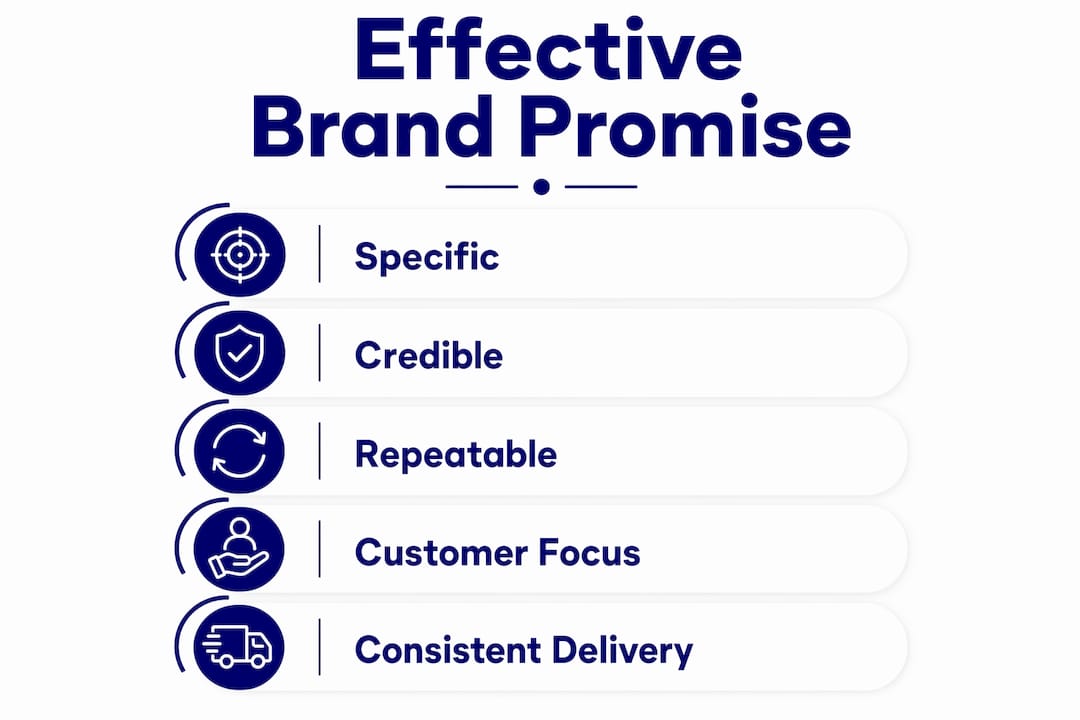
A brand promise must be specific, credible, and repeatable. Vague commitments like “we put customers first” or “quality you can trust” fail on all three counts. They are impossible to measure, impossible to operationalise, and impossible for customers to remember.

A proven template for brand promise formulation provides a reliable starting point: “[Name] is the [distinction] to provide [unique features] to [customer profile] who choose us to feel [emotional outcome].” This formula forces specificity at every stage. It names the distinction, identifies the customer, and anchors the promise in an emotional outcome rather than a functional feature list.
Follow these steps to build yours:
- Identify your genuine distinction. What do you do that no competitor does in quite the same way? This must be real, not aspirational. If you cannot prove it, do not promise it.
- Define your customer profile precisely. “Everyone” is not a customer profile. The more specific you are about who you serve, the more resonant your promise becomes.
- Name the emotional outcome. Customers do not buy products. They buy feelings. Confidence, belonging, relief, excitement. Name the one your brand reliably delivers.
- Pressure-test for deliverability. Every word of your promise must be something your operations, customer service, and product teams can actually fulfil today, not in three years.
- Align internally before launching externally. A brand promise shapes product development, customer service standards, and employee behaviour. If your team does not understand and believe the promise, customers will feel the gap immediately.
Pro Tip: Involve your frontline teams in crafting the promise. The people who speak to customers daily know what the brand actually delivers versus what leadership thinks it delivers. That gap is where most brand promises fail.
Common pitfalls include promises that are too broad to be meaningful, promises built around aspirations rather than current capabilities, and promises that live only in the marketing department. Consistency in promise delivery is the foundation of brand trust. A promise broken once is remembered far longer than a promise kept a hundred times.
Brand promise examples and what makes them work
The most effective brand promises share a common trait: they set a specific expectation and then meet it, repeatedly, across every customer interaction. Here are four examples worth studying.
Nordstrom promises exceptional customer service, and backs it with a returns policy so generous it has become legendary. The promise is not stated in a tagline. It is embedded in every operational decision the company makes, from staff training to store layout.
Geico promises that customers can save 15% or more on car insurance. The specificity of that number is deliberate. It is measurable, memorable, and credible. Customers know exactly what to expect before they pick up the phone.
Zappos built its entire brand around delivering happiness. That sounds abstract until you see it in practice: free shipping both ways, 365-day returns, and customer service teams empowered to spend hours on a single call if that is what it takes. The promise is operationalised at every level.
Tesla promises technological leadership and a premium experience. Every product launch, every software update delivered overnight, and every Supercharger network expansion reinforces that promise. The brand does not just say it leads. It demonstrates it continuously.
What these brands have in common is worth noting clearly:
- The promise is specific enough to be tested by the customer
- Every department, not just marketing, is responsible for delivering it
- The promise connects a functional benefit to an emotional outcome
- It is consistent across years and market conditions, not refreshed with every campaign cycle
You can explore how authenticity in branding amplifies the impact of a well-kept brand promise, particularly for brands building long-term trust in competitive markets.
Key takeaways
A brand promise is the single most powerful commitment a business makes to its customers, and its value depends entirely on consistent, organisation-wide delivery.
| Point | Details |
|---|---|
| Definition is precise | A brand promise is a customer-facing commitment, distinct from mission statements, taglines, and value propositions. |
| Trust context is urgent | With brand trust below 50% globally, a credible promise is a direct competitive advantage. |
| Emotional outcomes drive loyalty | Promises anchored in emotional outcomes create advocates, not just repeat buyers. |
| Specificity is non-negotiable | Vague promises cannot be operationalised or measured. Use a structured template to force clarity. |
| Delivery is everyone’s job | A brand promise only holds when product, service, and operations teams all own it equally. |
Brand promises are worth more than most leaders realise
I have worked with marketing teams who spent months crafting a brand promise, got it beautifully worded, printed it on the wall of the boardroom, and then never mentioned it again. That is not a brand promise. That is a framed aspiration.
The brands I have seen get this right treat the promise the way a legal team treats a contract. Every decision, from hiring to product design to customer service policy, gets measured against it. When a new initiative does not align with the promise, it gets challenged. That discipline is rare, and it is exactly what separates brands that customers genuinely love from brands that customers merely tolerate.
The uncomfortable truth is that most broken brand promises are not broken by the marketing team. They are broken by operations, by finance cutting corners, or by leadership prioritising short-term margin over long-term trust. That is why the promise must live at leadership level, not just in the brand guidelines document.
If you are a marketing leader reading this, your job is not just to articulate the promise. It is to hold the whole organisation accountable to it. That is harder than writing a good sentence. But it is the work that actually builds brand equity.
— Calum
How Michaelbell can help you build a brand promise that sticks
At Michaelbell, we work with marketing teams who know their brand has something worth promising but struggle to articulate it with the precision and consistency that makes it land. We specialise in the space where external creative meets internal alignment, which is exactly where brand promises either succeed or fall apart. Whether you need help defining the promise itself, embedding it across your customer journey, or ensuring your internal teams are as committed to it as your customers are, we have the expertise to get you there. Explore our brand communications services and see how we can help you turn your brand promise into brand love.
FAQ
What is the definition of a brand promise?
A brand promise is the commitment a business makes to its customers about the experience and value they can consistently expect from every interaction with the brand. It is distinct from a mission statement, tagline, or value proposition.
How does a brand promise differ from a value proposition?
A value proposition focuses on specific transactional benefits, while a brand promise is the broader overarching commitment that the value proposition must support. The promise sets the expectation; the value proposition explains the functional delivery.
Why does a brand promise matter in 2026?
With global brand trust below 50%, a credible and consistently delivered brand promise is one of the few remaining tools that genuinely differentiates a brand and builds lasting customer loyalty.
What makes a brand promise effective?
An effective brand promise is specific, credible, and repeatable. It names a clear distinction, identifies a defined customer, and anchors the commitment in an emotional outcome that the entire organisation can deliver consistently.
Can a broken brand promise be repaired?
Broken brand promises can damage trust irreparably, particularly when the failure is repeated or systemic. Recovery is possible but requires transparent acknowledgement, operational change, and sustained consistent delivery over time.