
Roster agency model explained: a guide for UK marketing leaders

A roster agency model is a curated, governed shortlist of external agencies and specialists that a marketing organisation can activate on demand. Rather than running ad hoc procurement every time a new brief lands, you pre-qualify a defined set of suppliers, agree on commercial terms upfront, and mobilise them through a structured workflow. The result is faster activation, cleaner governance, and a supplier base that actually reflects your strategic priorities.
The core elements of any roster model are:
- A curated shortlist of pre-approved agencies and specialists
- Agreed commercial terms (retainers, call-off rates, or day rates)
- Clear activation rules that govern who gets briefed and when
- A governance framework with defined roles, KPIs, and review cadence
- A single point of contact or roster owner who manages the relationships
Michaelbell has practical experience designing and operating within this model, and this guide draws on that experience alongside published best practice from The Observatory International, Agency Mania, and TrinityP3.
Table of Contents
- What is a roster agency model, and which variant suits you?
- How does a roster agency model work day to day?
- When does a roster model suit your organisation?
- How to build your roster step by step
- Governance: how do you keep a roster performing?
- Commercial approaches and contract models
- Common pitfalls and how to avoid them
- Sample roster composition for a mid-market UK brand
- How to measure success and realistic timelines
- Is a roster model right for your organisation?
- Key takeaways
- A practitioner’s view on making rosters work
- How Michaelbell can help you build a performing roster
- Useful sources
What is a roster agency model, and which variant suits you?
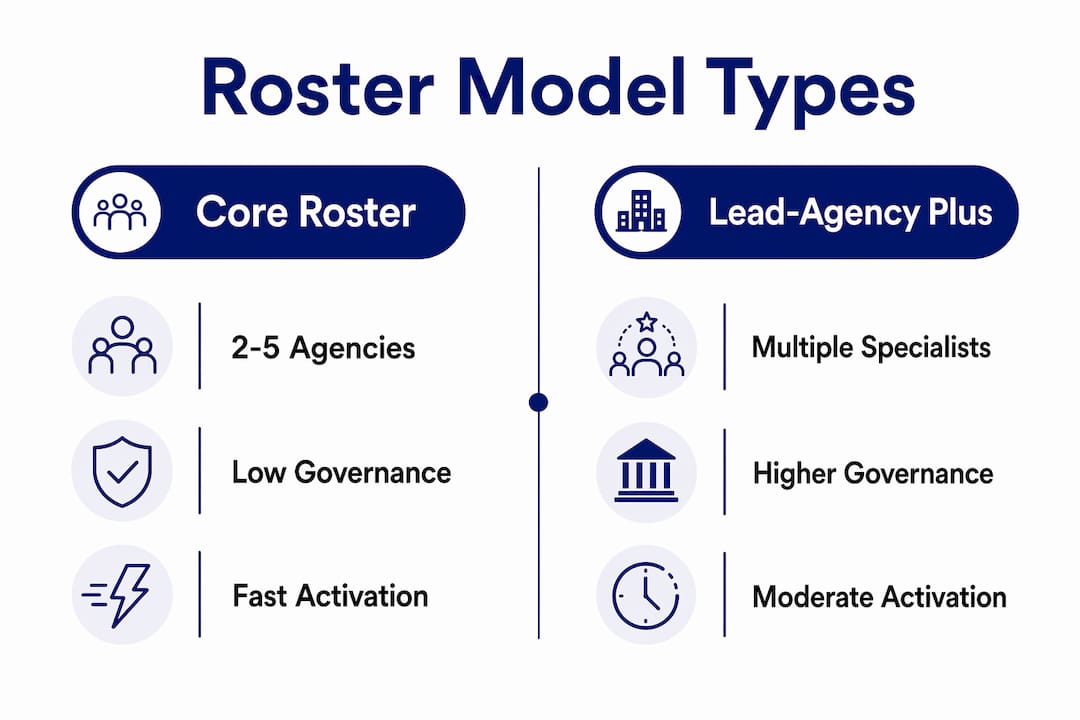
The three most common variants differ in scope, control, and the number of agencies involved.
Core roster is a tight group of two to five agencies covering your primary disciplines: brand strategy, creative, digital production, and media. Every brief goes to one of them. This suits centralised brands with consistent volume and a strong internal marketing function.
Bench or hybrid roster keeps a stable core for ongoing brand work while maintaining a vetted pool of specialists available on demand. TrinityP3 highlights a clear trend toward this model: a right-sized core for brand continuity, with specialist expertise on tap for high-impact projects without fixed overhead. Growth-stage firms and brands with seasonal peaks tend to find this the most practical arrangement.

Lead-agency-plus-specialists places one agency in an orchestrating role, with category specialists brought in beneath it. The lead agency owns integration and quality control. This works well for decentralised organisations that want a single accountable partner but still need niche capability.
| Variant | Typical agency count | Governance burden | Activation speed |
|---|---|---|---|
| Core roster | 2–5 | Moderate | Fast |
| Bench / hybrid | 3–6 | Higher | Moderate |
| Lead-agency-plus-specialists | 1 lead + 2–4 specialists | Lower for client | Fast via lead |
The Roster describes how a bench model simplifies contracting: selected talent or agencies are put on deck under a single statement of work, reducing the procurement friction that typically slows specialist engagement, as explored in technology-assisted roster management.
How does a roster agency model work day to day?
Activation follows a consistent pattern regardless of variant. A brief is issued to the relevant roster agency, a statement of work (SOW) is agreed against pre-negotiated rates, and deliverables are tracked against the SOW. No new supplier search, no fresh negotiation from scratch.
- Brief issued by the marketing or brand team to the designated roster agency
- SOW drafted against the master agreement’s rate card and scope definitions
- Work delivered, reviewed, and signed off by the campaign owner
- Invoice raised against the SOW and processed through centralised billing
- Performance data logged for the quarterly business review
Ownership matters as much as process. The roster owner (usually a senior marketing or procurement lead) holds the master agreements and manages the supplier relationships. Campaign owners sit within the marketing team and are accountable for individual briefs. A single point of contact at each agency reduces the coordination overhead that multiplies when multiple stakeholders brief the same supplier independently.
Centralised billing and a searchable supplier record are worth setting up from day one. They prevent the slow accumulation of small, unmanaged suppliers outside the roster that Agency Mania identifies as a persistent governance failure.
Pro Tip: Set a formal threshold, such as a minimum spend or project value, below which no new supplier can be engaged outside the roster. This single rule prevents the long tail of inefficient small suppliers that quietly erodes cost control.
When does a roster model suit your organisation?
A roster outperforms a single-agency or purely in-house approach when:
- You run multiple campaigns across different channels or markets simultaneously
- You need specialist capability (out-of-home, direct mail, video production, internal comms) that no single agency covers well
- Your brief volume is high enough to justify the governance investment
- You want cost predictability through pre-agreed rates without committing to a large retained team
It is likely a poor fit when:
- Your brand is early-stage with a single, focused campaign need
- Creative control is highly centralised and one trusted agency relationship already delivers everything you need
- Your annual marketing spend does not justify the procurement and governance overhead
Agency Mania argues that the correct roster size is a direct function of strategy and organisational needs. There is no universal ideal count. A mid-market UK brand running integrated campaigns across digital, print, and internal channels might need four to six agencies. A startup with a single product launch might need one.
How to build your roster step by step
- Discovery and stakeholder mapping. Identify who needs to be involved: marketing, procurement, finance, legal, and any regional or product leads. The Observatory International recommends drawing in stakeholders from technology, data, supply chain, and creative decision-making early, not as an afterthought.
- Capability audit. Map what you currently have in-house against the gaps. Be honest about where internal resource is stretched or absent.
- Sourcing and vetting. Build a shortlist using defined scoring criteria: strategic fit, creative quality, cultural alignment, commercial terms, and references. Check qualities of an aligned creative agency before finalising your criteria.
- Onboarding. Agree SLAs, SOW templates, IP ownership, data handling, confidentiality, and rate-banding before any work begins. Set the performance review schedule at this stage.
- Phased roll-out. Start with your core disciplines, run a pilot activation, and expand the bench only once governance is bedded in.
For larger transformations, bringing in an impartial specialist to manage the transition reduces internal workload and handles the political sensitivities that arise when incumbent agency relationships are restructured.
Governance: how do you keep a roster performing?
Agency Mania is clear that without structured governance mechanisms, even the best roster will fail. Governance is not a bureaucratic add-on; it is the mechanism that makes the model work.
Core roles:
- Roster owner: holds master agreements, manages supplier relationships, owns the review process
- Category leads: accountable for specific disciplines (creative, media, digital)
- Procurement liaison: manages commercial terms and contract compliance
- Project managers: own individual SOWs and day-to-day delivery
Recommended cadence:
- Weekly activation calls to align on live briefs and resource availability
- Quarterly business reviews (QBRs) with each agency covering performance, pipeline, and relationship health
- Annual evaluations to reassess roster composition and commercial terms
Suggested KPIs by supplier type:
| Supplier type | KPIs |
|---|---|
| Creative agencies | Brief-to-concept time, revision rounds, brand consistency score |
| Media partners | Cost per activation, reach vs. plan, reporting timeliness |
| Specialist suppliers | Delivery against SOW, quality rating, rehire rate |
Anonymous feedback per engagement, uploaded to a shared evaluation platform, gives you the contextual data to reward high performers and address underperformance before it becomes a pattern.
Commercial approaches and contract models
Retainers suit agencies doing consistent, predictable volume. A monthly fee buys a defined scope of resource and output. Call-off arrangements work better for bench agencies: you draw down against a pre-agreed annual value as briefs arise. Day rates apply to specialist or project-based work where scope is variable.
Key contract clauses to include:
- SOW clarity: scope, deliverables, timelines, and acceptance criteria defined before work starts
- Termination: notice periods and exit provisions that protect both parties
- IP ownership: all creative work produced under the agreement assigned to the client on payment
- Data handling and confidentiality: GDPR-compliant data processing agreements for any agency handling customer data
- Rate-banding: agreed rate ranges for different resource levels, reviewed annually
The Observatory International advises designing roster agreements for flexibility rather than long-term exclusivity. Hybrid or bench models let you mobilise specialist talent for high-impact projects without locking into fixed overhead.
Common pitfalls and how to avoid them
One-size-fits-all roster design. The Observatory International identifies this as the most common error. A roster built for last year’s strategy will not serve next year’s priorities. Build in an annual review that reassesses composition, not just performance.
Too many agencies. More suppliers mean more governance overhead, more relationship management, and more risk of brief duplication. Keep the core tight.
Weak governance or unclear ownership. Overlap and duplicated spend follow directly from ambiguous roles. Define the roster owner and category leads before the first agency is onboarded.
Mitigation steps:
- Build a living roster document that is reviewed quarterly alongside the QBR cycle
- Assign a named owner to every SOW before briefing begins
- Run a structured onboarding session with every new agency covering brand guidelines, SOW templates, and escalation paths
- Set a formal supplier threshold to prevent unmanaged spend outside the roster
Sample roster composition for a mid-market UK brand
| Category | Agency type | Activation trigger | Priority order |
|---|---|---|---|
| Brand strategy | Strategic consultancy | Annual planning, repositioning | 1st |
| Creative (ATL/BTL) | Integrated creative agency | Campaign briefs above £5,000 | 1st |
| Digital production | Digital-specialist agency | Always-on content, web, email | 1st |
| Media planning and buying | Independent media agency | Any paid media activation | 1st |
| Internal comms | Specialist internal comms agency | Employee campaigns, change programmes | 2nd |
| Specialist (video/OOH/DM) | Production or specialist house | Project-specific briefs | 2nd |
Activation thresholds keep the roster efficient. Briefs below a defined value (for example, under £5,000) may be handled by a single pre-approved supplier without a competitive mini-pitch. Above that threshold, two or three roster agencies receive the brief and respond with a short proposal.
How to measure success and realistic timelines
0–3 months (set-up): The goal is process, not output. Measure time-to-activate (from brief to signed SOW) and onboarding completion rate.
3–6 months (first activations): Track brief-to-SOW cycle time, first-campaign delivery against plan, and early quality ratings from campaign owners.
6–12 months (measurable efficiency): By this point you should see cost-per-activation trending down, rehire rates climbing for your strongest agencies, and campaign performance data that lets you compare roster suppliers objectively.
Short-term metrics to track from day one:
- Time-to-activate (target: under five working days for standard briefs)
- Brief-to-SOW cycle (target: under three working days)
- SOW completion rate against agreed timelines
Medium-term metrics (months 3–12):
- Campaign performance vs. benchmarks
- Rehire rate per agency
- Cost-per-activation vs. pre-roster baseline
Is a roster model right for your organisation?
Work through these five questions before committing:
- Do you run more than three concurrent campaigns or briefs at any given time? If yes, a roster is likely worth the governance investment.
- Do you need specialist capability that no single agency covers? If yes, a bench or hybrid model fits.
- Is your annual marketing spend large enough to justify pre-agreed commercial terms with multiple suppliers? If yes, proceed.
- Do you have a named person who can own the roster and run the review cadence? If no, resolve this before building the roster.
- Is your brief volume consistent enough to sustain retainer relationships? If no, a call-off or day-rate model suits better than a retainer.
If you answered yes to three or more, a roster model is the right direction. If you answered no to questions 4 or 5, address those gaps first. A roster without an owner and without a commercial model matched to your volume will underperform from the start.
Key takeaways
A roster agency model delivers speed, cost control, and specialist access only when governance is built in from the start, not bolted on later.
| Point | Details |
|---|---|
| Choose the right variant | Core, bench, or lead-agency models suit different scales and levels of creative centralisation. |
| Governance is the deciding factor | Clear roles, a defined review cadence, and named SOW owners determine whether the roster performs. |
| Match commercial terms to volume | Retainers suit consistent briefs; call-off and day-rate structures suit variable or specialist demand. |
| Build in flexibility | Design agreements without long-term exclusivity so you can adapt the roster as strategy shifts. |
| Michaelbell as your starting point | Michaelbell offers roster audits, agency onboarding, governance templates, and integrated brand comms delivery across the full roster lifecycle. |
A practitioner’s view on making rosters work
The gap between a well-designed roster and one that actually performs comes down to one thing: discipline in the first 90 days. Most organisations invest heavily in the sourcing and vetting phase, then underinvest in onboarding and the first review cycle. By the time a QBR surfaces a problem, the relationship has already drifted.
What we see consistently is that the agencies who perform best on a roster are not always the most talented. They are the ones who received a clear brief, a well-structured SOW, and honest feedback after the first activation. The roster model rewards operational clarity on the client side as much as creative quality on the agency side.
One anonymised example worth sharing: a mid-market UK brand came to us with six agencies on their roster and no governance framework. Three of those agencies had not been briefed in over a year. The fix was not to find better agencies. It was to reduce the roster to four, assign category leads, and run the first QBR within 60 days of the restructure. Campaign delivery times dropped, and the rehire rate for the retained agencies climbed within two quarters. The roster was the same industry; the governance was the difference.
How Michaelbell can help you build a performing roster
Michaelbell works with marketing and communications teams across the UK to design, populate, and govern agency rosters that actually deliver. We are not a passive supplier on someone else’s list. We operate as an embedded partner, which means we understand what good roster governance looks like from the inside.

Our services cover the full roster lifecycle: capability audits, agency sourcing and vetting, SOW and SLA templates, onboarding programmes, governance frameworks, and ongoing campaign delivery across creative, internal comms, direct mail, video, digital, and media. If you want to know whether your current agency model is working as hard as it should, speak to our team and we will get straight back to you.
Useful sources
The following resources informed this guide and are worth bookmarking for deeper research:
- Agency Roster Modelling and Transformation, World Federation of Advertisers: a practical session covering roster types, pros and cons, and change management
- Agency Roster Transformation Guide, The Observatory International: stakeholder engagement, governance design, and transformation best practice
- Aligning Your Roster to Your Model, Agency Mania: governance mechanisms, evaluation platforms, and roster sizing logic
- Roster Definition, TrinityP3: definitions, hybrid model rationale, and right-sizing principles
- What’s a Roster Bench and How Does It Work, The Roster: bench model mechanics and simplified contracting approaches
Use these sources to populate your own scorecards and SOW templates. Michaelbell’s types of creative agency partnerships guide and our brand control guidance are practical complements to the external reading above.