
What is brand architecture? a guide for leaders

Brand architecture is defined as the organisational structure of brands within a company’s portfolio, clarifying how parent brands, sub-brands, and products relate to one another. It is the framework that determines whether a new product carries the corporate name, stands alone, or sits somewhere between the two. Companies like Procter & Gamble and FedEx have built their entire market positioning around deliberate architecture choices. Get it right and you create clarity for customers, alignment for teams, and a platform for growth. Get it wrong and you create confusion that costs real money.
What is brand architecture and why does it matter?
Brand architecture is fundamentally about interdependence choices between brands, not naming conventions or visual identity. The structure you choose determines how closely your products are linked in the customer’s mind and how much equity flows between them. Harvard Business School describes it as a blueprint specifying relationships among a company’s brands, influencing customer interpretation at every touchpoint.
The practical consequences are significant. Organisations with clear brand architecture see 3.5 times more visibility than those without. That figure reflects something real: when customers and stakeholders understand how your brands relate, they trust them more quickly and engage with them more confidently.
Brand architecture also functions as a roadmap for aligning identity, messaging, and positioning across a portfolio. Without it, marketing teams make inconsistent decisions, product launches create internal debates, and customers receive mixed signals. With it, every brand decision has a logical home.
What are the main types of brand architecture?
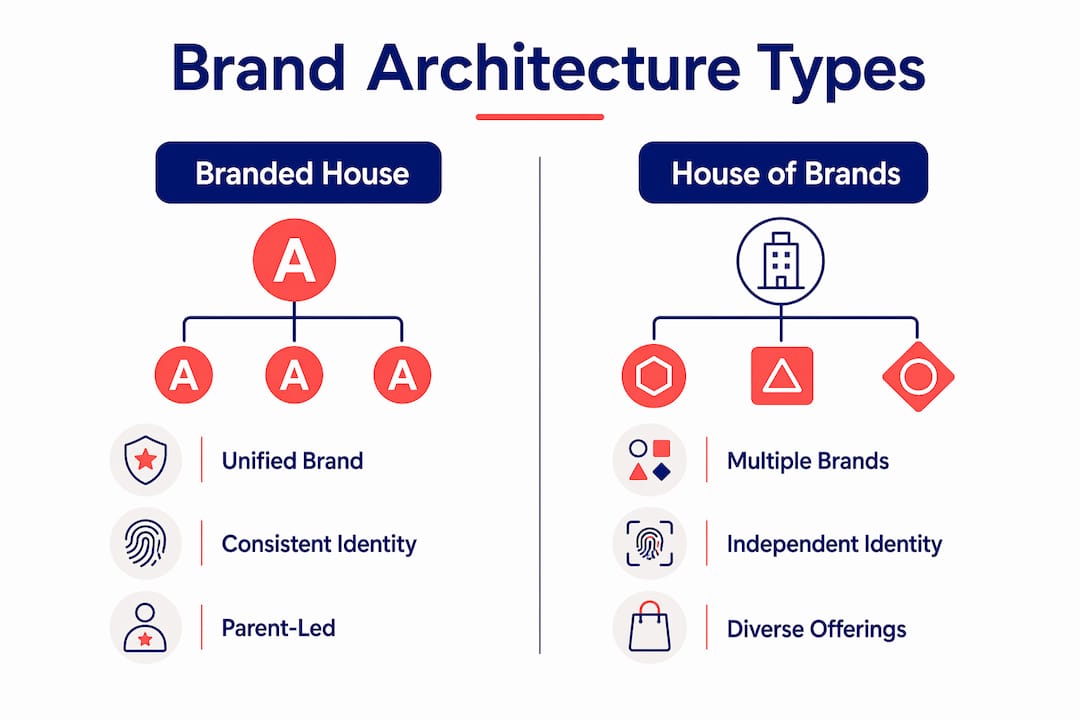
The common brand architecture types are the branded house, the house of brands, and the hybrid model. Each suits different strategic goals and customer relationship styles.
The branded house (monolithic model)
The branded house places one master brand at the centre of everything. Every product or service carries the parent brand’s name and identity. FedEx is the clearest example: FedEx Express, FedEx Ground, and FedEx Office all trade on the same name and visual system. The benefit is concentrated equity. Every customer interaction strengthens the same brand. The risk is that a problem with one product can affect the entire portfolio.

The house of brands
Procter & Gamble operates the opposite model. Ariel, Pampers, Gillette, and Fairy are all P&G products, but each stands independently in the market. Customers rarely connect them to the parent company. This model protects the corporate brand from product-level issues and allows each brand to own a distinct position. The trade-off is cost: building and maintaining multiple independent brands requires significant investment.
The hybrid or endorsed model
Most large organisations operate somewhere between the two. The hybrid model allows sub-brands to carry their own identity while receiving a degree of endorsement from the parent. Marriott International uses this approach: brands like Courtyard by Marriott and Westin carry varying levels of parent brand visibility depending on their audience and positioning.
Here is a comparison of the three models:
| Model | Parent Brand Linkage | Sub-Brand Independence | Typical Example |
|---|---|---|---|
| Branded House | High | Low | FedEx |
| House of Brands | Low | High | Procter & Gamble |
| Hybrid / Endorsed | Medium | Medium | Marriott International |
Pro Tip: If you are unsure which model fits your organisation, map your current portfolio on this table before making any decisions. You may already be operating a hybrid without realising it.
Why does brand architecture matter for business success?
Brand architecture acts as a guiding logic for marketing decisions, enabling consistent and cohesive brand presence across every channel and market. Without that logic, marketing teams default to individual judgement, and individual judgement varies. The result is a portfolio that looks and feels inconsistent to the people who matter most: your customers.
The business case for investing in architecture clarity is well supported. Consider what clarity delivers:
- Reduced internal confusion: Teams spend less time debating brand ownership and more time executing.
- Faster product launches: A defined architecture tells you immediately how a new product should be positioned and named.
- Stronger brand equity: Consistent brand relationships build cumulative trust with customers over time.
- Clearer stakeholder communication: Investors, partners, and employees understand the portfolio without needing a lengthy explanation.
“Brand architecture provides the organising framework for stakeholders to understand brand portfolios, clarifying how corporate and sub-brands differentiate and position themselves.” — Wikipedia on Brand Architecture
The reduction in marketing inefficiency alone justifies the work. When architecture is aligned, debates about whether a new product should carry the parent brand name disappear. The framework answers the question before it is even asked.
How do organisations choose the right brand architecture model?
The strategic trade-off between portfolio clarity and flexibility is the central decision every leadership team must navigate. Branded houses maximise equity transfer but reduce flexibility. A house of brands offers independence but demands greater investment per brand. Neither is universally correct.
Before selecting a model, leadership should work through a structured set of questions:
- Who is the target customer for each brand? If the same customer buys across your portfolio, a branded house builds recognition efficiently. If each brand serves a distinct segment, independence may protect positioning.
- How much equity does the parent brand carry? A strong, trusted parent brand is an asset worth leveraging. A weak or neutral parent brand adds little value to sub-brands.
- What is the competitive positioning of each product? If two products compete in adjacent categories, shared branding can create confusion rather than clarity.
- What does the existing structure look like to customers? Many organisations operate with legacy brand structures embedded in past decisions. Customers have already formed interpretations. Any new architecture must account for what already exists in the market.
- What is the long-term portfolio strategy? If acquisitions are planned, a house of brands model offers more flexibility to absorb new brands without disrupting the parent.
Pro Tip: Start by diagnosing customer confusion, not internal preference. Ask a sample of customers to describe how your brands relate to each other. Their answers will tell you more than any internal workshop.
Assessing legacy structures is particularly important. Even without a formal architecture document, existing brand structures create legacy interpretations among customers. Ignoring those interpretations when designing a new framework is one of the most common and costly mistakes organisations make. For context on how this plays out during periods of brand change, the Michaelbell guide on brand refresh versus rebrand is worth reading alongside this framework.
How to create and maintain an effective brand architecture
Creating brand architecture is a strategic project, not a design exercise. The process requires input from leadership, marketing, and customer insight teams working together.
The core steps are as follows:
- Define your future state: Start with business goals, not brand aesthetics. Where is the organisation going in the next three to five years? The architecture should serve that direction.
- Audit the current portfolio: Map every brand, sub-brand, and product. Identify overlaps, gaps, and inconsistencies. This audit often surfaces brands that have outlived their strategic purpose.
- Choose your model: Use the decision framework above. Document the rationale so future teams understand why the architecture was designed as it was.
- Build brand guidelines: Architecture without guidelines is a plan without execution. Guidelines specify how each brand should look, sound, and behave relative to others in the portfolio.
- Share it internally: Tools like Frontify’s brand portal facilitate sharing and visualising brand architecture, giving teams access to diagrams and guidelines in one place. Internal alignment is as important as external clarity.
Pro Tip: Treat brand architecture as a living document. Review it annually or whenever a significant business event occurs, such as an acquisition, a new market entry, or a major product launch.
Common pitfalls to avoid include designing architecture in isolation from sales and product teams, over-engineering a complex hierarchy that no one can remember, and failing to communicate the new structure to internal stakeholders before it goes to market. Architecture decisions materially affect daily marketing tasks, from branding new products to deciding endorsement levels. If the people executing those tasks do not understand the framework, the architecture exists only on paper.
For organisations building brand architecture from the ground up, the Michaelbell article on agency support in startup branding offers a useful perspective on how external partners can accelerate the process. Strong visual storytelling also plays a role in communicating architecture clearly to both internal teams and external audiences.
Key takeaways
Effective brand architecture is the single most important structural decision a marketing leader can make, because it determines how every brand in the portfolio is perceived, positioned, and managed.
| Point | Details |
|---|---|
| Core definition | Brand architecture defines how parent brands and sub-brands relate, clarifying portfolio structure for customers and stakeholders. |
| Three primary models | Branded house, house of brands, and hybrid each suit different strategic goals and levels of brand independence. |
| Business case | Organisations with clear architecture see 3.5 times more visibility, reducing confusion and improving marketing efficiency. |
| Decision framework | Choose your model based on customer insight, equity strength, competitive positioning, and long-term portfolio strategy. |
| Implementation discipline | Architecture requires brand guidelines, internal sharing tools, and annual reviews to remain effective over time. |
Why most organisations get brand architecture wrong
I have worked with organisations that had genuinely strong brands sitting inside portfolios that made no sense to anyone outside the boardroom. The brands were good. The structure was invisible. Customers could not tell what related to what, and marketing teams were making it up as they went along.
The most underestimated problem is legacy. Organisations assume they are starting fresh when they design a new architecture. They are not. Customers already have a mental model of your brands, however imperfect. Any new structure has to work with that existing understanding, not against it. Ignoring it is the fastest way to spend a significant budget on a framework that confuses people more than it clarifies.
The second mistake I see consistently is treating architecture as a one-time project. Leadership approves a document, the agency delivers a diagram, and then nothing changes in how the organisation actually operates. Architecture only works when it is embedded in daily decisions: how you name a new product, how much parent brand visibility you give a campaign, how you introduce a new acquisition to the market.
The organisations that get this right treat their brand architecture the way a good CFO treats a financial model. It is reviewed regularly, updated when circumstances change, and used to make real decisions. That discipline is what separates brands that grow coherently from those that accumulate confusion over time. Brand recognition is built through consistency, and consistency requires a structure that people actually follow.
— Calum
How Michaelbell helps you build brand architecture that works
At Michaelbell, we work with marketing teams and business leaders who know their brands need structure but are not sure where to start. We bring the strategic clarity and creative expertise to audit your current portfolio, define the right model for your goals, and build the guidelines your teams need to execute consistently.
Whether you are managing a growing portfolio, integrating an acquisition, or simply trying to reduce the internal friction that comes from unclear brand relationships, we can help. Our brand communications services are designed to give you the thinking and the tools to make architecture work in practice, not just on paper. Get in touch and we will get straight back to you.
FAQ
What is the brand architecture definition in simple terms?
Brand architecture is the structure that defines how a company’s brands, sub-brands, and products relate to each other. It clarifies which brands are independent, which are endorsed by a parent, and which share a single identity.
What are the three main types of brand architecture?
The three main types are the branded house, the house of brands, and the hybrid model. Each differs in how much the parent brand is visible and how independently sub-brands operate.
Why is brand architecture important for marketing teams?
Clear brand architecture reduces internal confusion, speeds up product launches, and improves consistency across campaigns. Organisations with defined architecture see 3.5 times more market visibility than those without.
How do you decide which brand architecture model to use?
Start by assessing your customer base, the strength of your parent brand’s equity, and your long-term portfolio strategy. Diagnosing existing customer perceptions of your brands is the most reliable starting point.
How often should brand architecture be reviewed?
Brand architecture should be reviewed annually and whenever a significant business event occurs, such as a merger, acquisition, or major new product launch.