
What is brand equity? A guide for marketers

Brand equity is the added value a brand name confers on a product or service beyond its functional benefits, directly shaping customer loyalty, pricing power, and purchase decisions. A customer who chooses Starbucks over a cheaper alternative is not paying for coffee alone. They are paying for a feeling, a set of associations, and a level of trust that the Starbucks brand has built over decades. That premium is brand equity made visible. For marketing professionals and business leaders, understanding and measuring this asset is one of the most commercially significant things you can do.
What is brand equity and why does it matter?
Brand equity is defined as the added value a brand name gives a product beyond its functional attributes, influencing loyalty, pricing power, and purchasing behaviour. It is not a soft, intangible concept to be discussed in brand workshops and then forgotten. It is a structural commercial asset that affects how much you can charge, how loyal your customers remain, and how resilient your business is when the market turns difficult.
The importance of brand equity lies in what it enables. Brands with strong equity can price above category norms without losing volume. They attract customers with lower acquisition costs because word of mouth and reputation do much of the work. They also recover faster from crises because customers extend goodwill to brands they trust. Apple, for example, has maintained premium pricing across product categories for years, not because its hardware is categorically superior in every specification, but because its brand associations around design, simplicity, and status are deeply embedded in consumer perception.

Brand equity also connects directly to your customer journey and the experiences you create at every touchpoint. Every interaction either deposits into or withdraws from the equity account. That cumulative effect is what makes brand equity both powerful and slow to build.
What are the core components of brand equity?
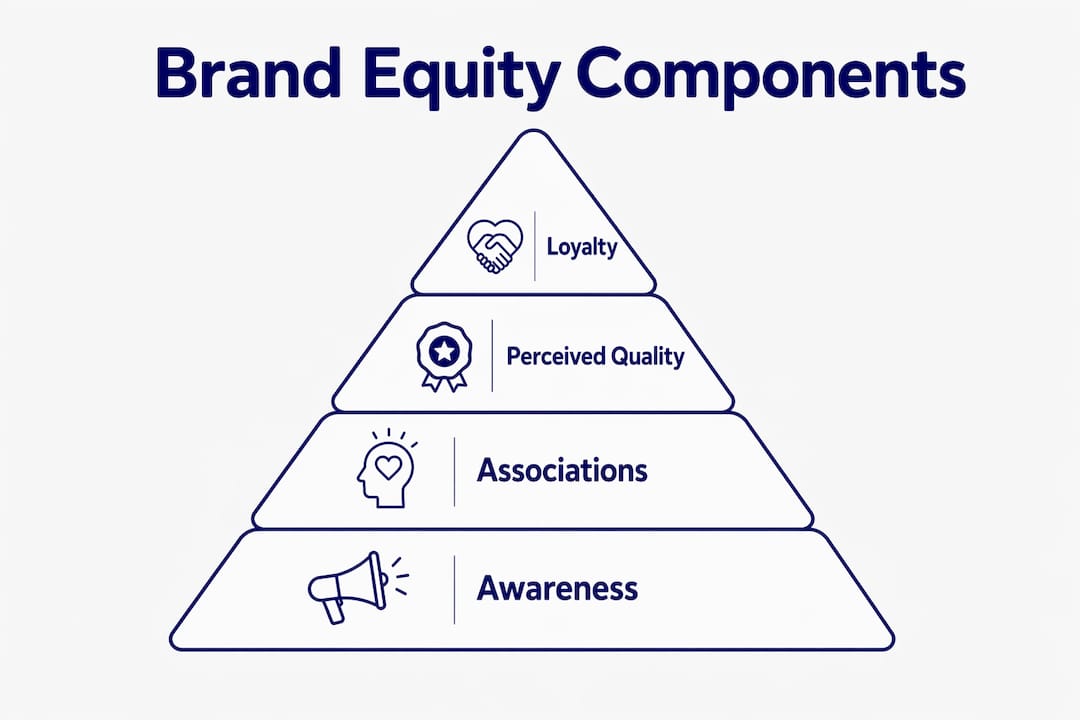
David Aaker’s framework, still the most widely referenced model in marketing science, identifies four primary dimensions of brand equity. Each one is measurable and each one feeds the others.
- Brand awareness is the degree to which consumers recognise and recall your brand without prompting. Unaided recall in surveys is the standard measure. High awareness is the entry point. Without it, the other dimensions cannot function.
- Perceived quality is the consumer’s judgement of a product’s overall excellence relative to alternatives. It is not the same as actual quality. A brand can have high perceived quality even when objective performance is average, and vice versa. Net Promoter Score and customer satisfaction indices are common proxies.
- Brand associations are the mental connections consumers make with your brand. These include personality traits, values, visual cues, and emotional responses. Distinctive assets such as Coca-Cola’s red or Nike’s swoosh are associations that have been built through consistent repetition over time.
- Brand loyalty is the tendency of customers to repurchase and resist switching to competitors. Repeat purchase rates, churn rates, and share of wallet are the clearest indicators.
These four dimensions are interdependent. High awareness without positive associations produces little commercial value. Strong loyalty built on perceived quality is far more durable than loyalty built on price promotions alone.
Pro Tip: When auditing your brand equity, map each dimension separately before drawing conclusions. A brand can score well on awareness and poorly on associations, which points to a very different strategic problem than low awareness across the board.
How to measure brand equity effectively
Successful measurement uses a balanced scorecard of 8 to 12 metrics spanning consumer perception and financial impact. Fewer than eight and you risk missing critical signals. More than twelve and you dilute focus, making it harder to act on what you find.
The most practical approach splits your scorecard into two categories.
- Consumer perception metrics: unaided brand awareness, aided awareness, brand consideration, preference ranking, Net Promoter Score, and sentiment scores from social listening tools.
- Financial impact metrics: price premium (the percentage above category average that customers will pay), revenue per customer, customer lifetime value, and retention rate.
Price premium is the most direct financial measure of brand equity, reflecting customers’ genuine willingness to pay more for your brand over a functionally equivalent alternative. It is the clearest signal that brand equity is translating into commercial value.
Annual brand equity tracking is inadequate for capturing meaningful shifts in consumer perception. Monthly or continuous tracking is the preferred approach, because delayed insight reduces your ability to adjust marketing or reposition before losses accumulate. A brand that only audits once a year may not detect a reputational slide until it has already affected revenue.
Integrating brand equity measurement into Marketing Mix Modelling (MMM) adds another layer of rigour. Techniques such as Cointegrated Vector Autoregression (CVAR) separate long-term baseline demand driven by brand from short-term media effects. This distinction matters enormously for budget allocation decisions.
Pro Tip: Build your scorecard around metrics your CFO can connect to revenue. If a metric cannot be linked to a commercial outcome, it is statistical theatre. The Harris Interactive and BERA composite models are worth studying for their approach to commercial linkage.
What business impact does strong brand equity drive?
Strong brand equity drives pricing power, baseline demand growth, customer lifetime value, and resilience during crises. These are not theoretical benefits. They are structural competitive advantages that compound over time.
The pricing power effect is the most immediate. Brands with strong equity face lower price elasticity, meaning customers are less sensitive to price increases. In consumer goods, this translates directly to margin. In SaaS, it means lower churn when you raise subscription prices. In professional services, it means clients do not instinctively seek three competing quotes before renewing.
“Strong brands face lower price elasticity, stabilise demand, and increase retention and profitability over time.” This is the commercial case for brand investment, stated plainly.
Baseline demand stability is the less-discussed benefit. When a brand has strong equity, a portion of its sales volume is driven by brand preference rather than media spend. This baseline is far more cost-efficient than demand generated purely through paid channels. It also provides a buffer during periods when media budgets are cut.
Brand equity links to retention patterns, sales quality, and pricing power, all of which validate marketing spend in terms that finance teams understand. Brands that invest in equity over time also demonstrate greater resilience during market disruptions. During the 2020 economic contraction, brands with high pre-crisis equity recovered consumer trust and sales volume faster than those relying primarily on promotional activity.
Relationship marketing strategies that deepen customer loyalty are one of the most direct ways to convert brand equity into measurable retention gains. The connection between equity and loyalty is not passive. It requires deliberate investment in customer experience and communication.
Common pitfalls in managing brand equity
Most brand equity programmes fail not because of poor data, but because of poor discipline in how that data is used. The most common mistakes are worth naming directly.
- Tracking too many metrics. Prioritising 8 to 12 core indicators linked to commercial outcomes is the standard. Teams that track 30 metrics rarely act on any of them with confidence.
- Overreliance on awareness. Awareness is the entry point, not the destination. A brand can have high awareness and deeply negative associations, which is worse than low awareness with positive sentiment.
- Ignoring qualitative signals. Quantitative shifts in equity metrics should trigger qualitative investigation to understand the underlying drivers. A drop in NPS tells you something is wrong. It does not tell you what or why.
- Annual-only audits. Monthly tracking catches problems before they become crises. Annual snapshots are useful for strategic reviews but insufficient for operational decision-making.
- Disconnecting brand from finance. Brand equity measurement that lives only in the marketing team has limited organisational impact. Connecting metrics to revenue quality and margin gives brand investment the commercial credibility it deserves.
Pro Tip: Present brand equity data in quarterly business reviews alongside revenue and retention figures. When brand health sits next to commercial performance, it stops being a marketing vanity metric and starts being a business indicator.
Practical steps to build and sustain strong brand equity
Brand equity is a slow, cumulative asset built through consistent messaging and quality customer experiences over time. There is no shortcut. The following steps reflect what actually works in practice.
- Define your distinctive assets and protect them. Colour, tone of voice, visual identity, and sonic branding are all equity-building tools when used consistently. Inconsistency erodes recognition.
- Invest in emotional storytelling. Rational product messages inform. Emotional narratives build associations. The brands with the strongest equity, from John Lewis to Innocent Drinks, have built emotional connections through consistent creative investment.
- Optimise every customer touchpoint. The post-purchase experience, customer service interactions, and digital touchpoints all contribute to perceived quality. A brilliant campaign followed by a poor onboarding experience destroys equity faster than it was built.
- Monitor brand reputation continuously. Social listening tools, review platforms, and sentiment analysis give you early warning of reputational shifts. Act on signals quickly rather than waiting for annual reports.
- Align internal communications with external brand promises. A brand promise that your team does not believe or understand will never be delivered consistently. Internal alignment is the foundation of external credibility. Brand comms that connect internally and externally is where durable equity is built.
- Use SEO to build brand awareness as part of a long-term equity strategy. Organic visibility reinforces brand recognition at scale and compounds over time in a way that paid media cannot replicate.
Key takeaways
Brand equity is a measurable commercial asset built through consistent brand experiences, and the most effective way to protect it is to track it continuously with a focused scorecard of 8 to 12 metrics linked directly to revenue outcomes.
| Point | Details |
|---|---|
| Definition of brand equity | The added value a brand name gives beyond functional benefits, driving loyalty and pricing power. |
| Core dimensions | Awareness, perceived quality, brand associations, and brand loyalty all interact to determine overall equity strength. |
| Measurement best practice | Use a balanced scorecard of 8 to 12 metrics; track monthly, not annually, to catch shifts early. |
| Commercial impact | Strong equity reduces price elasticity, stabilises baseline demand, and improves customer lifetime value. |
| Building equity | Consistent messaging, emotional storytelling, and aligned internal communications compound equity over time. |
Why brand equity measurement is still misunderstood
I have worked with marketing teams that produce detailed brand health reports every quarter and still cannot get budget approved for brand investment. The reports are thorough. The data is credible. But the metrics sit in a marketing deck and never reach the CFO’s agenda. That is the real problem with brand equity measurement in most organisations. It is treated as a marketing discipline rather than a commercial one.
The shift I have seen work is simple. Stop presenting brand equity as a perception story and start presenting it as a demand story. When you can show that a five-point increase in brand consideration correlates with a measurable uplift in baseline sales volume, the conversation changes entirely. Finance teams are not resistant to brand investment. They are resistant to brand investment that cannot be connected to revenue.
The other thing I would push back on is the idea that brand equity is only relevant for large consumer brands. I have seen it matter enormously in B2B services, in professional services firms, and in SaaS businesses where reputation drives trial and retention. The mechanics are the same. The measurement tools are the same. The only difference is the category context.
Brand equity is not a luxury for businesses with large marketing budgets. It is the most durable competitive advantage available to any business that communicates with customers. The question is not whether to invest in it. The question is whether you are measuring it well enough to know if your investment is working.
— Calum
How Michaelbell can help you build brand equity
At Michaelbell, we work with marketing teams and business leaders who know their brand has commercial potential but need a sharper strategy to unlock it. We connect external brand communications with internal alignment, so the brand promise you make to customers is the same one your team delivers every day.
Whether you need a clearer measurement framework, a more consistent creative approach, or a communications strategy that connects perception to commercial outcomes, our team brings the expertise and the partnership mentality to make it happen. Explore our brand communications services to see how we approach brand equity development for businesses at every stage of growth. We would love to hear about your brand challenges and get straight to work.
FAQ
What is the definition of brand equity?
Brand equity is the added value a brand name gives a product or service beyond its functional benefits, influencing customer loyalty, pricing power, and purchase decisions. It is built through consistent brand experiences over time.
How do you measure brand equity?
Measure brand equity using a balanced scorecard of 8 to 12 metrics covering consumer perception (awareness, NPS, sentiment) and financial impact (price premium, customer lifetime value, retention rate). Monthly tracking is more effective than annual audits.
What is the difference between brand equity and brand value?
Brand equity refers to consumer perception and the commercial advantages it creates. Brand value is the financial expression of that equity, often calculated as part of a business valuation or acquisition assessment.
What affects brand equity most?
Consistent messaging, quality customer experiences, and strong brand associations are the primary drivers. Negative publicity, inconsistent communication, and poor customer service are the fastest ways to erode it.
Why is brand equity important for business growth?
Strong brand equity reduces price elasticity, lowers customer acquisition costs, stabilises baseline demand, and improves resilience during market downturns. These effects compound over time, making brand equity one of the highest-return long-term investments a business can make.