
What is brand repositioning: a guide for business leaders

Brand repositioning is the strategic process of shifting a brand’s customer value proposition, target audience, competitive frame of reference, or reasons to believe, while retaining core brand equity. It is not a cosmetic update. According to Harvard Business School Online, repositioning impacts four distinct levers: who you serve, what you promise, how you compete, and why customers should believe you. Jill Avery of Harvard Business School describes it as retraining the market on what a brand means. For business professionals and entrepreneurs, understanding what is brand repositioning is the first step towards using it as a genuine growth tool rather than a reactive fix.
What is brand repositioning vs rebranding?
Brand repositioning and rebranding are not the same thing. Confusing them leads to expensive mistakes and missed opportunities.
Rebranding is primarily visual and cosmetic. It involves changes to a logo, name, colour palette, or design system. A brand refresh vs rebrand decision is often triggered by outdated aesthetics or a merger. The underlying market position may remain entirely unchanged.
Repositioning, by contrast, changes brand meaning and the relationship a brand holds with its customers. It affects how the market perceives your value, your relevance, and your competitive standing. A brand can reposition without changing a single visual element, and it can rebrand without repositioning at all.

The table below shows the core differences:
| Dimension | Rebranding | Repositioning |
|---|---|---|
| Primary focus | Visual identity, name, logo | Market meaning, value, perception |
| Triggers | Outdated aesthetics, mergers | Audience shift, competitive pressure |
| Timescale | Months | Two to four years |
| Risk | Customer confusion | Loss of existing brand equity |
| Outcome | New look | New market position |
The risk profile differs significantly too. Rebranding risks confusing loyal customers who no longer recognise the brand. Repositioning risks alienating them by changing what the brand stands for. Both risks are manageable with the right preparation, but only if you know which one you are actually attempting.
Pro Tip: Before committing to either path, audit your brand health first. Ask whether your problem is how you look or what you mean. The answer determines everything.
What are the key strategic levers in repositioning?
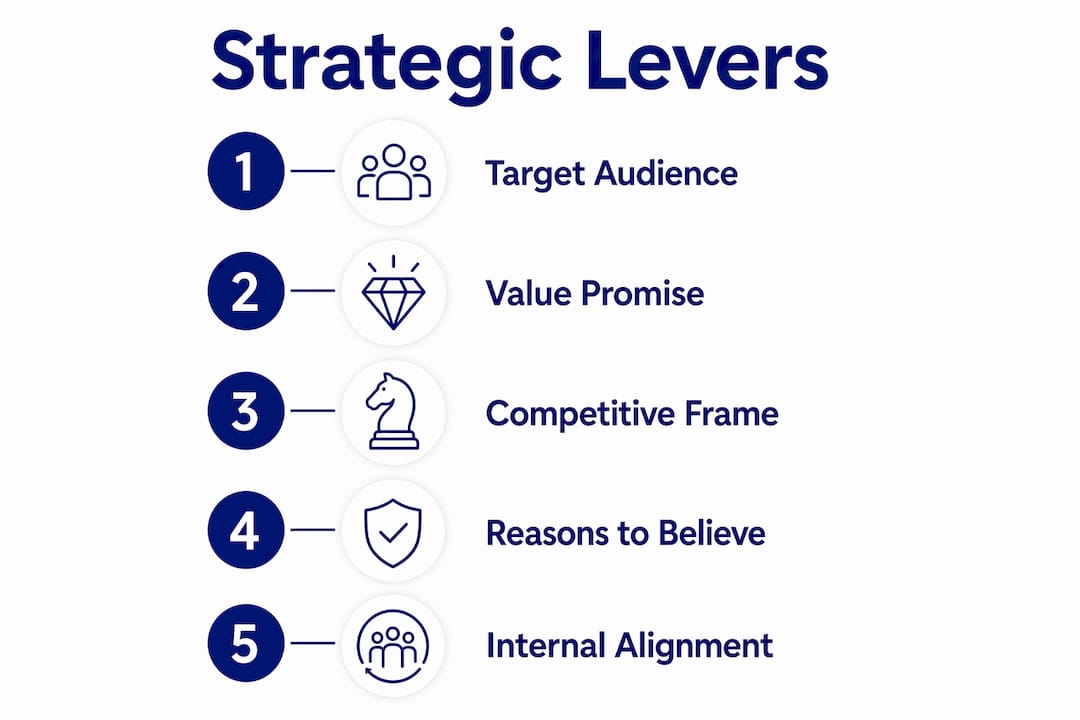
Effective repositioning requires deliberate choices across four interconnected areas. Adjusting one without considering the others produces inconsistency.
1. Target audience
Repositioning often involves expanding or shifting who you serve. A brand that built its reputation with small businesses may need to move upmarket to enterprise clients. That shift requires changes in tone, pricing, distribution, and proof points, not just messaging.
2. Value promise
Your value promise is the core benefit you deliver better than anyone else. Refining it means being honest about what the market actually needs now, not what worked five years ago. A unique selling proposition that once felt differentiated can become table stakes as competitors catch up.
3. Competitive frame of reference
The frame of reference defines the category you compete in. Repositioning sometimes means moving into a different category entirely. A financial services firm that repositions as a technology company changes its competitive set, its talent strategy, and its customer expectations all at once.
4. Reasons to believe
Reasons to believe are the proof points that make your promise credible. They include product features, client results, certifications, and partnerships. Without them, repositioning is just a claim. With them, it becomes a credible narrative.
5. Internal alignment
Internal team alignment behind the repositioning rationale is the most underestimated lever. External messaging fails when the people delivering the brand experience do not understand or believe the new direction. Culture and communications must shift alongside the market strategy.
Pro Tip: Run an internal communications audit before you launch any external repositioning activity. If your own team cannot articulate the new position clearly, your customers certainly will not.
What are the biggest pitfalls in brand repositioning?
Repositioning fails more often than it succeeds. The reasons are predictable, and most are avoidable.
- Changing too much at once. Trying to communicate multiple disparate differentiators destroys market clarity. Focus on parity with competitors first, then own exactly one primary difference.
- Underestimating the timeline. Perceptual change takes two to four years of consistent activity. Businesses that treat repositioning as a campaign rather than an operational shift abandon it too early and lose the investment already made.
- Ignoring existing brand equity. Loyal customers have a web of associations with your brand. Disrupting those associations without a clear reason erodes trust. Repositioning should build on what already works, not discard it.
- Misaligned internal messaging. Legacy internal messaging undermines repositioning efforts regardless of how polished the external work is. Sales teams pitching the old story while marketing pushes the new one creates visible contradiction.
- Skipping market research. Repositioning based on internal assumptions rather than customer insight produces a position that feels right internally but lands poorly externally. Qualitative research with existing and target customers is non-negotiable.
Recognising the signs your brand needs a refresh is one thing. Knowing whether the solution is a refresh, a rebrand, or a full repositioning is another. Getting that diagnosis right saves significant time and money.
How to reposition a brand: practical steps
Repositioning is not a campaign. It is an operational shift across product, pricing, distribution, and communication that takes years to embed. The steps below reflect brand repositioning best practices drawn from real market experience.
Step 1: Define the desired position clearly. Write a positioning statement that names your target audience, your competitive frame, your promise, and your reasons to believe. If you cannot write it in two sentences, it is not clear enough yet.
Step 2: Conduct thorough market and audience research. Interview existing customers, lapsed customers, and your target audience. Identify the gap between how the market currently perceives you and where you want to be. That gap is your repositioning brief.
Step 3: Audit your current brand health. Measure awareness, perception, and sentiment before you begin. Without a baseline, you cannot track whether the repositioning is working. Brand revitalisation case studies consistently show that brands which skip this step struggle to demonstrate ROI.
Step 4: Develop an integrated strategy. Repositioning touches every part of the business. The table below shows which functions need to align:
| Business function | Repositioning implication |
|---|---|
| Product | Features and roadmap must reflect the new promise |
| Pricing | Price signals category and quality perception |
| Distribution | Channels must match where the new audience shops |
| Communications | Messaging, tone, and creative must carry the new narrative |
| People and culture | Internal teams must understand and embody the new position |
Step 5: Align your internal teams first. Becoming more chosen in the market requires every customer touchpoint to deliver the same message. That starts with your people. Run internal briefings, update sales materials, and revise onboarding content before any external launch.
Step 6: Track perceptual and commercial outcomes. Measure repositioning on perception shifts and commercial results over multiple years, not on short-term campaign metrics. Track brand recall, category association, net promoter score, and revenue from the new target segment annually.
Refreshing your brand storytelling approach is often the most visible output of repositioning. But the story only lands when the substance behind it has genuinely changed.
Key takeaways
Brand repositioning succeeds when it changes market perception through consistent operational commitment across audience, promise, competitive frame, and internal culture, sustained over multiple years.
| Point | Details |
|---|---|
| Repositioning is not rebranding | Repositioning changes market meaning; rebranding changes visual identity. |
| Four levers drive repositioning | Audience, value promise, competitive frame, and reasons to believe must all align. |
| Internal alignment is non-negotiable | External messaging fails without internal teams understanding and delivering the new position. |
| Expect a two to four year timeline | Perceptual change requires sustained operational commitment, not a single campaign. |
| Own one primary difference | Communicating multiple differentiators destroys clarity; focus on one credible distinction. |
Why repositioning is harder than it looks
I have worked with brands that approached repositioning with genuine ambition and strong creative work, only to watch the effort stall because the internal culture never caught up. The external campaign looked brilliant. The sales team was still pitching the old story. That contradiction is visible to customers, even when they cannot name it.
The brands I have seen reposition successfully share one quality: they treated it as a business decision, not a marketing project. The leadership team owned it. The product team built to it. The people team communicated it internally before a single external asset went live. That sequence matters more than the quality of the creative.
There is also a temptation to reposition in response to a competitor rather than in response to a genuine market opportunity. Reactive repositioning almost always produces a weaker result because it is defined by what you are running from rather than what you are running towards. The strongest repositioning work I have encountered starts with a clear answer to one question: what do we want to be chosen for, and by whom?
Repositioning is not an exercise in sounding different. It is about becoming more credible and chosen when the market changes around you. That takes patience, clarity, and the willingness to make the internal changes that the external promise demands.
— Calum
How Michaelbell supports brand repositioning
Repositioning a brand is one of the most demanding things a marketing team can take on. It requires clarity of thought, consistency of execution, and the kind of internal and external alignment that is genuinely difficult to achieve without the right partner.
At Michaelbell, we work as an extension of your team, not as an outside vendor. We specialise in brand communications that connect your external positioning with your internal culture, so the story you tell the market is the same story your people live every day. From positioning strategy to integrated communications planning, our brand strategy services are built for marketing teams who need to move with confidence. If you are ready to reposition with purpose, we would love to talk.
FAQ
What is brand repositioning in simple terms?
Brand repositioning is the deliberate process of changing how a brand is perceived in the market. It involves shifting the value proposition, target audience, or competitive position to better meet business goals.
How long does brand repositioning take?
Perceptual change typically takes two to four years of consistent activity across product, pricing, communications, and customer experience. It is an operational shift, not a short-term campaign.
What is the difference between repositioning and rebranding?
Rebranding changes visual identity such as logos and names. Repositioning changes market meaning, competitive stance, and customer perception. A brand can do one without the other.
Why does brand repositioning fail?
Repositioning most commonly fails due to internal misalignment, an unclear or overcrowded differentiator, or treating it as a campaign rather than a sustained business commitment.
How do you measure brand repositioning success?
Track perceptual shifts through brand health surveys, category association scores, and net promoter score, alongside commercial outcomes such as revenue from the new target segment, measured annually over multiple years.