
What is brand revitalization? A guide for marketers

Brand revitalization is defined as the process of updating a company’s brand strategy and execution to remain relevant and profitable as markets and customers change. It is not a cosmetic fix. It is a deliberate, research-led effort to restore a brand’s appeal, sharpen its positioning, and rebuild its connection with customers. For marketing professionals and business leaders, understanding brand revitalization is the difference between managing decline and engineering growth.
What is brand revitalization and why does it matter?
Brand revitalization is the intentional reinvention of a brand to preserve its relevance, appeal, and profitability in evolving markets. It typically occurs when products age, profits decline after a peak, and the brand no longer resonates with its audience. The process involves repositioning, updated messaging, visual identity changes, and product adjustments. Done well, it is one of the most powerful tools in a brand strategist’s kit.
The importance of brand revitalization lies in what happens when brands ignore the signals. Relevance erodes quietly. Customers shift their loyalty to competitors who speak their language more clearly. A brand that fails to adapt does not simply stagnate. It actively loses ground.

Brand rejuvenation is the recognised industry term for this process, used interchangeably with brand revitalization across marketing literature. Both describe the same strategic intent: restoring a brand’s vitality without abandoning what made it valuable in the first place.
What triggers the need for brand revitalization?
Common triggers for brand revitalization include declining sales, lost market share, poor brand differentiation, and shifts in consumer preferences. These signals rarely arrive all at once. More often, they accumulate gradually until the brand’s position becomes genuinely precarious.
Recognising the triggers early is where the diagnostic work begins. The most reliable tools are:
- Brand audits: A structured review of how the brand performs across all touchpoints, from advertising to customer service.
- SWOT analysis: Mapping strengths, weaknesses, opportunities, and threats relative to the competitive environment.
- Customer research: Surveys, focus groups, and social listening that reveal how real customers perceive the brand today.
- Stakeholder feedback: Input from internal teams, partners, and distributors who see the brand from different vantage points.
The critical distinction here is between an aesthetic problem and a strategic one. A brand that looks dated but still resonates emotionally needs a refresh. A brand that has lost its meaning, its differentiation, or its relevance to its core audience needs full revitalization. Confusing the two is expensive. Applying a new logo to a brand with a broken value proposition solves nothing. You can spot the nine key signals that indicate a brand needs attention before the situation becomes critical.
Pro Tip: Run a perceptual mapping exercise with your current customers before committing to any revitalization programme. It reveals where your brand sits in their minds relative to competitors, and that gap is where your strategy begins.
How do you revitalize a brand? Step-by-step process
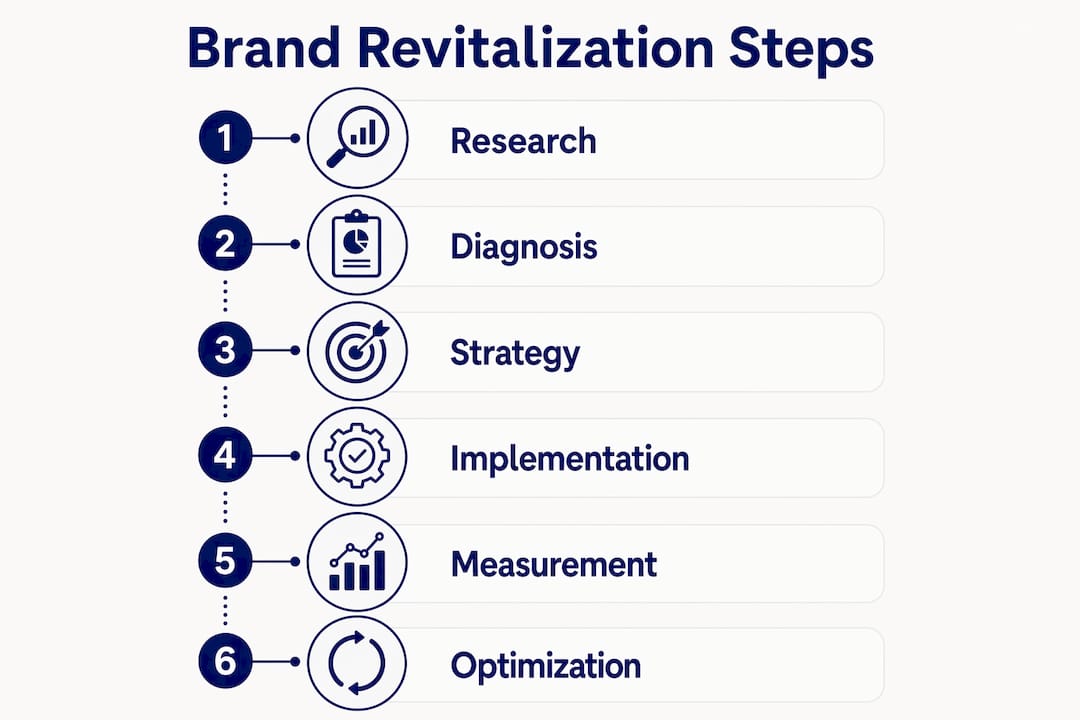
Brand revitalization follows a structured process: brand audit, SWOT analysis, redefining the target audience and positioning, developing the strategy, implementing changes, and monitoring key performance indicators. Each step builds on the last. Skipping the diagnostic phase to rush into execution is the most common mistake brands make.
The six core steps
- Brand audit: Assess current brand health across all channels. Use perceptual mapping, digital marketing audits, and customer feedback to establish a clear baseline.
- SWOT analysis: Identify internal strengths and weaknesses alongside external opportunities and threats. This shapes the strategic direction.
- Redefine audience and positioning: Clarify who the brand serves today and what it uniquely offers them. Positioning must reflect current market realities, not historical assumptions.
- Develop the strategy: Build a plan that covers messaging, visual identity, product or service updates, and the customer experience. Every element should reinforce the repositioned brand.
- Implement changes: Roll out the updated brand consistently across all touchpoints. Internal alignment is as critical as external execution. Your team must understand and believe in the new direction.
- Monitor KPIs: Track performance continuously, not just at launch.
Brand health assessment begins with research tools like perceptual mapping and digital audits. This research informs a new brand position implemented across the customer journey to restore engagement and credibility.
Key performance indicators for brand revitalization
| KPI | What it measures |
|---|---|
| Brand perception | How customers describe and feel about the brand |
| Customer satisfaction | Whether the brand experience meets or exceeds expectations |
| Customer loyalty | Repeat purchase rates and net promoter scores |
| Market share | The brand’s competitive position within its category |
| Sales performance | Revenue trends following revitalization activity |
Effective revitalization measurement goes beyond awareness. Tracking customer perceptions, satisfaction, loyalty, and sales impacts gives a far more accurate picture of whether the work is succeeding.
Pro Tip: Do not treat measurement as an afterthought. Build your KPI framework before implementation begins. That way, you have a clean baseline to measure against, and you can course-correct quickly if early results disappoint.
One principle from Branding Strategy Insider is worth holding onto throughout this process: in declining brand scenarios, the initial focus must be to protect and re-energise the brand core. Stabilising the core customer base prevents further loss and builds the financial foundation for future growth. Chasing new audiences before securing existing ones is a costly distraction.
Brand revitalization vs brand refresh, rebranding, and turnaround
These four terms are often used interchangeably. They are not the same. Understanding the distinctions helps you choose the right approach for your situation.
| Concept | Scope | Core focus | Preserves brand equity? |
|---|---|---|---|
| Brand refresh | Narrow | Visual and messaging updates | Yes, largely |
| Brand revitalization | Broad | Strategic repositioning and renewal | Yes, deliberately |
| Rebranding | Radical | New identity, often new name or direction | Partially or not at all |
| Brand turnaround | Financial | Immediate recovery from crisis | Focus is survival |
A brand refresh addresses surface-level ageing. Updated typography, a refined colour palette, refreshed campaign language. It does not touch the underlying strategy. Brand revitalization goes deeper. It re-examines positioning, audience relevance, and the value proposition. It preserves the core equities that customers still value while updating everything that has become a barrier to growth.
Rebranding is the most radical option. It can involve a new name, a new visual identity, and a fundamentally different market position. It is appropriate when the existing brand carries irreparable damage or when a business has changed so significantly that the old brand no longer fits. The risk is that rebranding discards equity that took years to build.
A brand turnaround, as revitalization levers make clear, focuses on renewal and demand acceleration rather than immediate financial recovery. Turnaround strategies are driven by crisis. Revitalization is driven by foresight. The best time to revitalise a brand is before the situation becomes urgent. For a detailed breakdown of when to choose each path, the strategic guide on brand refresh vs rebrand is worth reading carefully.
What strategies and techniques drive brand rejuvenation?
Brand rejuvenation draws on a combination of positioning work, creative execution, and customer engagement. No single lever does the job alone. The most effective revitalizations combine several of the following:
- Repositioning: Redefining what the brand stands for and who it serves. This is the strategic core of any revitalization effort. Brand repositioning can reinvigorate appeal by refining the value proposition and storytelling to resonate with evolving consumer expectations.
- Visual and packaging modernisation: Updating the brand’s look without abandoning the visual cues customers already associate with it. Familiarity and freshness must coexist.
- Product and service innovation: Introducing new offerings or improving existing ones to meet changed customer needs. A repositioned brand with an unchanged product range sends a contradictory message.
- Experience upgrades: Improving how customers interact with the brand at every touchpoint, from digital channels to in-store environments to post-purchase communications.
- Digital engagement and community building: Building genuine relationships with customers through social platforms, content, and storytelling tactics that deepen brand connection.
- Heritage and modernity: Blending the past and present in revitalization strategies can positively influence brand attitudes. Brands with genuine heritage have an asset that newer competitors cannot replicate. The skill is in making that heritage feel current rather than nostalgic.
The brands that revitalise most successfully do not chase trends. They listen to their customers, identify what still has genuine value in the existing brand, and build forward from that foundation.
How do you measure the success of brand revitalization?
Measurement is where many revitalization programmes fall short. Teams celebrate a successful launch and move on, without tracking whether the work has actually changed anything meaningful. The KPIs that matter go well beyond brand awareness.
Brand revitalization KPIs include brand perception, customer attitudes, satisfaction, loyalty, market share, and sales. Awareness tells you whether people have seen your new brand. Perception tells you whether they believe it. Loyalty tells you whether it has changed their behaviour. You need all three to understand the full picture.
Perceptual mapping, run before and after the revitalization, shows whether the brand has actually moved in customers’ minds. Digital marketing audits track engagement, sentiment, and share of voice across channels. Customer satisfaction scores and net promoter scores reveal whether the experience has improved. Performance management must be integral throughout the process, not bolted on at the end. Advanced measurement tools can support brand health evaluation at each stage of the process.
Key takeaways
Brand revitalization succeeds when it is grounded in customer research, protects core brand equity, and tracks performance across perception, loyalty, and sales, not just awareness.
| Point | Details |
|---|---|
| Start with diagnosis | Use brand audits, SWOT analysis, and customer research before making any changes. |
| Protect the brand core | Stabilise your existing customer base before pursuing new audiences. |
| Distinguish the approach | Choose between refresh, revitalization, or rebranding based on the depth of the problem. |
| Measure what matters | Track perception, loyalty, and sales, not just awareness, to assess real impact. |
| Blend heritage with relevance | Preserve what customers value while updating what has become a barrier to growth. |
Why research beats redesign every time
The most common mistake I see in brand revitalization is starting with the logo. It feels productive. It generates excitement internally. It gives leadership something tangible to approve. But many corporate rebrands fail because they start with visuals rather than client perceptions. PwC’s disciplined brand revitalization is the example worth studying. It began with research and client understanding, not design changes. The result was a revitalization that actually held.
The brands I have seen revitalise successfully share one trait. They are patient. They resist the pressure to show visible change quickly and instead invest time in understanding what their customers actually think, feel, and need. That research phase feels slow. It is, in fact, the fastest route to a revitalization that sticks.
The other pitfall is abandoning brand equity in the pursuit of relevance. A brand that has been around for decades carries associations that took years to build. Throwing those away to chase a younger audience is a gamble that rarely pays off. The better approach is to find the parts of your heritage that still resonate and make them feel alive again. That is where the real creative challenge lies, and it is far more interesting than starting from scratch.
— Calum
How Michaelbell supports brand revitalization
Brand revitalization is only as good as its execution. Strategy without consistent, well-crafted communication across every touchpoint leaves the work half-finished.
At Michaelbell, we work as an extension of your marketing team, not as an outside vendor. We bring together brand strategy, direct marketing, and internal communications to make sure your revitalized brand lands consistently, inside and outside your organisation. Whether you need to sharpen your positioning, refresh your messaging, or align your team around a new brand direction, our brand communications services are built for exactly that. We love a challenge, and we get straight to work. Get in touch to talk through what your brand needs next.
FAQ
What is brand revitalization in simple terms?
Brand revitalization is the process of updating a brand’s strategy, positioning, and communications to restore its relevance and profitability. It goes deeper than a visual refresh and addresses the underlying reasons a brand has lost its appeal.
How do you know when a brand needs revitalization?
The clearest signs are declining sales, falling market share, weakening customer loyalty, and growing competition from brands that feel more relevant. A brand audit and customer research will confirm whether the issue is strategic or cosmetic.
What is the difference between brand revitalization and rebranding?
Brand revitalization preserves core brand equity while updating positioning, messaging, and experience. Rebranding is more radical and can involve a new name, identity, and market direction, often discarding existing brand associations entirely.
How long does brand revitalization take?
The timeline depends on the scale of the changes required, but a thorough revitalization typically takes several months from initial audit to full implementation. Rushing the research phase is the most common cause of poor outcomes.
What are the most important KPIs for brand revitalization?
The most important KPIs are brand perception, customer satisfaction, loyalty, market share, and sales performance. Awareness alone is not a reliable indicator of whether the revitalization has worked.