
Programmatic advertising explained for UK marketers

Programmatic advertising is the automated buying and selling of digital ad impressions via software, matching the right ad to the right person at the right moment without a single manual negotiation. According to the IAB UK, it gives marketers the flexibility to adjust campaigns in real time, which is why it has become the default method for digital display buying. EMARKETER reports that programmatic now accounts for over 90% of US digital display ad spending, a figure that reflects a similar trajectory across the UK market.
The core appeal is simple: instead of emailing a media owner, agreeing a rate, and waiting for an insertion order, software handles the entire transaction in milliseconds. For a marketing team, that means more precise targeting, faster learning, and media spend that adjusts to performance rather than sitting locked in a fixed plan.
Key takeaways
Programmatic advertising is the most efficient way to buy digital media at scale, but it only delivers on that promise when strategy, creative, and measurement are set up correctly from the start.
| Point | Details |
|---|---|
| Automation is the core | Programmatic uses software to buy and sell ad impressions in real time, replacing manual negotiation entirely. |
| Auctions run in milliseconds | Bid requests, auction, and creative delivery complete in under 100 milliseconds as a page loads. |
| Four transaction types exist | Open exchange, private marketplace, programmatic guaranteed, and preferred deals each suit different campaign goals. |
| Risks need active management | Ad fraud, brand safety, and UK GDPR compliance require pre-bid controls, verification tools, and a consent management platform. |
| Michaelbell as your partner | Michaelbell provides integrated programmatic strategy, creative production, and media buying support for UK marketing teams. |
Table of Contents
- How programmatic advertising works: the real-time auction explained
- What types of programmatic transactions are available?
- Which channels and formats does programmatic cover?
- What are the real benefits of programmatic advertising?
- What are the main risks and how do you manage them?
- How does programmatic pricing work and what should you budget?
- How to get started with programmatic advertising in the UK
- An agency checklist: common mistakes and how to avoid them
- When programmatic works best: an agency perspective
- Programmatic strategy, creative, and media buying with Michaelbell
- Sources
How programmatic advertising works: the real-time auction explained
Every time a webpage or app loads, a rapid sequence fires behind the scenes. TechTarget’s definition puts it clearly: programmatic automates transactions that previously required requests and insertion orders, enabling impressions to be bought via real-time bidding in the time it takes a page to load. Here is the flow:
- A user visits a page. The publisher’s ad server sends a bid request to an ad exchange, describing the impression (site, format, audience data).
- The ad exchange passes that request to multiple demand-side platforms (DSPs), the software advertisers use to bid.
- Each DSP evaluates the impression against its targeting rules and submits a bid response in real time.
- The exchange runs an auction, the highest eligible bid wins, and the winning creative is served to the user.
Superscale’s explainer confirms that these auctions typically finish in under 100 milliseconds, making impression-by-impression decisions using rules and algorithms. The whole sequence completes before the page finishes loading.
The key roles in the ecosystem:
- DSP (demand-side platform): the advertiser’s buying interface. It holds targeting rules, budgets, and creative assets.
- SSP (supply-side platform): the publisher’s selling interface. It maximises yield by connecting inventory to multiple demand sources.
- Ad exchange: the marketplace where DSPs and SSPs meet to run auctions.
- Ad server: delivers the winning creative and records the impression.
- Data providers: supply audience segments (demographic, behavioural, contextual) that inform bidding decisions.
Header bidding changed the publisher side of this equation. Rather than calling a single ad server waterfall, header bidding runs auctions across multiple demand sources simultaneously before the ad server call. Publishers typically see stronger yield; advertisers compete on a level playing field. The trade-off is added technical complexity on the publisher’s site.
Pro Tip: Set viewable CPM (vCPM) as your primary pricing metric from day one rather than raw CPM. It filters out impressions that never appear on screen and gives you a cleaner signal of what you are actually paying for.
What types of programmatic transactions are available?
Not all programmatic buying works the same way. There are four main transaction types, each suited to different goals:
- Open exchange (real-time bidding): any advertiser can bid on any available impression. Broad reach, competitive pricing, but less control over where your ad appears. Best for performance campaigns and brands building scale quickly.
- Private marketplace (PMP): a publisher invites selected advertisers to bid on premium inventory before it reaches the open exchange. You get better brand safety and more predictable placements, at a higher floor price. Useful for mid-size brands that want quality without committing to a fixed buy.
- Programmatic guaranteed: a direct deal executed programmatically. Volume and price are agreed in advance, but the targeting and delivery are automated. The right choice for seasonal campaigns, large brand launches, or situations where a specific publisher’s audience is non-negotiable.
- Preferred deals: a fixed CPM is agreed with a publisher, but the advertiser has first right of refusal on inventory rather than a guaranteed volume. Sits between PMP and programmatic guaranteed in terms of commitment.
A small brand testing programmatic for the first time will usually start on the open exchange for reach and learning. A larger brand running a product launch alongside a premium publisher will typically use programmatic guaranteed to lock in the placement while keeping the operational efficiency of automated delivery.
Which channels and formats does programmatic cover?
Programmatic has moved well beyond the banner ad. EMARKETER confirms that inventory now includes connected TV (CTV), digital audio, and digital out-of-home (DOOH), alongside the display and video formats most marketers already know.
- Standard display: leaderboards, MPUs, and skyscrapers across desktop and mobile web.
- Rich media: interactive or animated display units with expandable panels or video elements.
- Online video (pre-roll, mid-roll, outstream): bought programmatically via video-specific DSPs or general platforms with video inventory.
- Connected TV (CTV): ads served into streaming apps on smart TVs and set-top boxes. Measurement differs from linear TV; reach is tracked at the device or household level.
- Digital audio: in-stream ads on podcast platforms and music streaming services. Creative specs are audio-only; brand safety controls are less mature than display.
- Digital out-of-home (DOOH): programmatic buying of digital billboard and screen inventory. Impressions are sold by audience or daypart rather than individual views.
- Mobile in-app: inventory inside smartphone apps, including interstitials, rewarded video, and native placements. Measurement relies on mobile measurement partners (MMPs) rather than cookies.
Each channel has its own creative specifications and attribution logic. Video and CTV require different creative lengths and aspect ratios from display; DOOH cannot use personal data in the same way as online formats under UK GDPR guidance from the ICO.
What are the real benefits of programmatic advertising?
The case for programmatic rests on four practical advantages:
- Efficiency at scale: automated buying removes the manual back-and-forth of traditional media negotiation. A single DSP can access thousands of publishers simultaneously, something no human trading team can replicate.
- Precision targeting: audience segments built from first-party data, third-party data, or contextual signals let you reach specific people rather than broad demographic buckets. You can leverage customer data to build lookalike audiences or retarget existing customers across channels.
- Real-time optimisation: the IAB UK highlights that advertisers can reallocate spend instantly toward higher-performing segments, which manual buying cannot match. If one audience segment is converting at twice the rate of another, the DSP can shift budget within hours, not weeks.
- Measurable outcomes: when measurement is set up correctly before launch, programmatic campaigns produce granular data on CPM, CPC, CTR, viewability, and post-click conversions. That data feeds the next campaign, compressing the learning cycle.
The adoption figures speak to the method’s effectiveness. Programmatic’s dominance in US digital display, tracked by EMARKETER, reflects a similar pattern across UK digital budgets as marketers follow the data.
What are the main risks and how do you manage them?
Programmatic’s scale is also its vulnerability. Three risks come up consistently for UK marketers:
- Ad fraud and invalid traffic (IVT): bots and fraudulent sites inflate impression counts without delivering real audiences. Mitigation: use a verification vendor such as DoubleVerify or Integral Ad Science, set pre-bid IVT filters, and check that publishers have adopted ads.txt and sellers.json for supply-chain transparency.
- Brand safety: open exchange buying can place ads next to harmful or irrelevant content. Mitigation: apply keyword blocklists, use contextual pre-bid segments, and favour private marketplaces for sensitive categories.
- Transparency and hidden fees: the programmatic supply chain has multiple intermediaries, each taking a margin. Mitigation: ask your DSP for log-level data, request a supply-path optimisation (SPO) audit, and use platforms that disclose fee structures clearly.
- Privacy and UK GDPR compliance: any audience data used in programmatic targeting must comply with UK GDPR and ICO guidance. Consent signals must flow through the supply chain via a consent management platform (CMP). The ASA also governs ad content standards regardless of delivery method. Integrating privacy-by-design into your data strategy from the start is far less costly than retrofitting it later.
How does programmatic pricing work and what should you budget?
Programmatic uses three main pricing models:
- CPM (cost per mille): you pay per 1,000 impressions. The most common model in display and video programmatic.
- CPC (cost per click): you pay only when a user clicks. Less common in programmatic display but available on some platforms.
- CPA (cost per acquisition): you pay per conversion. Usually requires a learning phase before the algorithm optimises effectively.
Beyond the media CPM, your total cost includes platform or transaction fees (typically a percentage of media spend charged by the DSP), data costs if you use third-party audience segments, and agency or managed-service fees if you are not running the platform in-house. Understanding how modern marketing approaches compare to traditional models helps set realistic expectations for these cost layers.
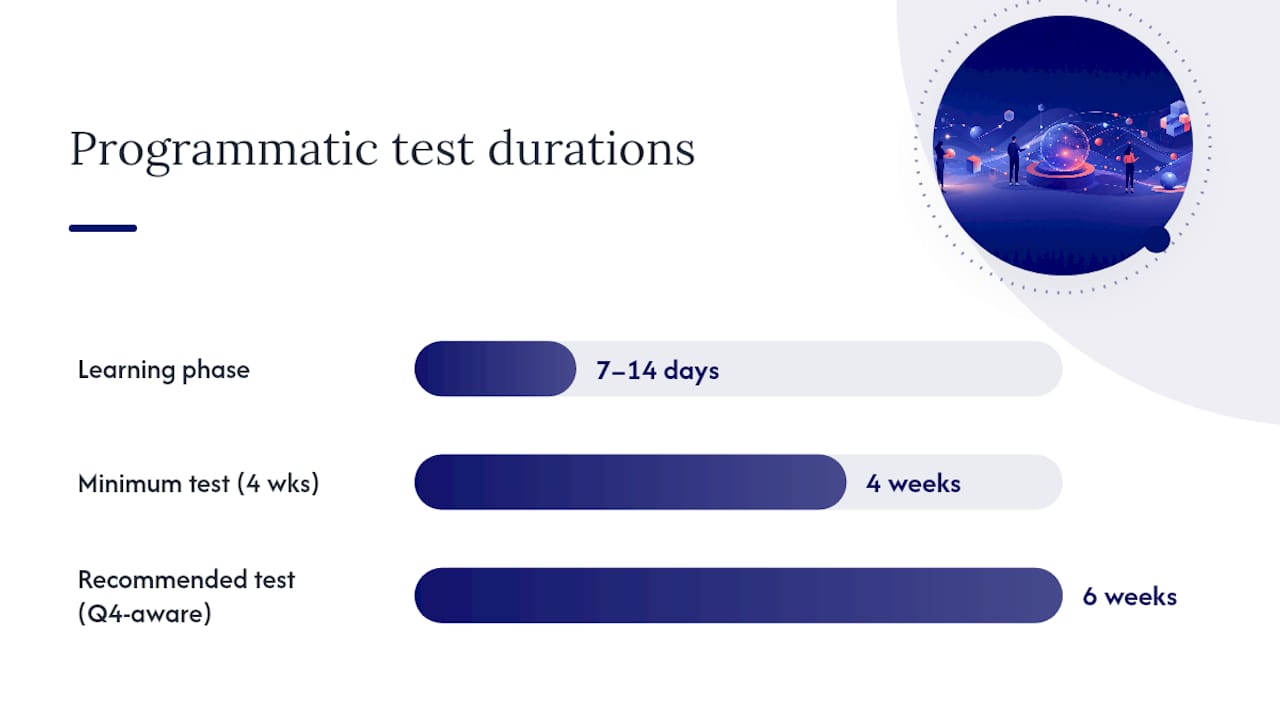
For budgeting, start with a test budget large enough to generate statistically meaningful data, typically a minimum of four to six weeks of spend at a consistent daily rate. The first 7–14 days are a learning phase; the algorithm needs enough impressions and conversions to optimise. Seasonality affects floor prices significantly, particularly in Q4, so factor that into your CPM expectations.
How to get started with programmatic advertising in the UK
The first decision is whether to run self-service or use a managed service.
Self-service DSPs give your team direct control over targeting, bidding, and reporting. The trade-off is the time and expertise required to operate the platform well. Managed service means a media agency or platform team operates the DSP on your behalf, which reduces the learning curve but adds a service fee.
When evaluating platforms, three are worth understanding as starting points:
- Amazon DSP: strong for brands with retail or e-commerce objectives. Access to Amazon’s first-party purchase data is a genuine differentiator for product-led campaigns.
- Google Display & Video 360 (DV360): broad inventory access, deep integration with Google’s measurement stack, and strong YouTube and CTV reach. A natural starting point for teams already using Google’s marketing tools.
- The Trade Desk: an independent DSP with strong data partnerships, transparent fee structures, and growing CTV and audio inventory. Preferred by many agencies for its openness and reporting depth.
Campaign setup checklist:
- Define your objective (awareness, consideration, or conversion) before touching the platform.
- Build your audience: first-party segments first, then contextual or third-party to extend reach.
- Confirm creative specs for each format and channel before briefing production.
- Set measurement parameters: CPM, viewable CPM, CTR, and conversion window before launch.
- Apply brand-safety filters and IVT pre-bid controls from day one.
- Schedule a weekly optimisation review for the first month, then move to fortnightly once performance stabilises.
For guidance on selecting the right agency partnership model for your programmatic activity, it is worth mapping your internal capabilities honestly before committing to a self-service approach.
An agency checklist: common mistakes and how to avoid them
From our work at MB Brand Communications, the same mistakes appear repeatedly in programmatic campaigns that underperform.
Common pitfalls:
- Launching without defined success metrics, then optimising toward the wrong signal.
- Running a single creative across all channels and audiences with no testing cadence.
- Over-relying on third-party audience data without validating it against first-party signals.
- Ignoring viewability thresholds and brand-safety controls until a problem surfaces.
Our practical checklist:
- Define your KPIs before briefing the platform: CPM, CPA, or ROAS, not “awareness.”
- Map each creative asset to its channel and audience: a 30-second video for CTV is not the same brief as a 300×250 display unit.
- Set brand-safety filters and ads.txt compliance checks before the first impression is served.
- Run controlled A/B tests on at least two creative variants per audience from launch. Our guide to testing in data-driven marketing covers the framework we use with clients.
- Align programmatic audience signals with your first-party data strategy so targeting improves over time rather than degrading as third-party cookies phase out.
When programmatic works best: an agency perspective
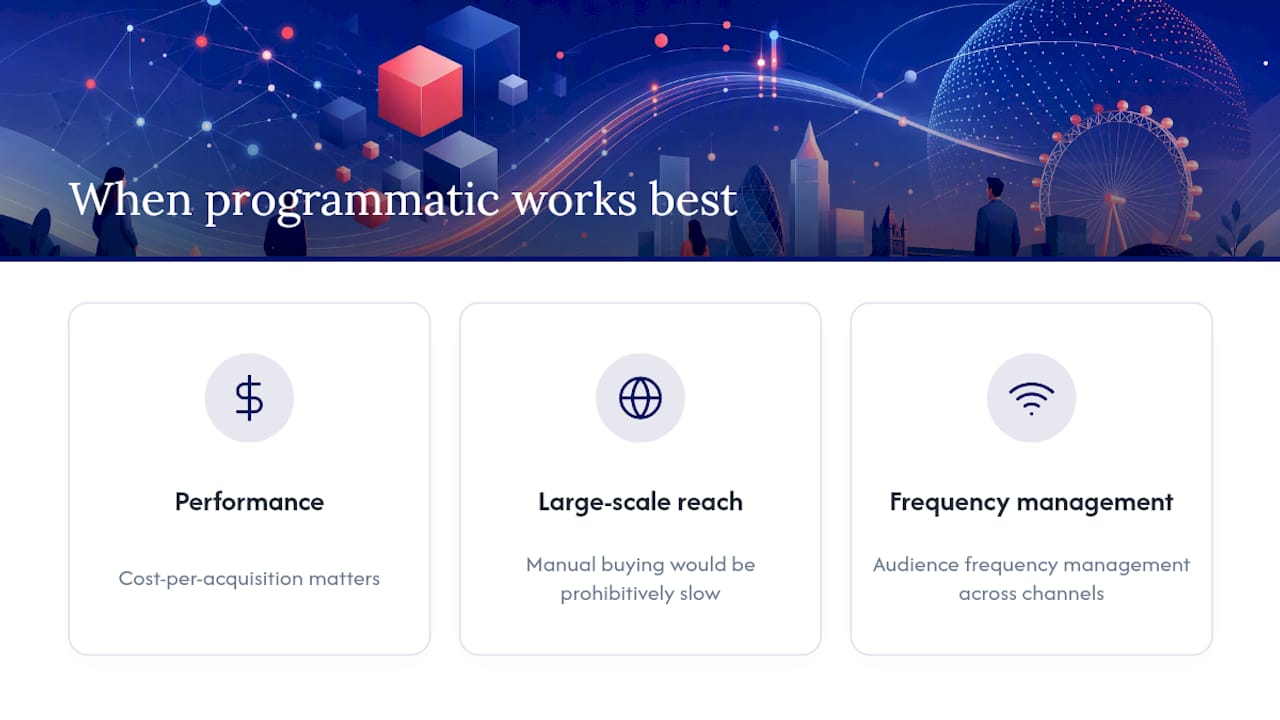
Programmatic delivers its clearest value in three situations: performance campaigns where cost-per-acquisition matters, large-scale reach campaigns where manual buying would be prohibitively slow, and audience frequency management across multiple channels simultaneously.
Where I see marketers go wrong is treating programmatic as a set-and-forget channel. The automation handles the bidding, but the strategy, creative, and measurement still need human judgement. The brands that get the most from programmatic pair it with a strong brand investment, because reach without creative impact rarely converts. If you want to understand why brand investment pays off alongside performance activity, the evidence is compelling.
Programmatic also works best when it is one part of a connected communications plan, not the whole plan. Owned channels, direct mail, and above-the-line activity all reinforce what programmatic reaches. The combination is consistently stronger than any single channel alone.
Programmatic strategy, creative, and media buying with Michaelbell
Programmatic is powerful, but it rewards teams who get the strategy, creative, and measurement right from the start. Michaelbell works with marketing teams as an integrated partner across all three: campaign strategy, creative production tailored to each programmatic format, audience and data setup, and hands-on media buying support.
We operate as an extension of your team rather than a distant vendor, which means you get agency-grade programmatic expertise without the overhead of building it in-house. Whether you are running your first programmatic campaign or looking to improve performance on an existing one, we can help you move faster and spend smarter. View our full agency services or get in touch to discuss your next campaign.
Sources
- FAQ on programmatic advertising: Keeping up with automated ad buying
- Back to Basics Guide to Programmatic | IAB UK
- What is programmatic advertising and how does it work? | Definition from TechTarget
- Programmatic advertising: how it works + platforms (2026)