
Why audience segmentation improves results: a guide for marketers

Audience segmentation improves marketing results because it lets you speak to smaller, better-defined groups with the right message at the right moment, then measure that effect against revenue. Companies that excel at this kind of disciplined personalisation generate around 40% more revenue than peers, according to McKinsey-cited research. At Michaelbell, we see this play out in every client engagement: the moment a brand stops broadcasting to everyone and starts talking to someone specific, the numbers shift.
Three outcomes you can expect immediately:
- Higher engagement and conversion — relevant messages earn attention; irrelevant ones get ignored or blocked.
- Lower wasted spend and improved ROAS — tighter targeting and suppression lists stop budget flowing to audiences who will never convert.
- Stronger retention and lifetime value — personalised lifecycle sequences keep customers longer and open upsell opportunities.
Table of Contents
- What audience segmentation actually means
- Five ways segmentation concretely improves your results
- How to implement audience segmentation step by step
- How to measure whether segmentation is working
- Common mistakes and UK GDPR considerations
- A UK segmentation example with measurable results
- Nine-point checklist to start or improve segmentation
- Key takeaways
- The part most guides skip
- How Michaelbell can help you get segmentation right
- Useful sources and further reading
What audience segmentation actually means
Audience segmentation is the practice of dividing your total addressable audience into smaller groups that share meaningful attributes or behaviours, so you can tailor messaging, offers, and measurement to each group rather than averaging across all of them.
The practical boundary matters. A segment needs to be large enough to activate at scale and measure with statistical confidence, yet distinct enough that a different message genuinely makes sense. For most teams starting out, three to five pilot segments is the right number before expanding to dynamic or predictive clusters.
Common use cases where segmentation pays off:
- Acquisition targeting (reaching only the firmographic or behavioural profiles most likely to convert)
- Lifecycle personalisation (different messages for trial users versus long-term customers)
- Retention campaigns (identifying at-risk cohorts before they churn)
- Upsell and expansion (surfacing the right product to high-LTV customers at the right moment)
- Paid-media optimisation (suppressing existing customers from prospecting campaigns to protect ROAS)
Five ways segmentation concretely improves your results
Higher engagement and conversion
Relevance drives response. When a message matches a recipient’s situation, intent, or need, open rates, click rates, and conversion rates all rise. The McKinsey-cited figure above — around 40% more revenue for personalisation leaders — reflects this at scale. Even modest segmentation, separating engaged email subscribers from cold contacts in Mailchimp, for instance, typically lifts open rates materially.
Reduced wasted spend and improved ROAS
Suppression lists are one of the fastest wins in paid media. Syncing your CRM segments to Google Ads or Meta and excluding existing customers from prospecting campaigns stops you paying to acquire someone you already have. First-party audiences built from CRM data and website behaviour consistently outperform third-party audiences on match rates, conversion rate, and cost per acquisition when activated correctly.
| Segmentation maturity | Typical ROAS impact | Retention uplift |
|---|---|---|
| No segmentation (broadcast) | Baseline | Baseline |
| Basic demographic splits | Moderate improvement | Low improvement |
| Behavioural and lifecycle segments | 20–30% higher ROI | 25–60% uplift |
| Dynamic and predictive clusters | Highest, varies by category | Highest, varies by category |
Shorter sales cycles and better pipeline quality
Tailored messaging removes friction at each decision point. A prospect who receives content matched to their specific role and buying stage moves through the funnel faster than one receiving generic material. The compounding effect is real: a 15% lift in landing-page conversion reduces CPL and feeds a higher-quality pipeline at every downstream stage.
Improved retention and lifetime value
Retention sequences built around lifecycle signals — product usage drop-off, days since last purchase, engagement score decline — catch at-risk customers before they leave. High-LTV cohorts identified through value-based segmentation also make natural lookalike audiences for prospecting, closing the loop between retention and acquisition.
Clearer attribution and faster optimisation
Segments make attribution more meaningful. When you can compare conversion rates, CPL, and ROAS by cohort rather than in aggregate, you know which groups are driving results and which are dragging the average down. Combining multi-touch attribution for directional insight with incrementality testing for causal proof gives you the confidence to reallocate budget quickly rather than waiting for an annual review.
How to implement audience segmentation step by step
- Map your data sources — CRM records, website analytics (Google Analytics 4), email engagement data (Mailchimp), SMS and messaging data (Link Mobility for multi-channel campaigns). Identify gaps before you build.
- Build segments in your CRM and analytics platform — HubSpot’s smart lists and active lists let you create dynamic segments that update automatically as contact properties change. Google Analytics 4 audiences can be published directly to Google Ads.
For a deeper look at using unified customer data across these steps, the Michaelbell guide on leveraging customer data for brand communications covers the practical data-mapping work in detail.
Pro Tip: When sizing test and control groups for incrementality checks, aim for a minimum of 1,000 users per group and a test duration that covers at least one full business cycle. For B2B, that often means 30–90 days to avoid false positives from short-window noise.
How to measure whether segmentation is working
Getting the measurement right is where most teams fall short. Platform-reported metrics flatter performance; revenue-focused KPIs tell the truth.
- Unify your data. Fragmented analytics and inconsistent metric definitions across platforms impede optimisation. Pull segment-level data into a single dashboard or data warehouse so you are comparing like with like.
- Run holdout tests for causal proof. Incrementality testing with holdout groups is the only reliable way to prove that your segmented campaign caused the uplift rather than coinciding with it.
Analytics-driven teams that align shared KPIs with unified data and a test-and-learn workflow see compounding benefits across the funnel, not just at the segment level where the change was made.
Common mistakes and UK GDPR considerations
Over-segmentation is the most common trap. Segments that are too granular become impossible to measure with statistical confidence and too small to activate efficiently in ad platforms. Three to five meaningful segments will outperform twenty micro-segments every time.
- Siloed optimisation: Editing bids or copy within a single platform without accounting for multi-channel effects produces misleading results. A segment that looks poor in Google Ads may be converting through email or direct.
- Message mismatch: Sending a highly specific ad promise to a generic landing page is one of the most reliable ways to generate high CTR and low conversion simultaneously. Each segment’s ad intent should match a dedicated landing page or at least a tailored content block. Practical guidance on keeping messaging consistent across segments is covered in the Michaelbell article on refreshing brand messaging for existing audiences.
- Data fragmentation: Poor identity resolution across devices and channels means the same person appears in multiple segments, distorting your numbers.
- Audience fatigue: Watch for rapid frequency increases and engagement score decline within a segment. Both signal that the creative or offer needs refreshing.
UK GDPR considerations: Profiling and behavioural segmentation require a lawful basis under the UK GDPR. Consent is the clearest basis for marketing profiling, but legitimate interest can apply where the processing is proportionate and the individual’s rights are not overridden. Whichever basis you rely on, document it, apply data minimisation (collect only what you need to build the segment), and maintain an audit trail. The ICO’s guidance on profiling and automated decision-making is the primary reference for UK teams.
Pro Tip: Review your segment definitions and data sources against your privacy notice at least once a year. Segments built on data collected under one stated purpose cannot simply be repurposed for a new campaign without revisiting the lawful basis.
A UK segmentation example with measurable results
A UK-based B2B technology firm running undifferentiated email campaigns to its full contact database was seeing flat engagement and a rising cost per opportunity. The team identified three distinct behavioural segments within the existing list: active product users, lapsed trialists, and cold contacts who had never engaged beyond the initial sign-up.
What changed:
- Separate email sequences were built for each segment in HubSpot, with messaging and offers matched to each group’s position in the lifecycle.
- Lapsed trialists received a re-engagement sequence with a time-limited incentive; cold contacts were moved to a lower-frequency nurture track.
- Landing pages were updated to match the specific promise in each segment’s emails, removing the message mismatch that had been inflating bounce rates.
- A holdout group was maintained for the lapsed trialist segment to provide an incrementality baseline.
The outcome: cost per opportunity fell by approximately a third within two business cycles, and the lapsed trialist segment produced a conversion-to-pipeline rate more than double the previous all-contacts average. The single biggest driver was the landing-page alignment, not the email copy itself.
The lesson: funnel improvements compound. Fixing the message-to-page match in one segment reduced CPL and improved pipeline quality across the board, because the same contacts were also receiving paid retargeting.
Nine-point checklist to start or improve segmentation
- Select your tooling — HubSpot for CRM-based dynamic lists; Google Analytics 4 for behavioural audiences; Mailchimp for email segmentation; Link Mobility for multi-channel messaging activation.
Key takeaways
Audience segmentation improves results by raising message relevance, concentrating spend on high-value groups, and enabling causal measurement tied to revenue rather than vanity metrics.
| Point | Details |
|---|---|
| Start small and meaningful | A small number of pilot segments generally outperform granular micro-segments that are too small to measure or activate. |
| First-party data wins | CRM and behavioural audiences outperform third-party data on match rates, conversion rate, and cost per acquisition. |
| Prove causation, not correlation | Holdout tests running for at least one business cycle (30–90 days for B2B) are the only reliable way to confirm segmentation caused the uplift. |
| Funnel improvements compound | A conversion lift in one segment reduces CPL and raises pipeline quality at every downstream stage. |
| Michaelbell as your partner | Michaelbell aligns segment strategy with commercial outcomes and handles data mapping, creative, activation, and measurement as an integrated service. |
The part most guides skip
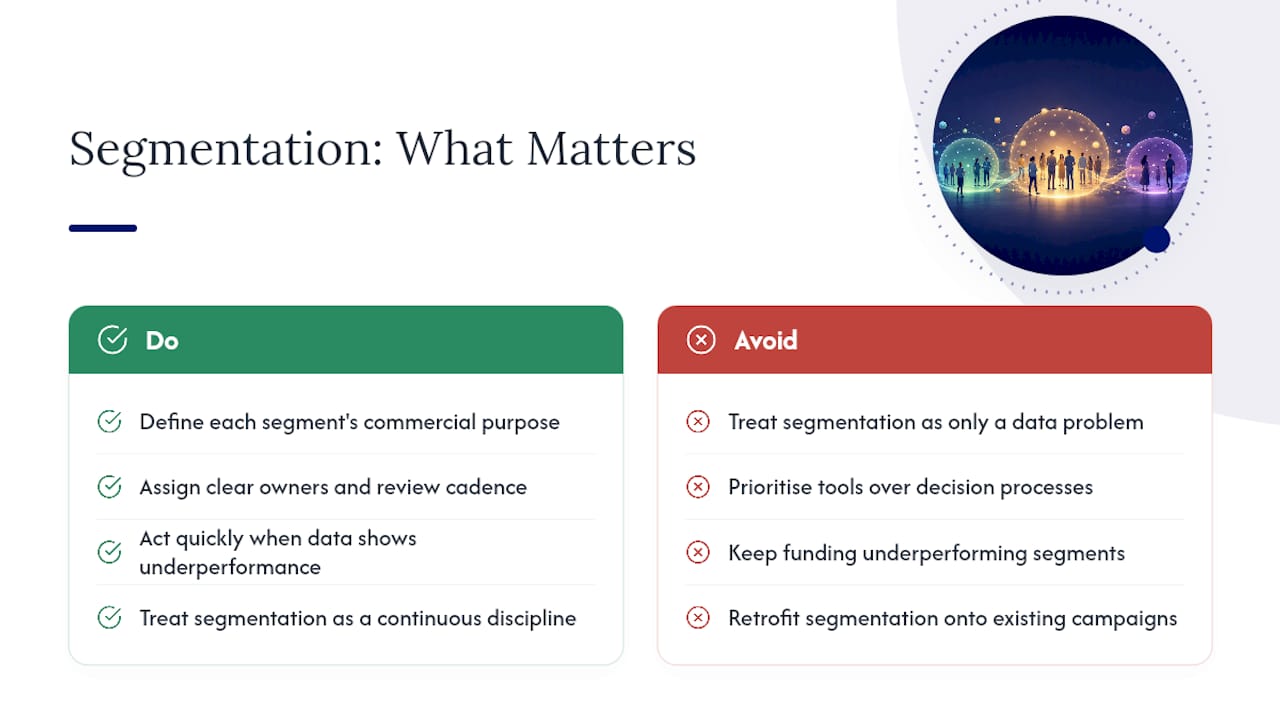
There is a tendency in segmentation advice to treat the exercise as a data problem. Get the right tool, build the right lists, and the results follow. The reality is messier. The teams that see the biggest lifts are not necessarily the ones with the most sophisticated tech stack. They are the ones that have agreed, internally, on what a segment is supposed to do commercially, and who reviews it, and how quickly they act when the data says something is not working.
The measurement rigour matters enormously, but it only pays off when the organisation is willing to act on what the tests reveal. That means shifting budget away from segments that are not performing, even when those segments feel strategically important. It means accepting that a holdout test result that contradicts your hypothesis is more valuable than one that confirms it. And it means treating segmentation as a continuous discipline, not a one-time project.
The brands that get this right tend to have one thing in common: they have aligned their segmentation work with their commercial priorities from the start, not retrofitted it onto an existing campaign structure. Unified brand messaging across segments is not just a creative preference; it is what makes the measurement coherent.
How Michaelbell can help you get segmentation right
Segmentation strategy is only as good as its execution. Michaelbell works with marketing teams and business leaders to design segment frameworks that connect directly to commercial outcomes, then activates them across email, paid media, direct mail, and digital channels as a fully integrated service.
We handle the data mapping, the creative variants, the channel activation, and the measurement framework, so your team is not juggling five platforms and three agencies to get one campaign live. The result is faster execution, cleaner attribution, and a single point of accountability for results. No long-term lock-in, no bloated retainer structure: just a team that works like an extension of yours.
If you are ready to move from broadcast to precision, take a look at our agency services or get in touch directly. We will get straight back to you.
Useful sources and further reading
- Measuring incrementality in next-best-action programmes
- What Is Audience Segmentation? How It Works (+Strategies) – MNTN
- Digital Marketing Optimization: 10 Best Strategies to Increase Marketing ROI
- Audience Segmentation: Types, Strategies and Examples
- Incrementality testing
- Use digital marketing analytics to optimise campaigns 2026
- Campaign optimisation best practices
This article is general information for marketing professionals and does not constitute legal or compliance advice. Confirm your specific UK GDPR obligations with a qualified data protection practitioner or the ICO directly.