
Why brand fatigue happens — and how to stop it

What is brand fatigue and why does it occur?
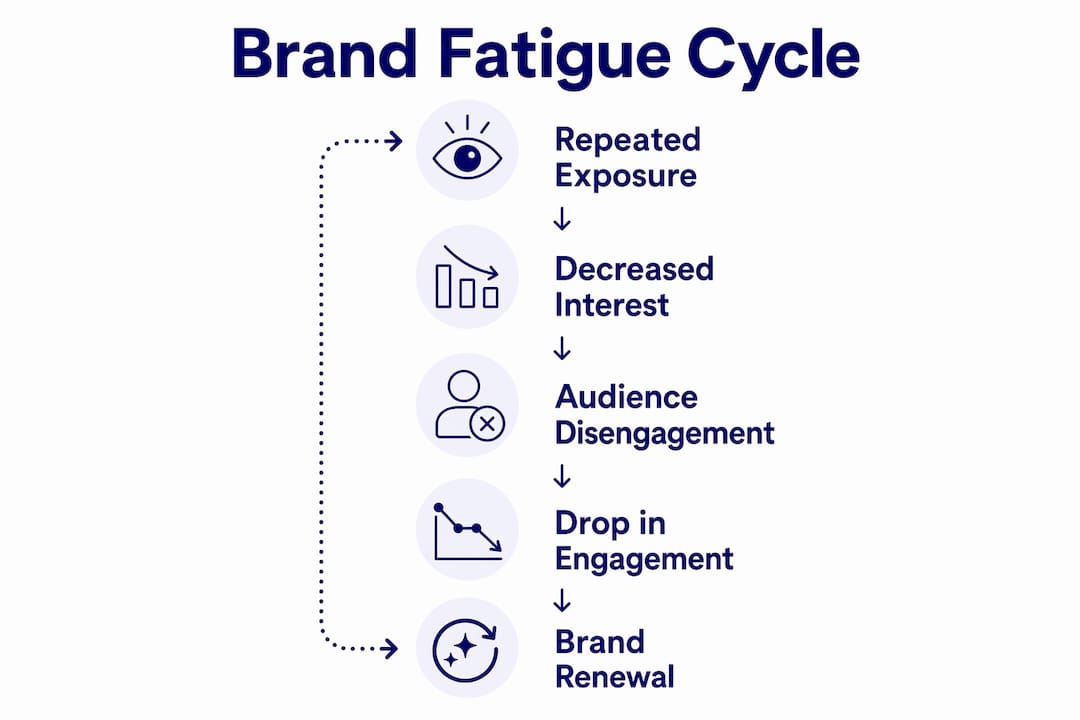
Brand fatigue is the gradual erosion of consumer interest caused by prolonged, repetitive exposure to a brand’s messaging. When audiences encounter the same creative, tone, or proposition too often, two things happen: cognitive exhaustion reduces their function-based interest, and emotional tiredness weakens their connection to the brand. Research confirms that cognitive and emotional depletion are the core psychological mechanisms driving brand switching behaviour.
Three forces typically accelerate this process:
- Overexposure — the same message, too frequently, across too many channels
- Stagnation — creative that stops evolving while audience expectations do not
- Irrelevance — branded content that fails to match what audiences actually need
Table of Contents
- What causes brand fatigue and how do you spot the signs?
- Strategic advice for UK marketing professionals
- How brand fatigue damages engagement
- How communication strategies help you overcome brand fatigue
- Why internal communication is central to brand engagement
- What brand fatigue recoveries look like in practice
- How to measure brand fatigue accurately
- How customer feedback prevents brand fatigue
- How to align your internal teams with brand values
- Key takeaways
What causes brand fatigue and how do you spot the signs?
Content saturation is the most common culprit. Consumer believability peaks around three campaign messages; continued repetition beyond this point causes trust erosion. Marketing teams that chase volume without creative variation fall into what practitioners call the “volume trap,” accelerating fatigue and damaging credibility.
Early warning signs include:
- Declining click-through and open rates across email and paid channels
- Rising cost-per-thousand impressions (CPM) with flat or falling return
- Reduced social engagement from previously active cohorts
- A hook rate drop exceeding 15% over a seven-day window
Pro Tip: Segment your audience by recency. Returning viewers fatigue faster than new prospects, so a blanket creative refresh often wastes budget. Diagnose by cohort first, then act.
Internal misalignment compounds the problem. When your teams lack a shared understanding of brand values, messaging becomes inconsistent, which confuses audiences and accelerates disengagement.
Strategic advice for UK marketing professionals
The goal is not to choose between consistency and innovation. It is to manage both deliberately.
- Refresh cycles matter. Strategic communications refresh keeps content relevant without abandoning brand equity
- Creative diversity over volume. Shift pipeline focus from output quantity to concept variety
- Use leading indicators. Monitor hook rate, frequency, and CPM before ROAS signals the damage
- Align internally first. Coherent internal messaging enables consistent external storytelling
Brand inertia can buy time — loyal customers tolerate fatigue longer due to habitual behaviour — but it is not a strategy. Proactive investment in creative renewal protects brand health before churn begins.
How brand fatigue damages engagement
Fatigued audiences do not disappear immediately. They disengage gradually, shifting from active participation to passive lurking. Research on young consumers shows that branded content overload and irrelevance drive users toward minimal engagement rather than outright departure. The result is a brand that retains followers in name but loses influence in practice. Over time, that passive disengagement translates into declining pipeline velocity and weakened brand credibility.
How communication strategies help you overcome brand fatigue
The most effective response combines creative renewal with disciplined messaging architecture. Rotate creative concepts on a defined cadence rather than waiting for performance to collapse. Vary format, tone, and channel mix to sustain novelty without abandoning brand recognition. Authenticity in branding consistently outperforms volume as a trust-building mechanism.

Why internal communication is central to brand engagement
External brand consistency starts with internal alignment. When your teams share a clear, lived understanding of brand values, every customer touchpoint carries the same conviction. MB Brand Communications works precisely at this intersection, unifying internal and external communication so that what your brand says publicly reflects what your people genuinely believe and deliver.
What brand fatigue recoveries look like in practice
Brands that recover from fatigue typically do three things: they audit their creative for concept repetition, they introduce a structured refresh cycle, and they rebuild internal alignment before relaunching externally. The nine signals that indicate a brand needs refreshing are rarely dramatic; they accumulate quietly in the metrics before they show up in revenue.
How to measure brand fatigue accurately
Blunt averages mislead. Effective fatigue detection uses cohort segmentation, audience supply metrics, and triangulated ad data to pinpoint wear-out precisely. A creative fatigue detection system built around a living Creative Intelligence Document tracks concept lifecycles and enables rapid, data-informed refreshes rather than reactive scrambles.
How customer feedback prevents brand fatigue
Feedback surfaces what metrics miss. Direct customer input reveals whether content feels repetitive or irrelevant before engagement data confirms it. Build structured listening into your communications calendar — post-campaign surveys, social listening reviews, and periodic brand perception checks. Familiarity builds trust, but without evolving content it also lowers engagement thresholds, making brands quietly vulnerable.
How to align your internal teams with brand values
Start with a shared brand narrative that every team member can articulate. Then:
- Run quarterly brand values workshops, not just onboarding sessions
- Create a single source of truth for messaging guidelines, accessible to all teams
- Brief internal stakeholders on campaign intent before external launch
- Measure internal brand confidence alongside external brand health
When your people are genuinely aligned, your external communications carry it.
Ready to protect your brand from fatigue? MB Brand Communications specialises in the internal and direct communication strategies that keep brands sharp, consistent, and genuinely engaging. See how we work — and let’s build something that lasts.
Key takeaways
Brand fatigue occurs when repeated exposure depletes consumer interest, and the most effective defence combines cohort-level monitoring, creative refresh cycles, and strong internal alignment.
| Point | Details |
|---|---|
| Fatigue is psychological | Cognitive and emotional exhaustion drive brand switching before audiences consciously notice disengagement. |
| Trust erodes quickly | Consumer believability peaks around three campaign messages, after which saturation damages credibility. |
| Cohort monitoring is critical | Returning viewers fatigue faster than new prospects; segment before refreshing creative. |
| Internal alignment prevents mixed messaging | Coherent internal communication enables consistent external storytelling and reduces audience confusion. |
| Refresh cycles protect brand health | Strategic, planned creative renewal sustains engagement without sacrificing brand recognition. |