
Why brand investment pays off: the business case

Brand investment is defined as a capital expenditure that builds brand equity, the accumulated value of consumer perception, trust, and preference that makes every future marketing effort more efficient and more profitable. Unlike a paid media campaign that stops working the moment you stop spending, brand equity compounds. NielsenIQ confirms that marketing which builds brand equity improves conversion rates across all future marketing efforts, not just the campaign it funds. That is the core reason why brand investment pays off: it is the only form of marketing spend that gets cheaper to maintain over time, not more expensive.
Why brand investment pays off: the financial case for brand equity
Brand equity is the measurable difference in business outcomes that a recognised brand produces compared to an unbranded equivalent. It shows up in pricing power, customer retention, lower acquisition costs, and investor confidence. Strong brands command price premiums and reduce price elasticity, meaning customers are less likely to switch when a competitor cuts prices. That is not a soft marketing benefit. That is a direct contribution to gross margin.
Brand equity and brand loyalty are related but distinct. Brand loyalty describes repeat purchase behaviour. Brand equity is the underlying perception that makes loyalty possible in the first place. You can buy short-term loyalty with discounts. You cannot buy brand equity. It is built through consistent, credible communication over time.
The business benefits of strong brand equity extend well beyond the marketing department:
- Pricing power: Customers pay more for brands they trust. A premium car manufacturer can charge significantly more than a generic equivalent for a mechanically similar product because the brand carries perceived quality and status.
- Talent attraction: Brand strength influences talent retention and lowers recruitment costs. People want to work for brands they respect.
- Investor confidence: Brand equity is increasingly integrated into ESG frameworks and analyst scoring models as a valuable intangible asset.
- Faster product launches: Strong brands enjoy easier new product launches because existing trust transfers to new offerings, reducing the cost and time needed to build credibility from scratch.
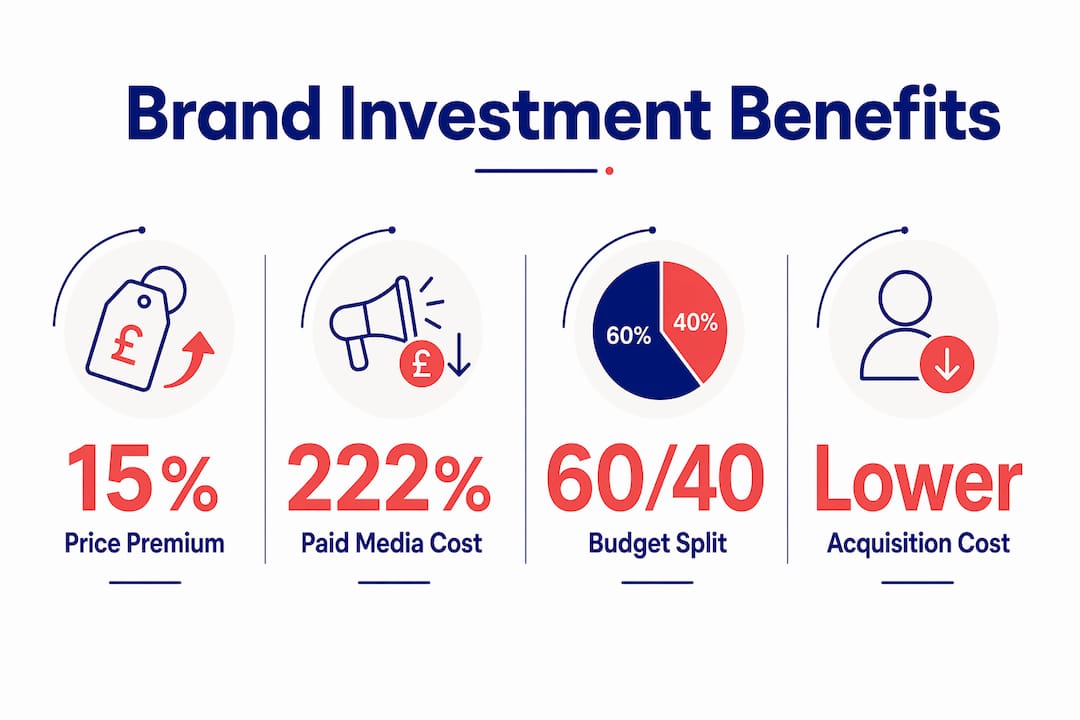
Pro Tip: Map your brand equity to a financial metric your CFO already tracks. If your brand commands a 15% price premium over the category average, that premium is a quantifiable return on your brand investment. Present it that way.
How does brand investment reduce customer acquisition costs?
Customer acquisition cost (CAC) is one of the clearest financial signals of brand health. Brands with high equity attract inbound interest, generate word-of-mouth referrals, and convert paid traffic at higher rates. All of that reduces what you spend to win each new customer.

Brand building reduces friction at every stage of the customer journey, making all marketing spend more effective over time. A well-known brand needs less convincing copy, fewer retargeting touchpoints, and less discounting to close a sale. That efficiency is operating leverage: your fixed brand investment generates a return that scales with every campaign you run on top of it.
The numbers make this concrete. Brands that neglect brand investment can face a 222% increase in paid media costs as organic demand dries up and they become entirely dependent on paid channels to generate awareness. That figure represents the cost of not investing in brand. It accrues quietly, quarter by quarter, until the paid media budget becomes unsustainable.
| Marketing approach | CAC trend over time | Conversion rate | Dependency risk |
|---|---|---|---|
| Brand-led investment | Decreases as equity builds | Improves consistently | Low: organic demand grows |
| Performance-only spend | Increases as competition rises | Flat or declining | High: stops when spend stops |
| Balanced brand and performance | Stable then declining | Highest over 3+ years | Minimal: brand buffers paid costs |
Pro Tip: Track brand-attributed CAC separately from paid CAC. If your organic and direct traffic converts at a higher rate than paid, that gap is your brand equity working. Quantify it and report it to your board.
What is the optimal budget split between brand and performance marketing?
The IPA’s landmark study The Long and Short of It validated a clear principle: a 60/40 brand to performance ratio delivers the highest sustained growth for consumer businesses. For B2B organisations, the recommended split shifts to 45% brand and 55% performance, reflecting longer sales cycles and the role of rational decision-making in purchase behaviour.
Most businesses do the opposite. They over-index on performance marketing because it produces measurable short-term results and under-invest in brand because the returns are slower to appear. That is a rational short-term decision with a damaging long-term consequence. Over-reliance on short-term activation produces lower conversion rates and stunted growth compared to a balanced approach.
The risks of chronic brand underinvestment are specific and compounding:
- Rising paid media costs as organic demand weakens
- Declining conversion rates as brand recognition fades
- Increased price sensitivity among existing customers
- Greater vulnerability to competitor brand activity
- Reduced ability to launch new products without heavy promotional spend
Think of brand investment the way leading companies treat technology infrastructure. Leading companies treat brand like technology infrastructure: a critical asset that requires consistent maintenance to generate sustained return. Cutting the brand budget to fund a short-term sales push is the equivalent of deferring server maintenance to save money. The savings are visible immediately. The costs arrive later, and they are larger.
For practical budget planning guidance, the starting point is auditing where your current spend sits relative to the 60/40 or 45/55 benchmark for your sector. Most marketing teams find they are running at 20/80 or worse without realising it.
How do you present brand investment returns to the board?
The most common reason brand investment gets cut is not that boards disbelieve in brand. It is that brand teams present the wrong evidence. Awareness scores and Net Promoter Score (NPS) are useful operational metrics. They are not the language of capital allocation decisions.
Boards require brand metrics like IRR, payback periods, and Revenue Premium Index rather than awareness scores to support brand investment decisions. Those are the metrics that sit alongside other capital expenditure proposals. If you want brand investment treated as a capital expenditure, you need to present it like one.
A practical framework for boardroom brand reporting uses four financial KPIs:
- Revenue Premium Index: The percentage price premium your brand commands over the unbranded category average. This is your brand’s direct contribution to gross margin.
- Brand-attributed CAC reduction: The difference in acquisition cost between customers who arrive via brand-driven organic channels and those acquired through paid media. This quantifies operating leverage.
- Payback period: How many months of brand investment are required before the CAC reduction and conversion rate improvement generate a positive return. Boards understand payback periods.
- Internal Rate of Return (IRR): The annualised return on brand investment modelled over a three to five year horizon, benchmarked against competitor brand strength data.
Neglecting to build this financial case creates what practitioners call “naming debt.” Neglecting brand investment creates naming debt, similar to financial debt, accruing interest as increased acquisition costs and reduced conversion rates every quarter. The longer it goes unaddressed, the more expensive it becomes to fix.
Pro Tip: When presenting to your CFO, lead with the CAC reduction trend, not the brand awareness chart. Show the financial gap between your organic CAC and your paid CAC, then explain that gap is what brand investment protects. That framing lands every time.
For guidance on presenting brand investment as a capital case internally, the language shift from marketing metrics to financial KPIs is the single most important change you can make.
Key takeaways
Brand investment pays off because it builds brand equity, a compounding asset that lowers acquisition costs, increases pricing power, and makes every marketing channel more efficient over time.
| Point | Details |
|---|---|
| Brand equity is a capital asset | Treat brand spend as capital expenditure, not operating cost, to reflect its long-term financial return. |
| Optimal budget split matters | Consumer brands should target a 60/40 brand to performance ratio; B2B brands should aim for 45/55. |
| Brand reduces acquisition costs | High brand equity lowers paid media dependency and can prevent CAC increases of up to 222%. |
| Boards need financial metrics | Present IRR, Revenue Premium Index, and payback periods rather than awareness scores to win budget approval. |
| Naming debt is real | Underinvesting in brand accrues compounding costs in rising CAC and falling conversion rates each quarter. |
The uncomfortable truth about brand investment in 2026
I have sat in enough boardrooms to know that brand investment is still treated as discretionary spend in most organisations. When budgets tighten, brand is cut first. Performance marketing survives because it has a dashboard. Brand survives because someone fights for it.
That dynamic is changing, but not fast enough. The organisations I see winning right now are the ones that have made the shift from presenting brand as a creative endeavour to presenting it as a financial one. They talk about Revenue Premium Index in the same breath as EBITDA. They show CAC trend lines, not campaign recall scores. That shift in language changes everything about how the board engages with brand investment.
The other thing I have noticed is that AI-driven commoditisation is making brand more valuable, not less. When every competitor can generate comparable content, run comparable ads, and offer comparable products at comparable prices, the only durable differentiator is how people feel about your brand. That is brand equity. And it cannot be automated.
My honest advice: do not wait for a brand crisis to make the financial case. Build the measurement framework now, while the brand is healthy, so you have the data to defend it when pressure comes. The brands that survive economic downturns are not the ones with the biggest budgets. They are the ones whose leaders made the case clearly enough that the budget was protected.
— Calum
How Michaelbell can help you build a brand that pays back
Michaelbell works with marketing teams and business leaders who know their brand is an asset but need help proving it. We build brand communications strategies that connect external creative with internal alignment, so your brand works consistently across every channel and every audience. Our team helps you translate brand strength into the financial metrics your board actually cares about, from brand equity measurement to budget allocation frameworks grounded in IPA and Brand Finance research. We operate as an extension of your team, without the overhead of an in-house agency. If you are ready to make brand investment work harder for your business, explore our services and let us show you what a properly structured brand communications strategy looks like in practice.
FAQ
What is brand equity and why does it matter financially?
Brand equity is the measurable value a brand adds to a product or service beyond its functional attributes. Financially, it drives pricing power, lowers customer acquisition costs, and contributes to enterprise value as a recognised intangible asset.
What is the recommended brand versus performance marketing budget split?
The IPA-validated benchmark is 60% brand and 40% performance marketing for consumer businesses, and 45% brand to 55% performance for B2B organisations. Deviating significantly from these ratios reduces long-term growth and increases paid media dependency.
How do I measure the return on brand investment for my board?
Present financial KPIs rather than awareness metrics. The most credible measures are Revenue Premium Index, brand-attributed CAC reduction, payback period, and IRR modelled over a three to five year horizon with competitor benchmarks.
What happens if a business underinvests in brand?
Underinvestment creates naming debt: a compounding liability where rising acquisition costs and falling conversion rates accumulate each quarter. Some brands have faced a 222% increase in paid media costs as a direct result of neglecting brand investment.
How long does it take for brand investment to show a financial return?
Brand investment typically shows measurable CAC reduction and conversion rate improvement within 12–24 months of consistent activity, with the strongest compounding returns visible over a three to five year horizon.