
Why brands need communications refresh cycles

A communications refresh cycle is a planned, periodic update of a brand’s messaging, visuals, and engagement approach designed to keep the brand clear, relevant, and trusted without losing its core identity. The industry term for this practice is brand communications refresh, and understanding why brands need communications refresh cycles is no longer optional for marketing leaders. Structured refreshes every 5 to 7 years deliver 47% higher total returns to shareholders over five years. Brands like Apple, Nike, and Innocent Drinks have all used disciplined refresh cycles to stay culturally relevant without abandoning the equity that made them trusted in the first place.
Why brands need communications refresh cycles to stay relevant
Brand communications that stand still do not stay still. They fall behind. Markets shift, audiences evolve, and the language that resonated three years ago can feel flat or even alienating today. A refresh cycle is the mechanism that keeps your brand voice, visual identity, and messaging architecture aligned with where your audience actually is, not where they were when you last updated your brand guidelines.
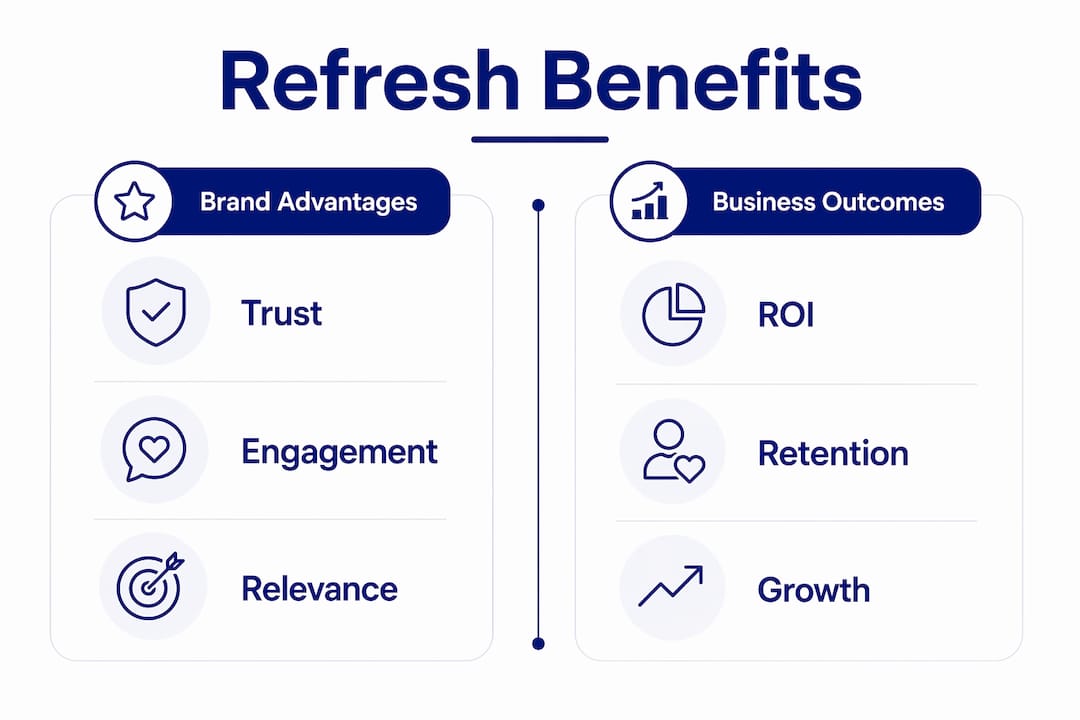
The financial case is clear. Brands with structured refresh cycles outperform those without by a significant margin on shareholder returns. That figure is not a coincidence. It reflects the compounding effect of sustained brand clarity: customers make faster decisions, sales cycles shorten, and retention improves. Each of those outcomes feeds directly into revenue.
81% of consumers consider trust in a brand mandatory before making a purchase. Trust is not built in a single campaign. It is built through consistent, coherent communication over time, and it erodes when messaging becomes inconsistent or outdated. Refresh cycles are the maintenance schedule that keeps trust intact.
What happens when brands neglect regular messaging updates
Stagnation in brand communications is rarely dramatic. It is quiet, gradual, and expensive by the time anyone notices.
The most immediate symptom is customer confusion. When a brand’s website, social channels, sales collateral, and advertising all carry slightly different tones, promises, or visual languages, audiences struggle to form a clear mental picture of what the brand stands for. Misaligned, inconsistent communication increases bounce rates, reduces conversions, and elongates sales cycles. That confusion does not announce itself loudly. It shows up in your analytics as a slow bleed.
Brand equity erodes in the same way. The accumulated trust and recognition a brand has built over years can be quietly undermined by messaging that no longer reflects the company’s actual offer, values, or audience. Customers who once felt a strong connection begin to feel the brand is speaking past them.
The internal dimension is equally damaging. 37% of employees report lacking feedback systems for problem resolution, which signals a communication gap that refresh cycles can directly address. When internal communications are outdated or misaligned with external messaging, employees struggle to advocate for the brand authentically. That gap slows operational efficiency and weakens the brand from the inside out.
- Declining click-through rates and rising bounce rates signal that messaging clarity is eroding
- Inconsistent tone across channels creates cognitive friction that pushes customers away
- Sales teams working from outdated messaging lose credibility in conversations with informed buyers
- Employee disengagement grows when internal communications do not reflect the brand’s current direction
Pro Tip: Set up a quarterly communications audit using Google Analytics, your CRM conversion data, and a simple internal survey. If two or more of those sources flag declining engagement, you have data-driven grounds for a refresh conversation.
Brand refresh vs rebrand: which protects your equity?
The distinction between a brand refresh and a full rebrand matters enormously, and conflating the two is one of the most common and costly mistakes marketing leaders make.
A brand refresh is an evolution, not a reset. It modernises visuals, sharpens messaging, and updates the communication architecture while preserving the equity assets that took years to build: trust, recognition, search presence, and customer loyalty. A rebrand, by contrast, is a reinvention. It discards existing identity in favour of something new, and with that comes the very real risk of losing the recognition and relationships the brand has spent years accumulating.
For most established brands, a full rebrand is rarely the right answer. The risks are high, the costs are significant, and the disruption to customer relationships can take years to recover from. A well-executed refresh cycle delivers the same sense of renewed relevance at a fraction of the risk. For a deeper look at how to make that strategic call, the refresh vs rebrand guide from Michaelbell is worth reading before any major decision.
| Feature | Brand refresh | Full rebrand |
|---|---|---|
| Core identity | Retained and evolved | Discarded and rebuilt |
| Equity protection | High: trust and recognition preserved | Low: existing recognition at risk |
| Cost and resource demand | Moderate | High |
| Risk to search presence | Minimal | Significant |
| Customer disruption | Low | Potentially high |
| Typical trigger | Messaging fatigue, market shift | Fundamental strategic pivot |
The table above makes the case plainly. Unless your brand faces a fundamental strategic pivot or a reputation crisis, a refresh cycle protects far more than it costs.
When should you refresh? Timing and cadence for maximum impact
Timing a communications refresh correctly is as important as the refresh itself. Refresh too often and you erode the consistency that builds memory and trust. Refresh too rarely and you risk the slow stagnation described earlier.
Industry leaders recommend a refresh every 5 to 7 years as a baseline, with flexibility to act sooner if performance data signals deteriorating brand clarity. That flexibility is the critical nuance. A fixed calendar schedule is a starting point, not a rule.
The following signals indicate a refresh is warranted before the standard cycle completes:
- Click-through rates and engagement metrics show a sustained downward trend across multiple channels
- Sales teams report that messaging no longer resonates with buyer conversations
- New competitors have shifted audience expectations in your category
- Your brand has evolved its offer, values, or audience but communications have not kept pace
- Internal feedback reveals that employees cannot articulate the brand’s current positioning clearly
The most important pitfall to avoid is refreshing for aesthetic boredom rather than business outcomes. When marketing teams grow tired of their own messaging before their audience does, premature refreshes waste budget and disrupt the very consistency that was building momentum. The audience’s relationship with your communications is always newer than yours.
Pro Tip: Before initiating a refresh, pull 12 months of data across your top three channels. If engagement is stable or growing, hold your nerve. If two or more channels show declining performance alongside qualitative signals from sales or customer service, the data is telling you something worth acting on.
Key elements of an effective communications refresh
A successful refresh is not a visual overhaul. It is a recalibration of how your brand communicates across every touchpoint, grounded in your core values and shaped by what your audience needs now.
Consistent, varied messaging repetitions simplify brand memory formation, increasing customer comfort and trust while facilitating faster decision-making. The word varied is doing important work in that sentence. Repetition without variation becomes wallpaper. Variation without repetition becomes noise. The refresh cycle finds the new register in which to repeat your core truth.
- Clarity first: Audit every customer-facing message for clarity before changing anything visual. Confused messaging is rarely a design problem
- Channel coherence: Refreshed communications must land consistently across digital, print, social, and internal channels. Mixed signals at any touchpoint undo the work done elsewhere
- Equity protection: Identify which brand assets carry the most recognition and trust before the refresh begins. Protect those deliberately
- Internal alignment: Structured feedback and multi-channel internal outreach improve employee engagement and ensure the refreshed brand voice is understood and used consistently from day one
- Measurement framework: Define what success looks like before launch. Engagement rates, conversion uplift, and sales cycle length are the metrics that tell you whether the refresh is working
For practical examples of how brands have executed this well, the brand revitalisation strategies resource from Michaelbell offers grounded, real-world reference points.
| Refresh element | Primary benefit |
|---|---|
| Messaging clarity audit | Reduces customer confusion and shortens decision time |
| Visual identity update | Signals relevance without discarding recognition |
| Internal communications alignment | Strengthens employee advocacy and operational consistency |
| Channel coherence review | Eliminates mixed signals that erode trust |
| Performance measurement framework | Enables data-driven evaluation of refresh impact |
How refreshed communications improve decisions and internal alignment
Brand communication shapes memory. Without refresh cycles, every customer interaction risks feeling like the first, burdening the audience with cognitive load that slows decisions. A well-refreshed brand reduces that load by giving customers a clear, consistent signal they can process quickly and trust.
The customer journey benefits directly. When messaging is coherent from first awareness through to purchase and retention, customers move through the customer journey with less friction. They spend less mental energy evaluating whether the brand is credible and more energy engaging with the actual offer. That shift in cognitive economy translates into measurably faster conversion and stronger loyalty.

Internally, the impact is equally tangible. When communications are refreshed with genuine employee input and clear internal rollout, teams feel ownership of the new direction. That ownership produces authentic advocacy, which is far more persuasive to customers than any paid media. Brand consistency across both internal and external channels amplifies trust and recognition in ways that isolated campaigns simply cannot replicate.
Pro Tip: Run a brief internal brand language workshop as part of every refresh cycle. Ask your customer-facing teams to describe the brand in three words before and after the refresh. The gap between those two answers tells you exactly how well the new communications are landing internally.
Key takeaways
Brands that commit to disciplined communications refresh cycles protect their equity, sustain audience trust, and outperform competitors who allow messaging to stagnate.
| Point | Details |
|---|---|
| Refresh every 5 to 7 years | Structured cycles deliver 47% higher shareholder returns and sustained brand clarity. |
| Refresh, do not rebrand | Evolution preserves trust, recognition, and search presence that full rebrands put at risk. |
| Use data, not boredom, as your trigger | Declining engagement metrics and sales feedback are the right signals to act on. |
| Align internally and externally | Refreshed communications only work when employees understand and use the new voice consistently. |
| Measure before and after | Define success metrics upfront so the refresh can be evaluated on business outcomes, not aesthetics. |
The discipline most brands skip
I have worked with enough marketing teams to know that the refresh conversation almost always starts in the wrong place. Someone in a leadership meeting says the brand feels tired, and within a week there is a brief out to a design agency for a new visual identity. That is not a refresh cycle. That is aesthetic anxiety dressed up as strategy.
The brands that get this right treat communications refresh as a business discipline, not a creative project. They track the signals: engagement rates, sales cycle data, employee sentiment, customer feedback. They act when the evidence tells them to, not when the marketing team has grown bored of their own work. And they protect what is working with the same rigour they apply to what needs to change.
The other mistake I see regularly is treating the refresh as a one-time event rather than a cycle. A single refresh without a plan for the next one is just a rebrand with better PR. The value is in the cadence. It is in knowing that in five years, you will look at the data again, ask the hard questions again, and make the changes the evidence demands. That discipline compounds over time in ways that individual campaigns simply cannot.
Partnering with an agency that understands both the strategic and the creative dimensions of a refresh makes that discipline far easier to maintain. The right partner holds you accountable to the data and brings the creative expertise to execute the changes without discarding what makes your brand worth refreshing in the first place.
— Calum
Ready to refresh your brand communications?
At Michaelbell, we design and execute communications refresh cycles that are grounded in data, aligned with your core brand values, and built to deliver measurable results. We work as an extension of your team, not as an outside vendor, which means we understand your brand from the inside before we change anything on the outside.
Whether you need a full communications refresh strategy or a focused review of how your messaging maps to the customer journey, we bring the creative expertise and strategic discipline to make it count. We love a challenge, and we will get straight back to you. Let’s talk about what your brand needs next.
FAQ
What is a communications refresh cycle?
A communications refresh cycle is a planned, periodic update of a brand’s messaging, visuals, and engagement approach. It maintains brand clarity and relevance without discarding the core identity or equity the brand has built.
How often should a brand refresh its communications?
Industry standards recommend a structured refresh every 5 to 7 years, with flexibility to act sooner if data signals such as declining engagement rates or extended sales cycles indicate that brand clarity is eroding.
What is the difference between a brand refresh and a rebrand?
A brand refresh evolves existing identity by modernising visuals and sharpening messaging while preserving trust and recognition. A rebrand discards existing identity entirely, which carries significantly higher risk and cost.
How do you know when a communications refresh is needed?
The clearest signals are sustained declines in click-through rates, rising bounce rates, sales teams reporting that messaging no longer resonates, and internal feedback showing employees cannot articulate the brand’s current positioning.
Can a communications refresh improve internal alignment?
Yes. Refreshed internal communications, delivered with structured feedback mechanisms and multi-channel outreach, improve employee engagement and ensure teams can advocate for the brand authentically and consistently.