
Why leaders invest in rebranding: a guide for executives

A rebrand is a justified strategic investment when there is a measurable gap between how your business is perceived and what it actually delivers today. It is not a fix for a weak product, a failing sales process, or poor operational performance. Before committing budget, run this quick check: Has your strategy shifted significantly since the brand was built? Are you losing deals where competitors cite your brand as a concern? Is M&A complexity or geographic expansion creating identity confusion? If you answered yes to any of these, a rebrand conversation is worth having. If the honest answer is that leadership is simply tired of the current look, stop there.
Gather this evidence first:
- Customer research showing confusion about what you do or who you serve
- Lost-deal analysis where brand perception was cited as a factor
- Internal feedback revealing that employees cannot articulate the company’s purpose
- M&A documentation showing conflicting brand architectures that create market confusion
Table of Contents
- Why do leaders invest in rebranding?
- What do leaders expect to gain from a rebrand?
- What are the real costs, timelines and risks?
- How do you measure whether a rebrand worked?
- How should leaders secure buy-in and embed the new brand?
- What are the practical first steps for executives who decide to proceed?
- How does leadership style shape a rebrand’s success?
- How does a rebrand affect company culture and employee engagement?
- What can leaders learn from successful rebranding initiatives?
- What are the most common challenges leaders face during a rebrand?
- Key takeaways
- The rebrand conversation most leaders avoid
- Michaelbell helps leaders rebrand with confidence
- Useful sources and further reading
Why do leaders invest in rebranding?
The most common and legitimate reasons leaders choose to rebrand fall into six clear categories. Understanding which one applies to your organisation is the first governance test, because rebranding when strategy and perception diverge is sound; rebranding because the board fancies a change is not.
- Mergers and acquisitions. M&A is arguably the single most frequent driver. When two organisations merge, conflicting identities create customer confusion and internal friction. A unified brand signals a unified business.
- Market repositioning. If you are moving upmarket, targeting a new segment, or shifting from a product to a solutions model, your existing brand may actively undermine the new positioning. A professional services firm that started as a local consultancy but now competes nationally needs a brand that reflects that ambition.
- Geographic expansion. A name or visual identity that works in one market can carry unintended connotations in another. Leaders expanding into new regions often discover that their brand does not travel.
- Reputation repair. After a public crisis, a rebrand can signal genuine organisational change. It only works, though, when the operational changes are real. A new logo over the same problems accelerates distrust rather than rebuilding it.
- Pricing power restoration. When a brand has been commoditised in the market’s mind, it is very difficult to charge premium prices. A brand repositioning effort that reframes value can restore margin.
- Company evolution. Businesses that have launched new product lines, scaled significantly, or pivoted their model often find their original brand no longer reflects the full scope of what they offer.
Two motives that do not hold up under scrutiny: leadership boredom and trend-chasing. Practical governance guides consistently flag these as the most common sources of failed rebrands, because the investment produces short-term noise without addressing any real business problem.
What do leaders expect to gain from a rebrand?
Commercial benefits
Clearer brand positioning directly supports customer acquisition. When prospects understand immediately what you do and for whom, conversion rates improve. Equally, a brand that commands respect in its category gives sales teams permission to hold on price. Brand clarity builds trust before a product conversation even begins, which shortens sales cycles and improves retention over time.

Pricing power is one of the most undervalued commercial outcomes. A brand that is perceived as a premium provider can charge accordingly, and that margin difference compounds across the customer base. Talent acquisition follows the same logic: a brand that communicates ambition and purpose attracts better candidates, which feeds growth.
Pro Tip: Pick two primary KPIs that map directly to your business case before the rebrand launches. If the case is built on pricing power, track average deal value and discount frequency. If it is built on acquisition, track inbound lead volume and cost per qualified lead. Measuring everything means measuring nothing.
Internal benefits
A rebrand done well re-energises employees. When the new brand reflects where the business is genuinely going, people feel proud to represent it. Internal communications become cleaner because everyone is working from the same narrative. Sales and marketing alignment improves because the positioning is no longer ambiguous. Employer brand campaigns that align with the refreshed external identity can also accelerate recruitment in competitive talent markets.

What are the real costs, timelines and risks?
Cost and timeline ranges
The investment varies considerably depending on scope. A brand refresh — updating visual elements and messaging without changing the fundamental architecture — typically costs around $10,000–$60,000 and takes 1–4 months. A full rebrand, covering strategy, architecture, design, application across all touchpoints, and internal rollout, generally costs $50,000–$500,000 or more and takes 6–18 months. The actual cost depends on organisation size, the number of touchpoints, and whether you need trademark searches and domain migrations.
| Phase | Typical duration | Key deliverable |
|---|---|---|
| Discovery and strategy | 4–8 weeks | Brand audit, positioning brief |
| Architecture and naming | 3–6 weeks | Brand architecture, name shortlist |
| Design and identity | — | Visual identity system |
| Application and guidelines | 4–8 weeks | Brand guidelines, asset library |
| Internal rollout | 4–8 weeks | Internal launch, training materials |
| External launch and tuning | Ongoing (3–6 months) | Campaign, measurement, iteration |
Risk categories leaders must manage
- Brand equity loss. Distinctive assets require five to seven years of consistent exposure to build reliable recognition. Removing them abruptly has caused high-profile failures. Audit what equity you hold before deciding what to change.
- SEO and domain disruption. A domain or URL structure change can wipe years of search authority. Plan a technical migration with proper redirects and a monitoring period of at least six months.
- Stakeholder resistance. Customers, employees, and investors all have emotional ties to the existing brand. Resistance is predictable; the question is whether you have a communication plan to manage it.
- Half-executed rollouts. A new logo on the website but old letterheads in the post is worse than no rebrand. Budget for full application across every touchpoint before you launch.
A rebrand that ignores product or operational weaknesses produces short-term buzz but not sustainable results. Fix the fundamentals first; the brand amplifies what is already there.
One practical note: always conduct a trademark search and check domain availability before finalising any new name. A name that is already registered in your target market is a legal and commercial liability. The refresh versus rebrand decision framework is worth working through carefully before committing to either path.
How do you measure whether a rebrand worked?
Measurement starts before launch, not after. Set baselines across your chosen KPIs in the three months prior to the rebrand going live. Without a pre-launch baseline, you cannot attribute movement to the rebrand rather than to market conditions or seasonal variation.
Realistic evaluation windows:
- Months one to three: early signals. Track website traffic, direct search volume, social sentiment, and internal engagement scores. These move quickly and indicate whether the launch has landed.
- Months four to nine: commercial indicators. Lead volume, conversion rate, average deal value, and cost per acquisition begin to reflect the rebrand’s commercial impact.
- Month twelve and beyond: brand equity metrics. Unaided recall, net promoter score, and customer lifetime value require a full year of data to show meaningful movement.
| KPI | Measurement frequency | Target direction |
|---|---|---|
| Unaided brand recall | Quarterly survey | Increase vs baseline |
| Inbound lead volume | Monthly | Increase vs pre-launch average |
| Average deal value | Monthly | Increase vs pre-launch average |
| Employee engagement score | Bi-annual survey | Increase vs pre-launch score |
| Customer retention rate | Quarterly | Maintain or improve |
| Organic search visibility | Monthly | Recover to baseline within 6 months post-migration |
Brand consistency across all touchpoints is a prerequisite for these metrics to move in the right direction. Inconsistent application dilutes the signal and makes measurement unreliable.
How should leaders secure buy-in and embed the new brand?
Academic research confirms that executive communication is the single most significant factor in securing employee adoption during a rebrand. Symbolic acts matter as much as formal announcements: when the CEO uses the new language, carries the new materials, and visibly champions the change, the organisation follows. When they do not, middle management reads the ambiguity as permission to ignore the new direction.
Practical steps for the first ninety days after launch:
- Appoint a named internal brand owner with authority to enforce standards and resolve inconsistencies.
- Hold a company-wide launch event that explains the why behind the change, not just the what.
- Brief senior leaders individually so they can answer questions from their teams with confidence.
- Replace all internal templates, email signatures, and presentation decks within the first thirty days.
- Create a feedback channel so employees can flag inconsistencies or raise concerns without going through formal channels.
- Conduct a thirty-day and ninety-day internal pulse check to catch resistance early.
Visible humility matters too. When a launch element does not land as expected, leaders who acknowledge it and course-correct publicly preserve more credibility than those who defend the decision regardless of evidence. The market respects honesty. Read more on leading a brand transformation for a practical framework on executive behaviours.
Pro Tip: Run an internal pilot with one team or business unit before the full external launch. Their feedback will surface inconsistencies in the guidelines, gaps in the asset library, and messaging that does not resonate internally — all of which are far cheaper to fix before the market sees them.
What are the practical first steps for executives who decide to proceed?
Before you brief an agency or approve a budget, complete this checklist:
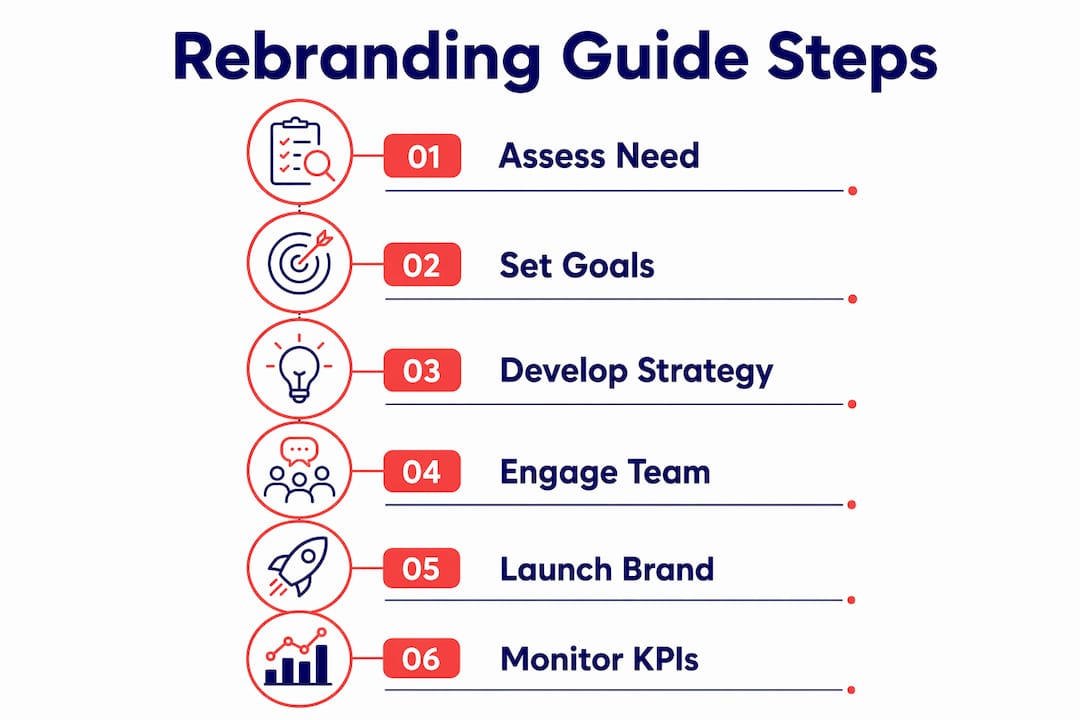
- Gather evidence. Conduct customer interviews, a lost-deal analysis, and an internal brand audit. The business case must be evidence-led, not instinct-led.
- Define the scope. Decide whether you need a refresh or a full rebrand. A refresh addresses visual and messaging updates; a full rebrand addresses strategy, architecture, and identity from the ground up.
- Set a realistic budget. Use the cost ranges above as a starting point. Build in a contingency of at least fifteen per cent for trademark searches, domain work, and unforeseen application costs.
- Appoint an internal champion. This person owns the project internally, manages stakeholder communication, and holds the agency accountable to the brief.
- Define success before you start. Agree the two or three KPIs that will determine whether the investment was worthwhile. Write them into the brief.
- Select a delivery partner. Look for an agency that covers both external creative and internal communications strategy, because a rebrand that lands externally but fails internally is only half a rebrand.
Pro Tip: Pilot the new brand on a subset of touchpoints before full rollout. A regional campaign, a new product launch, or a single market entry gives you real-world data on how the brand performs before you commit to full application across every channel.
How does leadership style shape a rebrand’s success?
The leader’s vision sets the ceiling for what a rebrand can achieve. A CEO who treats the project as a design exercise delegates it to the marketing team and checks in at the logo reveal. A CEO who treats it as a strategic investment owns the narrative, communicates the rationale personally, and uses the rebrand as a moment to reset the organisation’s ambition.
Transformational leaders tend to produce more durable rebrands because they connect the new brand to a compelling future state that employees and customers can both believe in. Transactional leaders who focus on the deliverables without articulating the purpose often find that the new identity fails to embed. The Cambridge research on CEO symbolism in organisational change shows that rational and emotional functions of executive symbolism both matter: leaders must explain the logic and create new emotional connections simultaneously.
How does a rebrand affect company culture and employee engagement?
Employees form strong attachments to the brand they have represented, sometimes for years. A rebrand can feel like a loss of identity, particularly for long-tenured staff. Handled poorly, it generates resistance, cynicism, and attrition. Handled well, it becomes a rallying point.
The organisations that manage this best treat the internal launch as seriously as the external one. They explain the strategic rationale clearly, involve employees in the process where possible, and give people time to adapt. Training programmes that help staff understand and articulate the new brand positioning are not a luxury; they are a prerequisite for consistent external delivery. When employees understand why the brand has changed and feel respected in the process, they become advocates rather than resistors.
What can leaders learn from successful rebranding initiatives?
Old Spice is a textbook case of repositioning. The brand had become associated with an older generation and was losing relevance. Rather than a cosmetic update, the team rebuilt the entire brand personality around wit and confidence, targeting a younger male audience. The commercial results were significant and the repositioning has held for over a decade.
Meta’s rebrand from Facebook illustrates both the opportunity and the risk. The strategic rationale was clear: the parent company needed an identity that reflected its broader ambitions beyond a single social platform. The execution, however, coincided with a period of reputational difficulty, which meant the rebrand was read by many as deflection rather than genuine evolution. The lesson: timing and operational credibility matter as much as the brand work itself.
Burberry’s transformation under Christopher Bailey and later Riccardo Tisci demonstrates how a brand with genuine heritage can be repositioned upmarket without losing its core identity. The key was a clear internal narrative, consistent visual language, and leadership that was visibly committed to the new direction across every touchpoint.
What are the most common challenges leaders face during a rebrand?
The challenges that most often derail rebrands are predictable, which means they are also preventable.
Stakeholder misalignment is the most common. When the board, the marketing team, and the sales team each have a different view of what the rebrand is trying to achieve, the brief becomes incoherent and the output reflects that. Align on the strategic objective before briefing anyone.
Scope creep is the second. A brand refresh that gradually expands into a full rebrand without a corresponding budget or timeline adjustment is a recipe for a half-finished project. Define scope in writing and manage change requests formally.
Inconsistent rollout undermines the investment. A new brand that appears on the website but not in proposals, email signatures, or office signage sends a confused signal. Build a full asset migration plan before launch day.
Internal resistance from employees who feel the change was imposed on them without explanation is both predictable and manageable. The solution is communication, not persuasion. Explain the business rationale honestly, create space for questions, and give people time.
Finally, measuring too early leads to premature conclusions. Brand metrics take time to move. Leaders who judge a rebrand’s success at the three-month mark are measuring the launch, not the brand.
Key takeaways
Leaders who invest in rebranding as a strategic business decision, grounded in evidence and supported by strong internal communication, consistently achieve better commercial and cultural outcomes than those who treat it as a design project.
| Point | Details |
|---|---|
| Rebrand only on evidence | Legitimate triggers include M&A, repositioning, reputation repair, and geographic expansion — not leadership preferences. |
| Scope determines cost | A refresh typically costs $10,000–$60,000 and takes 1–4 months; a full rebrand costs $50,000–$500,000+ and takes 6–18 months. |
| Measure from a pre-launch baseline | Set KPIs and baselines three months before launch; expect commercial metrics to move by month nine and brand equity metrics by month twelve. |
| Leadership communication is the critical variable | Academic research confirms that consistent executive symbolism and communication is the single most important factor in employee adoption. |
| Michaelbell covers strategy through rollout | Michaelbell’s integrated approach covers brand strategy, internal communications, and external creative — reducing the risk of a half-executed rebrand. |
The rebrand conversation most leaders avoid
The hardest part of a rebrand is not the design work. It is the honest conversation that has to happen before any brief is written: does the business actually deserve the brand it wants?
A rebrand signals ambition. But the market is not obliged to believe it. Customers who have experienced the old version of your business will test the new brand against their existing experience. If the product, the service, or the culture has not changed, the new identity will feel like a costume rather than a transformation.
The leaders who get the most from a rebrand are those who use the process to force internal clarity first. The brand strategy conversation surfaces disagreements about positioning, audience, and value proposition that have often been avoided for years. That clarity, once achieved, makes every subsequent decision easier — from hiring to pricing to partnership selection.
A rebrand is not a marketing project. It is a business decision that happens to have a creative output.
Michaelbell helps leaders rebrand with confidence
If you have worked through the decision framework above and concluded that a rebrand is the right move, the next question is how to execute it without losing brand equity, disrupting your SEO, or leaving your team behind.
Michaelbell is the integrated brand communications partner for leaders who want strategy, creative, and internal rollout handled as one joined-up project rather than three separate briefs. We cover strategic audits, brand architecture, tone of voice, internal communications, copywriting, and full campaign execution — giving you the depth of an in-house team without the overhead. Our approach means the external brand and the internal narrative are built together, which is where most rebrands fail.
If you are ready to have a straight conversation about whether a rebrand is right for your business, see our services or get in touch directly. We will tell you honestly what we think the evidence supports.
Useful sources and further reading
- When to Rebrand: The CEO’s Decision Framework — A practical framework distinguishing refresh from full rebrand, with cost and timeline guidance. Useful for scoping conversations with your board.
- Why Do Companies Rebrand? (Affirma) — Covers the strategic triggers for rebranding, with M&A and repositioning explored in depth.
- Rebranding Your Business: When and How to Do It Right — Honest on the limits of rebranding; useful for leaders who need to test whether the fundamentals are in place first.
- Why Do Companies Rebrand? 7 Reasons and Examples — Covers brand equity protection and the risk of removing distinctive assets too quickly.
- Academic research: leadership role in organisational branding (ScienceDirect) — The primary academic source on executive communication and employee buy-in during rebranding.
- Leadership lessons from the HBO Max rebrand (ninety.io) — Practitioner analysis of what happens when a rebrand launch goes wrong and how visible course-correction preserves credibility.
- CEO symbolism in organisational change (Cambridge) — Academic research on how CEOs use symbols to facilitate acceptance of organisational change.
- Brand refresh vs rebrand: a strategic guide for leaders — Michaelbell’s guide to the scope decision; useful before you brief any agency.
- How to lead a brand transformation initiative — Practical leadership frameworks for executives managing a rebrand from the inside.