
How to write a brand messaging guide for your startup

Your brand messaging guide is a one-page document that tells your team, your customers, and your investors exactly what you do, who you do it for, and why it matters — in language people actually remember. Here is the template to start with:
“We help [audience] achieve [outcome] by [method], unlike [alternative].”
Copy it, fill in the brackets, and you have a working v1 positioning line. Paste it into your homepage headline or the opening slide of your pitch deck today.
Three steps to ship your v1 in a single session:
- Run a 30-minute customer language audit: pull three to five sales call recordings or email threads and highlight the exact phrases your best customers use to describe their problem.
- Draft your positioning line using the template above, then write three supporting messages (one sentence each) that back it up with evidence.
- Share the draft with your CEO and one sales rep for a 15-minute verbal gut-check before you paste it anywhere public.
That is your v1. It will not be perfect, and it should not be. If you want hands-on help moving faster, MB Brand Communications runs focused messaging workshops that get you from blank page to usable framework in days, not weeks.
Table of Contents
- What is brand messaging, and why does it matter for your startup?
- What are the core components of a brand messaging framework?
- What is the six-step process to build your startup brand messaging?
- Messaging hierarchy and ready-to-use templates
- How do you find customer language and test messaging quickly?
- How does voice differ from tone, and how do you write tone rules by channel?
- Where should you use your messaging, and how do you adapt it by channel?
- How do you socialise messaging inside your startup and govern future changes?
- What does a brand messaging project realistically cost and how long does it take?
- Common founder mistakes and how to fix them fast
- Key takeaways
- What founders consistently get wrong about brand messaging
- MB Brand Communications: your messaging partner for UK startups
- Useful sources and further reading
What is brand messaging, and why does it matter for your startup?
Brand messaging is the collection of words, phrases, and narratives your company uses to communicate its value to every audience it touches. It is not your logo, your colour palette, or your font choices. Those are visual brand guidelines. Messaging is the verbal layer: what you say, how you say it, and what you never say.
For early-stage companies, getting this right early pays off in three specific ways. First, clear messaging shortens the sales cycle because prospects understand your value without needing a 45-minute demo. Second, a sharp investor narrative helps you land meetings and move through due diligence faster, because your story is consistent across your deck, your website, and your verbal pitch. Third, when you bring on a freelance copywriter, a new marketing hire, or a design agency, a written messaging guide cuts their onboarding time from weeks to days.
The principle that separates successful startup messaging from the rest is what Underscore VC calls radical reduction: the discipline to own one clear narrative rather than trying to communicate every benefit at once. Noisy markets punish complexity. The startups that break through are the ones that pick one primary outcome and say it clearly, repeatedly, and consistently.
The evidence for consistency is hard to ignore. Research on brand consistency shows that companies with aligned messaging across channels build recognition and trust faster than those with fragmented communications. For a startup burning runway, that speed is not a nice-to-have.
What are the core components of a brand messaging framework?
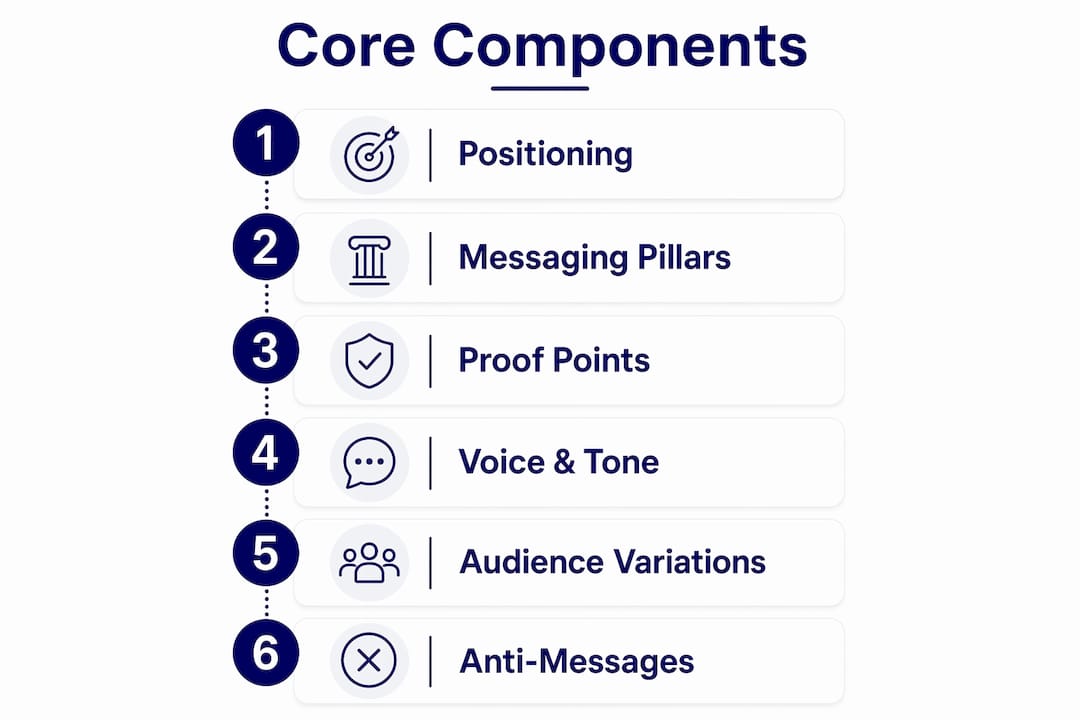
A solid framework has eight components. Not all of them belong in your v1 one-pager, but you need to know what each one does before you decide what to include now and what to add later.
Rushogen’s breakdown identifies positioning, pillars, proof points, voice and tone, audience variations, and anti-messages as the essential areas. Here is how each maps to real copy, and which ones are non-negotiable on day one:
| Component | What it does | Minimum for v1 | Example |
|---|---|---|---|
| Positioning statement | Defines your place in the market relative to alternatives | Yes | “For UK finance teams who waste hours on manual reconciliation, Ledgr automates the process so month-end closes in hours, not days.” |
| Value proposition | States the primary benefit in one sentence | Yes | “Save your finance team two days every month.” |
| Messaging pillars | Three themes that support the value proposition | Yes | Speed, accuracy, compliance |
| Supporting messages | One to two sentences per pillar with evidence | Yes | “Ledgr reconciles 10,000 transactions in under three minutes.” |
| Proof points | Specific, verifiable claims that back each pillar | Yes | “Used by 200 UK finance teams. SOC 2 Type II certified.” |
| Voice and tone | Personality descriptors and context-specific tone rules | Yes (brief) | “Direct, warm, never jargon-heavy. Formal in compliance docs, conversational in onboarding emails.” |
| Audience variations | Adapted messages for different buyer personas | Optional extra | CFO version vs. finance manager version |
| Anti-messages | Phrases and claims you explicitly avoid | Optional extra | “We never say ‘AI-powered’ without explaining what the AI actually does.” |
Three pillars is the right number for most early-stage teams. Rushogen’s framework recommends three to cover your primary pain point, your point of differentiation, and your outcome or trust signal. More than three and your team cannot remember them. Fewer than three and you leave gaps a competitor will fill.
Anti-messages deserve a mention even if you park them for later. They are guardrails that prevent drift: explicit lists of claims, phrases, or framings you will not use. They are especially useful when you bring in external copywriters or agencies who do not know your brand yet.
What is the six-step process to build your startup brand messaging?
A methodical process is what separates messaging that sticks from messaging that gets rewritten every quarter. Asana, Stripe, and CXL all recommend a sequenced approach: discovery, positioning, message development, testing, and rollout. Here is a six-step version built for UK early-stage teams, with realistic time budgets and clear owners.
Step 1: Customer and market research
Owner: Founder or head of marketing. Time budget: 4–8 hours.
Pull verbatim language from five to ten customer conversations, sales call recordings, or support tickets. You are looking for the exact words customers use to describe their problem and the outcome they want. Do not paraphrase. The raw phrases are your headline material.
Step 2: Competitive positioning
Owner: Founder with marketing input. Time budget: 2–4 hours.
Map two to three alternative approaches (not necessarily direct competitors by name) and identify the gap your product occupies. Write a draft positioning statement using the template from the opening of this guide.
Step 3: Messaging pillar development
Owner: Head of marketing or external copywriter. Time budget: 3–6 hours.

Write three pillars, each with a one-sentence supporting message and one to two proof points. Keep each pillar to a single theme. If a pillar needs three sentences to explain, it is two pillars pretending to be one.
Step 4: Proof point audit
Owner: Marketing with product and sales input. Time budget: 2–3 hours.
Gather verifiable evidence for every claim: customer numbers, certifications, case study results, awards, or third-party validations. Vague claims (“trusted by leading companies”) are worse than no proof at all.
Step 5: Voice and tone definition
Owner: Head of marketing or lead copywriter. Time budget: 2–4 hours.
Write five “we are / we are not” pairs. Then write three short tone examples: one for your homepage, one for a sales email, one for a support reply. These become your tone guardrails.
Step 6: Test, iterate, and roll out
Owner: Marketing with sales and leadership sign-off. Time budget: 1–2 weeks.

Test your headline and one-liner in real conversations and early ad campaigns. Gather feedback from sales reps. Update the document. Then distribute it to every team that produces copy.
| Step | Owner | Time budget | Key deliverable |
|---|---|---|---|
| 1. Customer research | Founder / head of marketing | 4–8 hours | Verbatim language bank |
| 2. Competitive positioning | Founder | 2–4 hours | Draft positioning statement |
| 3. Pillar development | Head of marketing / copywriter | 3–6 hours | Three pillars with supporting messages |
| 4. Proof point audit | Marketing + product + sales | 2–3 hours | Verified proof point list |
| 5. Voice and tone | Head of marketing / copywriter | 2–4 hours | Voice descriptors + tone examples |
| 6. Test and roll out | Marketing + leadership | 1–2 weeks | Approved messaging one-pager |
Total time to a solid v1: roughly two to three working days of focused effort. A full framework with rollout support typically runs four to six weeks.
Messaging hierarchy and ready-to-use templates
The messaging hierarchy is a ladder. At the top sits your shortest, sharpest line. Each rung down adds detail. The discipline is knowing which rung to use in which context, and never skipping straight to the bottom.
Here are the levels, with blank templates and a filled UK SaaS example:
Level 1: Homepage headline (8 words or fewer)
Template: [Outcome] for [audience] — [differentiator].
Example: “Month-end close in hours, not days — for UK finance teams.”
Level 2: Subheadline (15–20 words)
Template: [Product name] [verb] [primary pain] so [audience] can [desired outcome] without [common frustration].
Example: “Ledgr automates bank reconciliation so finance teams close the books in hours, not days, without manual errors.”
Level 3: One-liner (30 seconds to read aloud)
Template: We help [audience] [achieve outcome] by [method], unlike [alternative].
Example: “We help UK finance teams close month-end in hours by automating reconciliation, unlike spreadsheet-based workflows that take days.”
Level 4: Elevator pitch (90 seconds)
Template: [Problem]. [Scale of problem]. [Our solution]. [How it works in one sentence]. [Proof]. [Call to action].
Example: “UK finance teams spend an average of two days every month on manual bank reconciliation. That is time your team cannot spend on analysis or strategy. Ledgr automates the entire process. It connects to your bank feeds, matches transactions in real time, and flags exceptions for human review. Two hundred finance teams already use it, and we are SOC 2 Type II certified. I would love to show you a 15-minute demo.”
Level 5: Three key messages (one sentence each)
- Speed: “Ledgr reconciles 10,000 transactions in under three minutes.”
- Accuracy: “Our matching engine achieves 99.4% accuracy on first pass.”
- Trust: “SOC 2 Type II certified and used by regulated UK finance teams.”
Level 6: Proof points (one to two per key message)
- Speed: “Average month-end close time drops from 2 days to 4 hours.”
- Accuracy: “Fewer than 0.6% of transactions require manual review.”
- Trust: “Used by teams in FCA-regulated firms across the UK.”
Dos and don’ts for writing short, memorable lines:
- Do use the customer’s language, not your internal product vocabulary.
- Do anchor every claim to a specific, verifiable number or credential.
- Do read every line aloud. If you stumble, rewrite it.
- Do not use superlatives (“the most powerful”, “the leading”) without proof.
- Do not write a headline that could apply to any product in your category.
- Do not bury your differentiator in the subheadline. Put it in the headline.
A strong unique selling proposition sits at the heart of every level in this hierarchy. If you cannot state your USP in eight words, your hierarchy has no foundation.
How do you find customer language and test messaging quickly?
Stripe recommends testing messages in real conversations and iterating when sales reps or marketers struggle to articulate the value proposition. The fastest way to find language that works is to listen before you write.
Interview script: eight high-value questions
Run 30-minute calls with five to eight customers or prospects. Record with permission. Ask:
- What were you trying to solve when you first looked for a product like ours?
- How would you describe the problem to a colleague who had never heard of us?
- What had you tried before, and why did it fall short?
- What made you decide to move forward with us?
- How would you describe what we do to someone in your network?
- What has changed since you started using us?
- What would you tell a peer who was considering us?
- If we disappeared tomorrow, what would you miss most?
Highlight every phrase that appears more than once across interviews. Those repeated phrases are your headline candidates.
Ad headline and landing page test plan
Run two to three headline variants as Google Ads or LinkedIn Sponsored Content against the same audience segment. Test one variable at a time: the primary benefit claim, the differentiator, or the audience label. A pragmatic threshold for early-stage teams: if one variant generates a click-through rate at least 20% higher than the others after 500 impressions, treat it as the working winner and update your one-pager.
Metrics to monitor
- Click-through rate on paid headline tests
- Landing page conversion rate (visitor to sign-up or demo request)
- MQL-to-SQL movement (are marketing-qualified leads converting to sales conversations?)
- Direct sales feedback: can your reps repeat your one-liner without prompting?
When reps start using your exact language in calls without being told to, your messaging is working. When they paraphrase or avoid the line entirely, it is a signal to revisit.
Pro Tip: Recruit interview participants from your existing customer base first, not cold prospects. Customers who have already bought can articulate the value in their own words far more precisely than people who have only seen your website. Use those exact phrases in your next ad test.
How does voice differ from tone, and how do you write tone rules by channel?
Asana’s brand messaging guidance draws a clear line between the two: voice is your consistent brand personality, the character that stays the same whether you are writing a homepage or a support ticket. Tone is how that personality adjusts to context. Your voice does not change. Your tone does.
Think of it this way: a confident, direct person does not become a different person when they write a formal email versus a text message. They adjust their register, their word choices, and their level of formality. That is tone. The underlying personality is still theirs.
The voice descriptor exercise
Write five “we are / we are not” pairs. Be specific. Vague pairs (“we are friendly / we are not cold”) give writers nothing to work with.
- We are direct. We are not blunt.
- We are confident. We are not arrogant.
- We are warm. We are not informal.
- We are precise. We are not technical for its own sake.
- We are ambitious. We are not hyperbolic.
For a deeper look at how tone of voice shapes brand perception, the principles apply at every touchpoint, from your homepage to your error messages.
Three tone examples by channel
Homepage (confident, outcome-focused):
“Close your books in hours. Ledgr automates reconciliation for UK finance teams.”
Sales email (warm, specific, low pressure):
“Hi Sarah, I noticed your team is still using spreadsheets for month-end. We have helped three similar-sized finance teams cut that process from two days to four hours. Worth a quick call?”
Support reply (calm, clear, reassuring):
“Thanks for getting in touch. Here is exactly what to do to resolve this. If these steps do not work, reply here and we will sort it out with you directly.”
Drift prevention checklist:
- Phrases to avoid: “world-class”, “cutting-edge”, “synergy”, “leverage” (as a verb), “solutions”.
- Complexity ceiling: no sentence in customer-facing copy should exceed 20 words.
- Jargon rule: if a term needs explaining, either explain it in the same sentence or replace it.
- Review any external copy against your “we are not” list before publishing.
Where should you use your messaging, and how do you adapt it by channel?
Your messaging hierarchy does not change by channel. What changes is which level of the hierarchy you lead with, and how much supporting detail you include. The core claim stays identical everywhere.
Channel map:
- Homepage: Lead with your headline (Level 1) and subheadline (Level 2). Include all three key messages with proof points. This is the fullest expression of your framework.
- Paid ads: Use your headline only. Test variants of the primary benefit claim. Never introduce a new claim in an ad that does not appear in your framework.
- Sales deck: Open with your one-liner (Level 3), then walk through each pillar with one proof point per slide. Close with the elevator pitch structure.
- PR and press releases: Lead with the one-liner. Use proof points as supporting quotes. Avoid internal jargon entirely.
- Job adverts: Use your value proposition and two to three voice descriptors to attract candidates who fit your culture. Proof points here are about company traction, not product features.
- Support documentation: Tone shifts to calm and instructional, but your voice descriptors still apply. Avoid marketing language in support contexts.
Simple adaptation rules:
- What to keep: your primary benefit claim, your differentiator, your proof points (select the most relevant one per context).
- What to shorten: supporting messages. In ads, cut to the claim only. In emails, cut to one pillar per message.
- What never to change: your positioning statement and your “we are not” guardrails.
For UK search, write homepage headlines and meta descriptions that match the language your customers use in Google searches, not your internal product vocabulary. If your customers search for “automate bank reconciliation UK”, that phrase belongs in your H1, not a paraphrase of it.
Pro Tip: Pair your startup brand strategy with your messaging framework from the start. Messaging built without a clear strategy tends to drift as the product evolves. Strategy gives your messaging a stable anchor.
How do you socialise messaging inside your startup and govern future changes?
A messaging framework that lives in a shared drive and never gets opened is not a framework. It is a document. The difference is governance: who owns it, who can change it, and how changes get communicated to the team.
Rollout timeline
Week 1: CEO and co-founders review and sign off. No changes without consensus at this stage. The positioning statement and value proposition are locked.
Week 2: Sales team training. Run a 60-minute session where reps practise delivering the one-liner and elevator pitch. Record it. Use the recordings to identify where the language breaks down.
Week 3: Website and marketing materials updated. Every piece of customer-facing copy is reviewed against the framework. Inconsistencies are flagged and corrected.
Week 4 onwards: Ongoing governance. Any proposed change to the framework goes through the marketing owner, who logs it, assesses the impact, and brings it to the CEO for sign-off if it affects the positioning statement or value proposition.
Roles and sign-off responsibilities
The CEO owns the positioning statement. No one changes it without their explicit approval. The head of marketing owns the full framework document, manages the review cadence (every three to six months, per Underscore VC’s guidance), and is the first point of contact for proposed edits. Product feeds in when a new feature or capability changes what the product actually does. Sales accepts the framework when they can use it in real conversations without prompting.
Governance checklist
- Who can propose edits: any team member, via a short written brief to the marketing owner.
- How changes are logged: a version-controlled document with a change log at the top (date, what changed, who approved it).
- Review cadence: every three to six months, or immediately after a significant product pivot or market shift.
- Distribution: the one-pager lives in a single, pinned location (Notion, Google Drive, or Confluence) that every team member can access.
Rushogen’s rollout checklist includes week-by-week actions that mirror this cadence. When MB Brand Communications runs a rollout with a client team, the 30–60 day process typically covers leadership alignment in week one, sales enablement in week two, and a full materials audit in weeks three and four, with a governance handover at the end so the client team can manage updates independently.
What does a brand messaging project realistically cost and how long does it take?
Set your expectations before you start. The timeline and cost depend on whether you are doing this yourself, using a freelancer, or working with an agency like MB Brand Communications.
| Phase | DIY timeline | Agency timeline | Typical UK cost (agency) |
|---|---|---|---|
| V1 one-pager (single session) | 3–4 hours | 1–2 days | £500–£1,500 |
| Short programme (positioning + pillars + voice) | 2–4 weeks | 2–3 weeks | £3,000–£8,000 |
| Full framework + rollout support | 6–10 weeks | 4–6 weeks | £8,000–£20,000 |
DIY is viable for a v1. The risk is not the time cost; it is the opportunity cost of getting it wrong and spending the next six months correcting inconsistent messaging across your website, your ads, and your sales materials. A freelance copywriter with brand messaging experience typically charges £400–£800 per day in the UK. An agency brings strategy, copy, and rollout support under one roof.
When agency investment is justified:
- You are preparing for a fundraising round and need a consistent narrative across your deck, your website, and your verbal pitch.
- You have a sales team of three or more people who are all describing the product differently.
- You are entering a new market or launching a new product line and need to reposition quickly.
- Your current messaging is generating traffic but not converting, and you cannot identify why.
Suggested checkpoints before escalating to an agency:
- You have completed steps 1–3 of the six-step process and your positioning statement still does not feel right after two rounds of revision.
- Your sales reps are consistently paraphrasing or avoiding your one-liner.
- Your homepage conversion rate has not improved after two headline tests.
If two of those three are true, the DIY approach has reached its limit.
Common founder mistakes and how to fix them fast
Most messaging problems come from the same handful of errors. Spot them early and the fix is straightforward.
Common mistakes:
- Overloading with features: Listing eight product capabilities instead of one primary outcome. Fix: return to your value proposition and cut everything that does not support it directly.
- Targeting everyone: “For businesses of all sizes” tells no one anything. Fix: name your primary audience segment explicitly, even if it feels limiting.
- Using internal jargon: Words your team uses internally that customers never say. Fix: run your draft through your interview transcripts. If a phrase does not appear in customer language, replace it.
- No proof: Claims without evidence (“the fastest”, “the most trusted”) that any competitor could make. Fix: audit every claim and attach a specific, verifiable number or credential.
- Pillar overload: Five or six messaging pillars that no sales rep can remember. Fix: cut to three, following Rushogen’s recommendation to cover pain, differentiation, and outcome.
Red flags that your messaging is not working:
- Sales reps cannot repeat your one-liner without looking at a slide.
- Your ad click-through rate is below category benchmarks.
- Different pages on your website make different primary claims.
- Investors ask “so what exactly do you do?” after reading your deck.
- New hires describe the product differently after two weeks in the role.
Quick fixes by priority:
- If reps cannot repeat the line: simplify it. Aim for ten words or fewer.
- If ads are underperforming: test a new headline that leads with the outcome, not the feature.
- If website pages conflict: audit every H1 against your positioning statement and align them.
- If investors are confused: your elevator pitch is missing a proof point. Add one specific number.
A full messaging revisit is warranted when your product has materially changed, your target audience has shifted, or your positioning statement no longer reflects how you win deals.
Key takeaways
A startup brand messaging guide works when it is built around one clear narrative, tested with real customers, and governed as a living document rather than a one-time exercise.
| Point | Details |
|---|---|
| Start with radical reduction | Own one primary outcome and say it clearly before adding supporting messages. |
| Use the six-step process | Move from customer research through to rollout in two to three focused working days for a v1. |
| Three pillars is the right number | Cover pain, differentiation, and outcome; more pillars dilute focus and are harder for teams to retain. |
| Test before you publish widely | Run headline variants in ads or sales conversations and iterate when reps cannot repeat your line. |
| Michaelbell runs the full process | MB Brand Communications offers messaging workshops, copy, and rollout support for UK startups ready to move from draft to deployed. |
What founders consistently get wrong about brand messaging
There is a pattern we see repeatedly at MB Brand Communications, and it is worth naming directly: founders treat messaging as a writing problem when it is actually a decision problem.
The writing is the easy part. The hard part is deciding what you will not say. Every startup has ten genuine benefits they could lead with. The ones that break through pick one and defend it. The ones that struggle keep adding to the list because cutting feels like leaving money on the table.
The second pattern is treating the messaging guide as a launch deliverable rather than an operational tool. A guide that gets written, approved, and filed is worth almost nothing. The value comes from the governance: the version control, the sales training sessions, the quarterly review that asks whether the market has shifted enough to warrant a change. Stripe’s advice on treating messaging as a living asset is the right frame. Think of it the way you think of your product roadmap: it has owners, a cadence, and release notes.
The third pattern is confusing voice with tone and writing a single set of rules that does not account for context. A support reply written in the same register as a homepage headline feels cold and robotic. A sales email written in the same register as a support reply feels timid. The brand storytelling approach that works across channels is one where the personality is consistent but the register is deliberately adjusted.
One thing we tell every client: the first version of your messaging guide does not need to be right. It needs to be written. A draft you can test is worth more than a perfect document you are still refining in six months.
MB Brand Communications: your messaging partner for UK startups
Messaging workshops, copy, and rollout support, without the overhead of a full in-house team. That is what MB Brand Communications delivers to UK startups who need to move from blank page to deployed framework without losing months to internal debate.
We run focused messaging engagements that cover every stage of the process outlined in this guide: customer research, positioning, pillar development, voice and tone definition, and a structured rollout that gets your sales team using the new language within 30 days. Our team works as an extension of yours, which means you get the strategic depth of an agency and the responsiveness of a colleague down the hall.
If you are preparing for a fundraising round, scaling a sales team, or simply tired of every team member describing your product differently, the right next step is a short discovery conversation. Visit our services page to see how we work and book a call with the team.
Useful sources and further reading
The following resources informed this guide and are worth bookmarking for deeper study:
- The Brand Messaging 1-Pager Template Every Early Stage Founder Needs — Underscore VC. The source for the radical reduction principle and the Goldilocks one-pager recommendation.
- Brand Messaging Framework: Components + 6-Step Guide — Asana. Practical guidance on voice versus tone and context-specific tone rules.
- How to Write Key Messages for a Startup — Stripe. Advice on testing messaging in real conversations and treating the framework as a living asset.
- Brand Messaging Framework: One Story, Whole Company — Rushogen. Detailed breakdown of framework components including anti-messages and rollout checklists.
- How to Build a Winning Messaging Strategy (with Examples) — CXL. Evidence-backed methodology for discovery, positioning, and message development.
- What is a brand messaging framework? — Michaelbell. An introductory explainer for founders building their first framework.
- Examples of strong startup branding that actually work — Michaelbell. Case studies showing how messaging frameworks translate into real marketing assets.
- Develop a brand positioning framework that works — Michaelbell. Guidance on aligning positioning statements to messaging pillars.
- Visual identity components for startups: a founder’s guide — Michaelbell. Reference for aligning messaging with visual brand elements.